
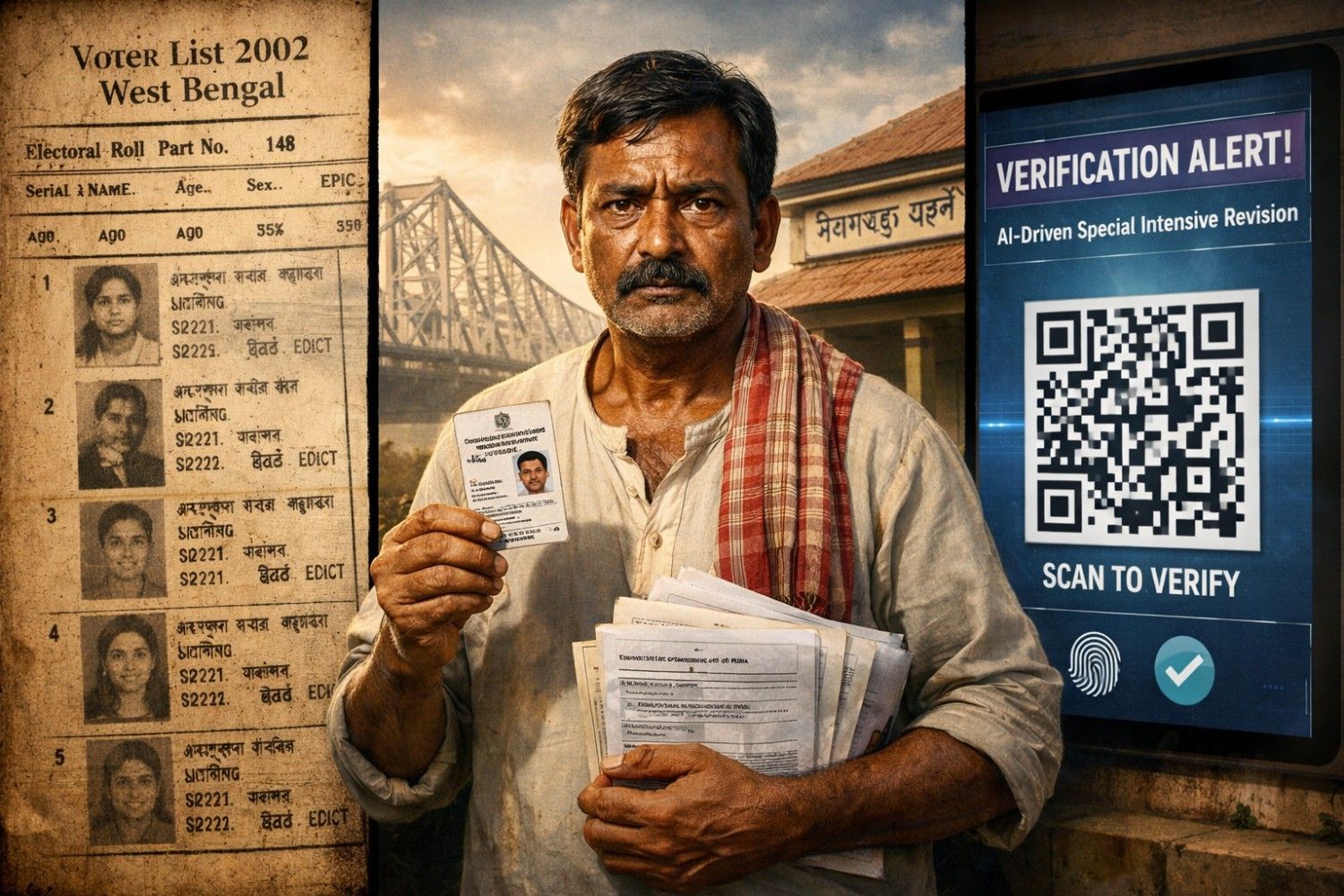

In the bustling streets of Kolkata and the quiet hamlets of the Sundarbans, a new anxiety has gripped the populace. It is not an election campaign, but a prelude to one that feels far more personal and precarious. For the first time in over two decades, the Election Commission of India (ECI) has undertaken a Special Intensive Revision (SIR) of the electoral rolls in West Bengal.
With millions of notices dispatched, reports of AI-driven errors, and a scramble for decades-old documents, the SIR 2026 has become a flashpoint of administrative chaos and political tension. If you are a resident of West Bengal, or simply an observer of Indian democracy, understanding the mechanics, the controversies, and the solutions regarding SIR 2026 is critical. This comprehensive guide breaks down everything you need to know: from the legacy of the 2002 voter lists to the recent Supreme Court interventions that have reshaped the process.
Part 1: What is Special Intensive Revision (SIR) and Why Now?
The Administrative Context
Most voters are accustomed to the annual Summary Revision of electoral rolls. However, the SIR is a much more rigorous exercise. Under Article 324 of the Constitution of India and Section 21(3) of the Representation of the People Act, 1951, the Election Commission has the power to revise electoral rolls intensively without prior permission from any authority.
The current SIR in West Bengal is significant because the last exercise of this magnitude was conducted more than 21 years ago, between 2002 and 2004. The ECI cites several reasons for this sudden intensification:
- Rapid Urbanization and Migration: Frequent migration has resulted in voters being registered in more than one place.
- Dead Voters: The non-removal of deceased voters from the rolls.
- Ineligible Inclusions: Concerns regarding the wrongful inclusion of foreign nationals or illegal immigrants.
The SIR 2026 is not limited to West Bengal; it covers roughly 51 crore electors across various states including Tamil Nadu and Kerala, preparing the ground for the 2026 Assembly elections.
The Timeline: A Race Against Time
The schedule for SIR 2026 has been tight and subject to revisions due to legal interventions. According to updated guidelines, the Final Electoral Roll is scheduled for publication on February 14, 2026, which is a critical deadline given that the tenure of the West Bengal Legislative Assembly expires in May 2026.
Key dates to remember include:
- House-to-House Enumeration: Concluded on December 11, 2025.
- Publication of Draft Electoral Roll: Published on December 16, 2025.
- Claims and Objections Deadline: Extended to January 19, 2026.
- Hearing and Verification Phase: Ongoing until February 7, 2026.
| Phase Description | Original Schedule | Revised Schedule | Status |
|---|---|---|---|
| House-to-House Enumeration | Nov 4, 2025 | Dec 11, 2025 | Concluded |
| Draft Roll Publication | Dec 9, 2025 | Dec 16, 2025 | Published |
| Claims & Objections | Dec 16, 2025 | Jan 19, 2026 | Closed |
| Final Publication | Feb 7, 2026 | Feb 14, 2026 | Upcoming |
Part 2: The Mechanics of Verification – "Legacy Linkage"
The core philosophy of SIR 2026 revolves around "Legacy Linkage." The Election Commission is attempting to map current voters to the database of the last SIR conducted in 2002-2004.
The Enumeration Form (Annexure III)
During the House-to-House (H2H) phase, Booth Level Officers (BLOs) visited residences to distribute Annexure III (Enumeration Form). This form contained pre-printed details such as the elector's name, EPIC number, address, and a QR code.
The critical task for the voter was to provide details of their entry in the last SIR (2002-2004). If a voter could successfully link themselves or a direct relative (parent) to the 2002 database, the requirement for additional documentary evidence was generally waived. However, for those who are "unmapped"—estimated to be around 31.38 lakh individuals in West Bengal—the situation is precarious. These individuals must now provide strict documentary proof during hearings to retain their voting rights.
Why the 2002 Roll Matters
To understand the gravity of the 2002 benchmark, we must look at the political landscape of that era. In the 2001 West Bengal Legislative Assembly election, the Left Front, led by Buddhadeb Bhattacharjee, won a majority with 199 seats, while the Trinamool Congress (TMC), formed just a few years prior in 1998, was emerging as the primary opposition.
"The electoral rolls from this specific period (roughly 2000-2002) are now being treated as the 'gold standard' for proving residency. If your family voted in the 2001 elections or was listed in the 2002 revision, that record is your primary shield against scrutiny today."
Part 3: The "Logical Discrepancy" Nightmare
While the legacy mapping was meant to simplify things, the introduction of AI and algorithmic verification turned the process into a nightmare for millions.
The Algorithm Gone Wrong
The ECI utilized software on the ERONET portal to identify "logical discrepancies" in the voter list. This resulted in approximately 1.36 crore electors—nearly 20% of the state's voting population—being flagged for verification. The categories of these discrepancies were often bizarre and disconnected from ground realities:
- Progeny Mapping: The software flagged instances where a father was listed as having six or more children, triggering a "suspicion of wrong connection".
- Age Gaps: Voters were flagged if the age difference between a parent and child was less than 15 years or more than 55 years. While child marriage is illegal, it is a historical sociological reality in India, and the Supreme Court later questioned the logic of using this as a basis to disenfranchise voters.
- Name Variations: The AI translation from Bengali to English caused massive errors. For example, the surname "Banerjee" was distorted to "Byneerjnzee" and "Banik" to "Vanek". These clerical errors, generated by the system, resulted in notices being sent to voters asking them to verify their identity.
Panic on the Ground
The issuance of these notices caused panic, particularly among the Matua community and Hindu refugees who migrated from Bangladesh. Many feared this was a precursor to a National Register of Citizens (NRC). Reports surfaced of undocumented migrants fleeing the state and even suicides linked to the anxiety of being struck off the voter lists.
As one researcher noted, "The real test lies in responding to notices... The question is how many voters—especially the poor, elderly, migrants, and disaster-affected—will be able to do that".
Part 4: Supreme Court Intervention – A Ray of Hope
In response to the chaos, petitions were filed in the Supreme Court of India. On January 19, 2026, a bench led by Chief Justice Surya Kant issued a comprehensive order to mitigate the "stress and strain" on the people.
Key Safeguards Mandated by the Court:
- Public Transparency: The ECI must publicly display the list of all 1.25 crore electors flagged for "logical discrepancies" at Gram Panchayat Bhavans, block offices, and ward offices.
- Written Receipts: To prevent documents from "going missing," officials are now strictly mandated to issue a written receipt for every document submitted by a voter.
- Authorized Representatives: Recognizing that many cannot attend hearings due to work or distance, the Court allowed Booth Level Agents (BLAs) or authorized family members to appear on behalf of the voter.
- Decentralized Hearings: Hearings must be conducted at the Panchayat and Block levels rather than distant district centers.
- No WhatsApp Orders: The Court rebuked the administration for issuing instructions via WhatsApp, demanding that all procedural changes be made via formal circulars to ensure accountability.
Part 5: How to Protect Your Vote – Practical Steps
If you are one of the millions facing scrutiny, here is a practical guide on how to navigate the SIR process.
Step 1: Check Your Status
You can verify if your name is in the draft roll or if you have been flagged by visiting your local ward office, Panchayat Bhavan, or checking the CEO West Bengal website (ceowestbengal.wb.gov.in).
Step 2: Gather the Right Documents
For the verification hearings, the ECI accepts a list of 13 indicative documents. The requirement depends on your birth year:
- If born before July 1, 1987: You need one document for yourself (e.g., Birth Certificate, Passport, or old educational certificate).
- If born between 1987 and 2004: You need a document for yourself AND one for a parent.
- If born after December 2, 2004: You need documents for yourself and BOTH parents.
| SI No. | Admissible Document | Details |
|---|---|---|
| 1 | Birth Certificate | Issued by competent authority |
| 2 | Indian Passport | Proof of citizenship |
| 3 | Educational Certificate | Includes Madhyamik/Class X admit cards |
| 4 | Employee Identity Card | Govt/PSU issued |
| 5 | Documents issued prior to 1987 | Banks/Post Office/Govt |
| 6 | Permanent Residence Certificate | State authority issued |
| 7 | Forest Right Certificate | For specific populations |
| 8 | SC/ST/OBC Certificate | Competent authority issued |
| 9 | NRC Records | Wherever applicable |
| 10 | Family Register | State/Local authorities |
| 11 | Land/House Allotment | Govt issued |
| 12 | Aadhaar Card | Proof of identity, not citizenship (Optional) |
| 13 | Bihar SIR Extract | For migrants from Bihar (2025) |
Step 3: Download Old Voter Lists (Legacy Proof)
One of the strongest proofs is showing your name or your parents' names in the 1998 or 2000 Voter Lists. These are considered "Legacy Rolls" because they predate heavy digitization and the current controversy.
How to Download Old Lists:
- Visit the Directorate of State Archives portal:
oldelectoralrolls.wb.gov.in. - Alternatively, use the CEO West Bengal website under "Legacy/Old Electoral Rolls".
- Select Year (1998, 2000, or 2002), District, and Assembly Constituency.
- Download the PDF parts and search for your family name.
Step 4: Use the Correct Forms
If your name is missing or needs correction, you must file the appropriate form under the Registration of Electors Rules, 1960:
- Form 6: For inclusion of a new name.
- Form 7: To object to someone else's inclusion or delete a name.
- Form 8: For correction of entries or transposition (shifting) of entry.
These forms must be submitted to the Electoral Registration Officer (ERO). Under the updated guidelines, you are entitled to a receipt for these applications.
Part 6: Exemptions for Vulnerable Groups
To ensure that the SIR process does not disenfranchise the weak, specific exemptions have been notified under Memo No. 246(24).
You are EXEMPT from physical attendance at hearings if you are:
- Student: Studying outside the state.
- Private/Govt Employee: Working outside West Bengal (including military/paramilitary).
- Elderly (85+): Or suffering from chronic illness/disability.
- NRI: Living abroad temporarily.
What to do instead:
- Doorstep Verification: For the elderly and infirm, BLOs are directed to visit their residence for verification.
- Representative Hearing: Students and employees can authorize a family member to appear at the hearing with their documents.
Part 7: The Political Fallout
The SIR 2026 has become a major battleground between the ruling Trinamool Congress (TMC) and the opposition BJP. The TMC, led by Mamata Banerjee, has historically resisted central moves that they perceive as "burdensome" to the voter or discriminatory, such as the NRC and CAA. The party has hailed the Supreme Court's intervention on "logical discrepancies" as a victory for the people.
Conversely, the ECI maintains that the process is essential to "purify" the rolls by removing dead and shifted voters. The tension is palpable as the final publication date of February 14, 2026, draws near, setting the stage for the high-stakes 2026 Assembly elections.
Conclusion
The Special Intensive Revision 2026 is more than just paperwork; it is a test of citizenship for millions in West Bengal. The combination of algorithmic errors and rigorous legacy requirements has placed a heavy burden on the common man. However, with the Supreme Court's safeguards and a clear understanding of the required documentation, voters can navigate this challenge. The key takeaways for every voter are simple but vital: do not panic, insist on written receipts for every document submitted, utilize the legacy rolls of 1998 and 2002 as your primary defense, and if you fall into a vulnerable category, demand the exemptions provided by law. Democracy requires vigilance, and in 2026, that vigilance begins with verifying your name on the list.
Community Insights