
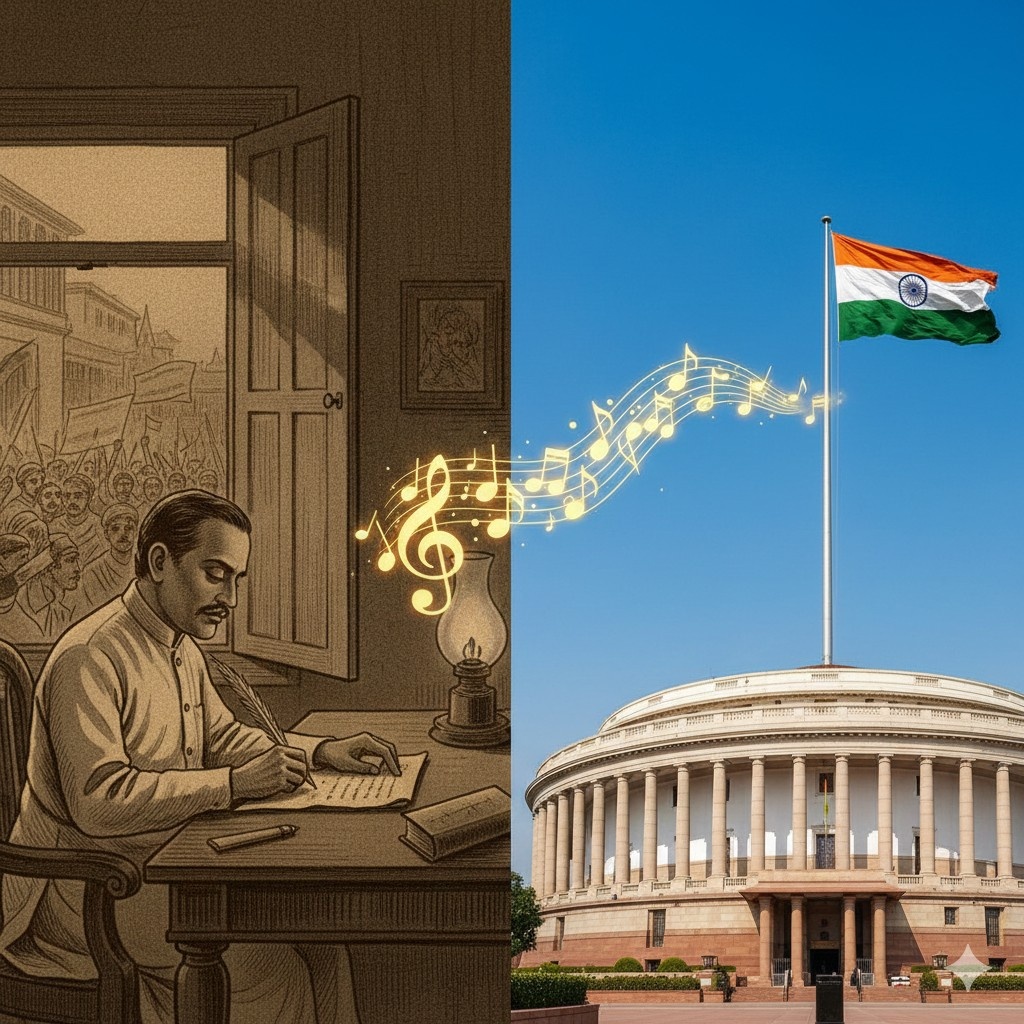

India stands at a significant cultural and legislative crossroads regarding one of its most potent symbols of independence. As the nation traverses the year-long commemoration of the 150th anniversary of its National Song, Vande Mataram, a renewed debate has emerged from the corridors of power in New Delhi. Recent developments in January 2026 indicate that the central government is actively reconsidering the legal and ceremonial protocols governing this historic composition. For decades, Vande Mataram has occupied a unique space—revered emotionally as equal to the National Anthem, Jana Gana Mana, yet distinct in its legal enforceability. This comprehensive exploration delves into the history, the current festivities, the legal dichotomies, and the potential policy shifts that seek to accord the National Song the same statutory sanctity as the National Anthem.
The 150th Anniversary: A Year of Commemoration
The cultural landscape of India is currently defined by the grand celebrations marking 150 years of Vande Mataram. The Union Cabinet, under the leadership of Prime Minister Narendra Modi, approved a nationwide celebration that formally commenced on 7 November 2025 and is scheduled to conclude on 7 November 2026. This period was chosen with historical precision; the song is believed to have been penned by Bankim Chandra Chattopadhyay on the auspicious occasion of Akshaya Navami, which fell on 7 November 1875.
The Ministry of Culture launched these celebrations with a spectacular inaugural ceremony at the Indira Gandhi Indoor Stadium in New Delhi. The event, graced by the Prime Minister as the Chief Guest, set the tone for a year dedicated to national pride. The festivities are not merely symbolic but are designed to be participatory, involving citizens from all walks of life—from school children and college students to police personnel, shopkeepers, and elected representatives.
A central feature of this commemoration is the mass singing of the full version of Vande Mataram at public places across states and Union Territories. To facilitate this, the government has released a dedicated campaign website offering approved branding collaterals, a curated exhibition on the song’s history, and a unique 'Karaoke with Vande Mataram' feature. This digital initiative encourages citizens to record and upload their own renditions of the song, fostering a personal connection with the composition that once fuelled the freedom struggle.
Furthermore, the cultural richness of the song was highlighted through a concert titled 'Vande Mataram: Naad Ekam, Roopam Anekam' (One Sound, Many Forms). Conducted by the internationally acclaimed Violin Maestro Dr Manjunath Mysore, this concert featured approximately 75 musicians and showcased a confluence of diverse traditional Indian musical genres, symbolising the unity the song represents. The release of a commemorative stamp and coin further cemented the significance of this sesquicentennial milestone.
Historical Context: From a Novel to a Nation’s Soul
To understand the weight of the current debates, one must revisit the origins of the song. Written by Bankim Chandra Chattopadhyay, Vande Mataram first appeared in the literary journal Bangadarshan as part of his novel Anandamath, which was later published as a standalone book in 1882. The era was one of profound transformation; India was undergoing major social, cultural, and political changes, with a growing consciousness of national identity rising against colonial rule.
The song emerged as a potent rallying cry during the Swadeshi movement (1905–1908). It invoked the Motherland as an embodiment of strength, prosperity, and divinity, giving poetic expression to an awakening spirit of self-respect. However, its journey was not without controversy. In 1937, the Indian National Congress adopted the first two stanzas of the song as the National Song, following a decision to drop the later verses. This historical decision remains a point of contention in modern political discourse.
The Bharatiya Janata Party (BJP) has frequently alleged that the omission of the later stanzas—which portray the motherland as a goddess-like figure—was an act of appeasement politics that diluted the song’s glory and sowed the seeds of Partition. Conversely, the Congress has maintained that the decision was made to ensure the song resonated with citizens of all faiths, some of whom felt the later verses were religiously specific. Despite these debates, the song’s status was formally recognised on 24 January 1950, when Dr Rajendra Prasad, the President of the Constituent Assembly, declared that Vande Mataram, having played a historic part in the struggle for Indian freedom, shall be honoured equally with Jana Gana Mana and shall have equal status with it.
The Tale of Two Songs: Anthem vs. Song
While Dr Prasad’s statement in 1950 promised 'equal status', the legal reality for the past 75 years has been quite different. Understanding the distinction between the National Anthem and the National Song is crucial to grasping the current administrative moves.
The National Anthem (Jana Gana Mana): Composed by Rabindranath Tagore and first performed in 1911, the Anthem enjoys explicit constitutional and statutory protection. Article 51A(a) of the Constitution places a fundamental duty on every citizen to abide by the Constitution and respect its ideals and institutions, the National Flag, and the National Anthem. Furthermore, the Prevention of Insults to National Honour Act, 1971, prescribes specific penalties. Whoever intentionally prevents the singing of the National Anthem or causes disturbance to any assembly engaged in such singing can be punished with imprisonment for a term which may extend to three years, or with a fine, or with both. Detailed executive orders govern the etiquette, such as mandatory standing, for the Anthem.
The National Song (Vande Mataram): In contrast, while the National Song holds immense emotional and cultural significance, it lacks the same statutory armour. There has traditionally been no penal provision for disrespecting Vande Mataram, nor has there been a legal mandate enforcing its singing or prescribing a specific posture, such as standing, during its rendition. This 'gap' or 'vacuum' in the law has been the subject of numerous Public Interest Litigations (PILs) over the years.
The Legal Battleground
The judiciary has frequently been approached to bridge the gap between the Anthem and the Song. Petitioners, including advocate and BJP leader Ashwini Kumar Upadhyay, have repeatedly sought directions from the Delhi High Court and the Supreme Court to grant Vande Mataram equal status in spirit and in law. These pleas have argued that the song is the symbol of India's history, sovereignty, and unity, and that disrespecting it should be treated as an anti-social activity.
The arguments presented in these petitions often rely on the sentiment that both songs were decided upon by the Constitution makers and therefore deserve a national policy to promote and propagate them equally. The petitioners have sought mandatory rendition of Vande Mataram in all educational institutions on working days and urged the government to frame a policy ensuring it is sung in schools.
However, the judicial response has historically been restrained. Courts have dismissed such pleas, noting that while Vande Mataram occupies a unique and special place in the psyche of the people, there is no reason to issue a writ directing the government to declare it the National Anthem or to enforce mandatory singing. In previous years, specifically around 2017 and 2022, the Ministry of Home Affairs (MHA) submitted to the courts that while both songs deserve equal respect, the subject matter of such proceedings could not be the subject of a writ. The Centre had defended its stance by citing that the Prevention of Insults to National Honour Act, 1971, covered only the National Anthem and the National Flag, leaving an absence of parallel provisions for Vande Mataram.
The 2026 Protocol Shift: A New Direction
The narrative has taken a distinct turn in January 2026. Coinciding with the 150th-anniversary celebrations, the Ministry of Home Affairs is reportedly deliberating on formalising protocols for the recitation of the National Song. High-level government meetings held early in the year have examined the possibility of introducing rules and instructions similar to those in place for Jana Gana Mana.
The discussions in the North Block have centred on several key questions: Should there be a defined set of circumstances in which the National Song may be sung? Should it be sung alongside the National Anthem? Most critically, should acts of disrespect towards Vande Mataram attract penalties akin to those prescribed for the Anthem? The government is considering whether to mandate standing during the recitation of the song, a requirement that is currently a matter of custom rather than law for the National Song.
This potential policy shift aligns with the ruling government's efforts to elevate the standing of the song, restoring it to what it considers its rightful historical glory. Senior officials from various ministries have participated in these deliberations to frame rules that would standardise the performance of the song in schools, official events, and public gatherings. If implemented, this would mark a significant departure from the government’s previous position in court, where it stated that no instructions had been issued laying down the circumstances for singing the song.
Standardising Respect
The proposed protocols aim to remove ambiguity. Currently, citizens often stand for Vande Mataram out of respect, but the lack of codification means there is no uniformity in behaviour at public events. The government's objective appears to be the creation of a 'moving archive' of respect—ensuring that the song is not only celebrated during its anniversary year but is institutionally embedded in the nation's daily life.
The discussions also touch upon the version of the song to be sung. While the full version is being promoted for mass singing during the commemorative year, protocols would likely clarify whether the truncated version (historically adopted) or the full version (which includes the verses celebrating the land as a goddess) is to be used in official protocols. This distinction is vital, as the full version contains the imagery that was the subject of the 1937 political debate.
Political Implications and Public Sentiment
The move to formalise Vande Mataram protocols is not without its political dimensions. It serves as a rebuttal to what the current administration describes as the historical suppression of the song's glory. By institutionalising the respect for Vande Mataram, the government is reinforcing a narrative of nationalism that draws heavily on the symbols of the pre-independence Swadeshi movement.
The Home Minister has previously engaged in heated parliamentary debates, accusing opposition parties of failing to honour the song due to appeasement politics. The counter-argument from the opposition has typically focused on the idea that nationalism should not be enforced through penal provisions and that the voluntary emotional connection to the song is more valuable than a legally mandated one. They have also pointed to the historical context of the Constituent Assembly's decision to have an Anthem for the state and a Song for the nation's character, implying a deliberate distinction in their usage.
Despite the political banter, the public sentiment towards Vande Mataram remains largely reverential. It is viewed as a cultural treasure, a melody that transcends the specific legalities of the state machinery. The government's initiative to launch a website where ordinary citizens—drivers, doctors, teachers—can upload their renditions reflects an understanding that the song belongs to the people. The 'Naad Ekam, Roopam Anekam' concept highlights that while the tune or the singer may vary, the devotion to the motherland remains the unifying thread.
Conclusion
As India celebrates the 150th year of Vande Mataram, the nation finds itself at a juncture where history, law, and emotion converge. The song that once fuelled the fight for freedom is now the subject of a new struggle—one that seeks to define its precise place in the legal framework of the republic. The celebrations led by the Ministry of Culture serve to remind the populace of the song's lyrical beauty and historical weight, while the deliberations within the Ministry of Home Affairs suggest a future where that weight is backed by the force of law.
Whether the government proceeds to amend the Prevention of Insults to National Honour Act to include Vande Mataram, or simply issues executive guidelines for its rendition, the intent is clear: to erase the 'gap' that has existed between the Anthem and the Song since 1950. For the citizen, the year 2026 offers a moment to reflect on the verses of Bankim Chandra Chattopadhyay, not just as a statutory obligation, but as the timeless ode to the motherland that Dr Rajendra Prasad hoped would be honoured equally in the hearts of all Indians.



Community Insights