
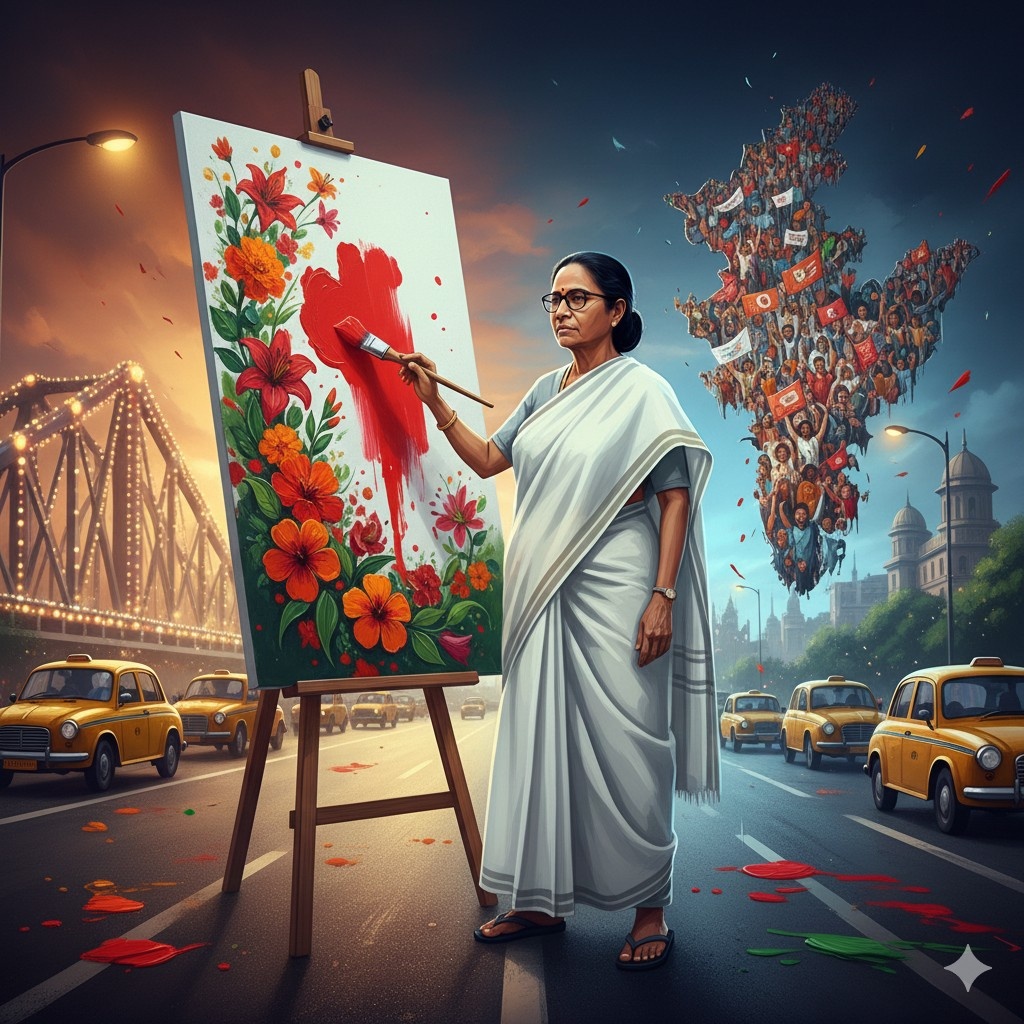

In the raucous theatre of Indian politics, few figures command the stage quite like Mamata Banerjee. Known affectionately and universally as ‘Didi’ (Elder Sister), the Chief Minister of West Bengal is best defined by her street-fighter tenacity, her white cotton saris, and her rubber flip-flops. Yet, beneath the veneer of the hardened administrator who toppled a thirty-four-year Left Front regime lies a persona that is relentlessly, almost aggressively, artistic. To view Banerjee merely as a politician is to miss a crucial component of her public identity. She is, by her own definition and output, a prolific poet, a painter, a lyricist, and a designer.
For the uninitiated, the sheer volume of her creative output is staggering. With over 143 books to her credit—a number she confidently predicted would cross the 150 mark within a year—Banerjee operates with a creative metabolism that rivals her political energy. Whether she is penning protest poems in a helicopter while surveying the districts or composing songs on a synthesiser for the upcoming Durga Puja, her artistic endeavours are not merely hobbies; they are an intrinsic part of her political communication. This blog explores the multi-coloured, often controversial, and deeply complex world of Mamata Banerjee’s art, examining how verses and brushstrokes serve as both a personal refuge and a potent political weapon.
The Poet in Power: Verses of Protest and Controversy
Literature has always held a sacred space in Bengali culture, a society that reveres Rabindranath Tagore and Kazi Nazrul Islam with near-religious fervour. Into this high-brow literary landscape stepped Mamata Banerjee, not with academic pretension, but with a torrent of “thousands of poems”. Perhaps her most discussed work is Kabita Bitan, a gargantuan volume released at the 2020 International Kolkata Book Fair containing over 900 poems.
Banerjee’s poetry is often characterised by its simplicity and directness. She writes about the soil, the motherland, and the struggles of the common man. However, her literary pursuits have frequently found themselves in the crosshairs of the state’s intelligentsia. A significant row erupted when the Paschimbanga Bangla Akademi—a wing of her own government’s Information and Cultural Affairs Department—conferred a special literary award upon her for Kabita Bitan. The award, intended to honour “relentless literary pursuit” by those working in other fields, was met with sharp rebuke from established literary circles.
Ratna Rashid Banerjee, a noted Bengali writer and researcher, returned her own Annada Shankar Smarak Samman award in 2019, stating she felt “insulted” by the move. She described the decision to praise the Chief Minister’s literary pursuit as a “travesty of truth” and a “crown of thorns”. Similarly, Anadiranjan Biswas resigned from the Sahitya Akademi’s Bengali advisory board in protest. Critics argued that the award was sycophancy masquerading as literary appreciation. Yet, her supporters, including poet Subodh Sarkar, defended the accolade, arguing that if leaders like Winston Churchill and Atal Bihari Vajpayee could be celebrated for their writing, Banerjee’s prolific body of work deserved recognition. They posited that the criticism stemmed from a specific class of elites who malign her year-round.
Beyond the awards, the content of her poetry often serves as a chronicle of her political battles. She has used rhyme to attack central government policies such as demonetisation, the GST, the Citizenship Amendment Act (CAA), and the National Register of Citizens (NRC). More recently, she claimed to have penned 26 poems in just two days against the Special Intensive Revision (SIR) of electoral rolls, which she alleged was a ploy to disenfranchise voters. Even her detractors, who mock verses like “Epang, Opang, Jhapang… Bang!” as meaningless nursery rhymes, cannot deny that her writing allows her to bypass traditional media and speak directly to her emotional base. As anthropological studies have noted, her admitted lack of “bhadralok” (gentlefolk) cultural capital is turned into an asset; her poems appeal to the masses precisely because of their simplicity and emotional raw content, rather than despite it.
A Canvas of Colours and Controversy
If her poetry acts as her voice, her paintings are her visual signature. Mamata Banerjee’s foray into visual arts is marked by a distinctive style—rapid strokes, floral motifs, and the frequent depiction of the “mother and child”. She has described her art as a "dreamer's creation," symbolising life’s shades through flowers, which she believes emit positive vibes and energy.
Her artwork has been displayed in solo exhibitions at prestigious venues like Gallerie 88 and the Kolkata Town Hall. These exhibitions often attract a galaxy of local celebrities, from cricketers to Tollywood stars, reinforcing the intersection of culture and political power. However, the commercial aspect of her art has been a subject of intense scrutiny and political mudslinging.
The most explosive controversy involved the sale of one of her paintings for ₹1.8 crore. Opposition parties and central investigative agencies alleged that the buyer was Sudipto Sen, the chairman of the Saradha Group, a company at the centre of a massive chit-fund scam that rocked West Bengal. During the 2014 Lok Sabha poll campaign, even Prime Minister Narendra Modi raised the issue, using the painting’s price tag to attack the Trinamool Congress’s integrity. The CBI’s investigation into the scam involved scrutinising these transactions, with allegations that the painting purchase was a method to launder money.
The Trinamool Congress, represented by leaders like Derek O’Brien, vigorously defended the sales. They asserted that the painting was sold transparently, with proceeds going to the Chief Minister’s Relief Fund and the Governor’s Relief Fund to aid victims of political violence in Nandigram and elsewhere. They maintained that payments were received by cheque and duly reported to tax authorities. O’Brien further clarified that while Banerjee donated her art to the party, she never personally profited from the sales; the funds were used for party expenditures and social activism. Despite the defences, the image of the “1.8 crore painting” remains a favourite stick for the Opposition to beat the ruling party with, illustrating how in Banerjee’s world, a canvas is never just a canvas—it is a political ledger.
Interestingly, her painting also serves as a form of live performance art during political protests. In a memorable instance in 2021, while sitting on a dharna near Kolkata’s Gandhi Murti to protest a 24-hour campaign ban imposed by the Election Commission, Banerjee spent her time painting. The visual of a Chief Minister, silenced by the EC, communicating through brush and paint, was a powerful piece of political theatre, drawing both social media humour and serious attention to her defiance.
The Songwriter of the Festival
In West Bengal, politics and festivals are inextricably linked, and music is the thread that binds them. Mamata Banerjee has seamlessly integrated herself into this cultural fabric as a songwriter and composer. The Chief Minister is known to release new songs annually to coincide with Durga Puja, the state’s biggest festival. In recent years, she has penned over ten songs for a single season, sharing them on social media platforms like X (formerly Twitter) and Facebook.
Her musical output is collaborative, involving some of the state’s most renowned singers. Tracks like Maa Go Tumi Sarbojanin, sung by playback star Shreya Ghoshal, have become popular staples in puja pandals (temporary marquees). Other compositions have been voiced by state ministers like Indranil Sen and popular artists such as Jeet Ganguli and Iman Chakraborty. The themes range from devotional tributes to the Mother Goddess to celebrations of the soil and rain. Titles such as Pahar kande sabuj kande (The mountains weep, the greenery weeps) and Mati aamar moner foshol (Soil is the harvest of my heart) reflect a pastoral romanticism that resonates with rural voters.
However, her music is not limited to festivity; it is also a vehicle for regional pride and political resistance. Amidst rising tensions regarding the treatment of Bengali migrant workers in BJP-ruled states, Banerjee composed songs centred on “Bengali Asmita” (pride). On World Music Day, she penned lyrics declaring herself a “music enthusiast”. By controlling the soundscape of the Durga Puja—the time when Bengali public life is at its most vibrant—she ensures her voice, quite literally, echoes in every neighbourhood. Community puja committees, often vying for state patronage, line up to play her songs, further embedding her cultural imprint onto the festivities.
The Synergic Relationship: Culture as Infrastructure
To understand why a Chief Minister would spend time designing logos (like the ‘Biswa Bangla’ emblem) or writing nursery rhymes, one must look at the unique political ecology of West Bengal. Academic analysis suggests that in Bengal, culture is not a passive backdrop to politics but an active infrastructure. The Trinamool Congress has perfected the "party-society" model, where neighbourhood clubs—traditionally spaces for sports and leisure—have been transformed into extensions of the state machinery.
This is most visible during Durga Puja. The state government provides significant financial grants to tens of thousands of registered clubs to organise the festival. In 2025, the grant was raised to ₹1.10 lakh per committee, alongside substantial electricity concessions. While the government frames this as support for the UNESCO-recognised intangible cultural heritage, critics view it as a sprawling patronage network designed to keep local club hierarchies loyal to the ruling party.
These clubs do not just organise pujas; they act as the delivery mechanisms for Banerjee’s welfare schemes. Programmes like Duare Sarkar (Government at the Doorstep) and Lakshmir Bhandar (financial support for women) are often facilitated through these local networks. By funding the cultural activities of these clubs, the state effectively maintains a "synergic relationship" where culture and politics mutually constitute one another. When a club plays a song written by the Chief Minister or builds a pandal based on a theme she advocates (such as migrant rights or safe drive campaigns), they are participating in a system where cultural expression is a form of civic speech and political alignment.
Designing the State: From Logos to Sculptures
Banerjee’s artistic impulse extends to the very branding of the state. She takes personal credit for conceptualizing and designing the ‘Biswa Bangla’ logo, which has become the ubiquitous emblem of West Bengal, appearing on everything from government stationery to handicraft showrooms. She also designs logos for specific government schemes, such as the Kanyashree Prakalpa, a targeted conditional cash transfer scheme aimed at retaining girls in school and preventing child marriage.
Her design ambitions have even touched public infrastructure. Ahead of the FIFA Under-17 World Cup in 2017, she designed a sculpture installed outside the Salt Lake Stadium. While professional critics may sneer at the aesthetics, her supporters view these contributions as evidence of a leader who is personally invested in every aspect of the state’s presentation, charging no money for her designs. This narrative of "selfless contribution"—giving proceeds of paintings to charity, designing logos for free—is carefully cultivated to counter allegations of corruption that dog her administration.
The Authentic "Didi" vs. The "Bhadralok"
The driving force behind this relentless artistic output is the cultivation of a specific political brand. For decades, Bengal’s cultural sphere was dominated by the Marxist "bhadralok"—an educated, upper-caste, culturally refined elite who prided themselves on world cinema, complex theatre, and intellectual debates. Banerjee’s predecessor, Buddhadeb Bhattacharjee, was a quintessential example: a playwright and translator of Gabriel García Márquez.
Mamata Banerjee disrupted this model. She does not try to emulate the high culture of the Left. Instead, she offers an alternative model of leadership based on emotionality, simplicity, and accessibility. In the foreword to one of her poetry collections, she frankly admits that she does not expect appreciation for the literary quality of her verses, but for their "simplicity and emotional content." She presents herself as a "vagabond dabbling with colours," distancing herself from professional pretensions.
This strategy serves a dual purpose. Firstly, it humanises her. By presenting herself as an artist who writes on helicopters and paints between signing files, she projects an image of boundless energy and relatability. Secondly, it creates a direct emotional conduit to the rural and semi-urban electorate who may feel alienated by the high-brow intellectualism of Kolkata’s traditional elites. Her songs, often simple melodies about mother and soil, resonate in a way that complex ideological tracts do not.
Conclusion: The Art of Politics
It is easy for critics to dismiss Mamata Banerjee’s artistic output. The opposition mocks her poems as gibberish, art historians ignore her paintings, and literary purists return awards in protest of her recognition. Yet, to judge her art solely by aesthetic standards is to misunderstand its function. In the context of West Bengal’s fierce political battleground, Mamata Banerjee’s art is functional. It is a tool for mobilization, a method of branding, and a medium for protest.
Her 143 books, her thousands of paintings, and her festive anthems create an omnipresent cultural footprint that rivals her administrative presence. Whether she is sketching a protest piece at a dharna site or penning a rhyme against the NRC, she is constantly reinforcing her narrative as the guardian of Bengal’s identity and the voice of the downtrodden. The "synergy" between her politics and her culture is absolute; one cannot exist without the other.
As she continues to govern, write, paint, and compose, Mamata Banerjee remains a unique figure in Indian politics—a leader who understands that in a state obsessed with culture, the most effective way to hold power is to become the culture itself. Whether for better or verse, the portrait of the Chief Minister as an artist is indelible, painted in the bold, chaotic, and vibrant colours of Bengal’s own complex reality.

Community Insights