
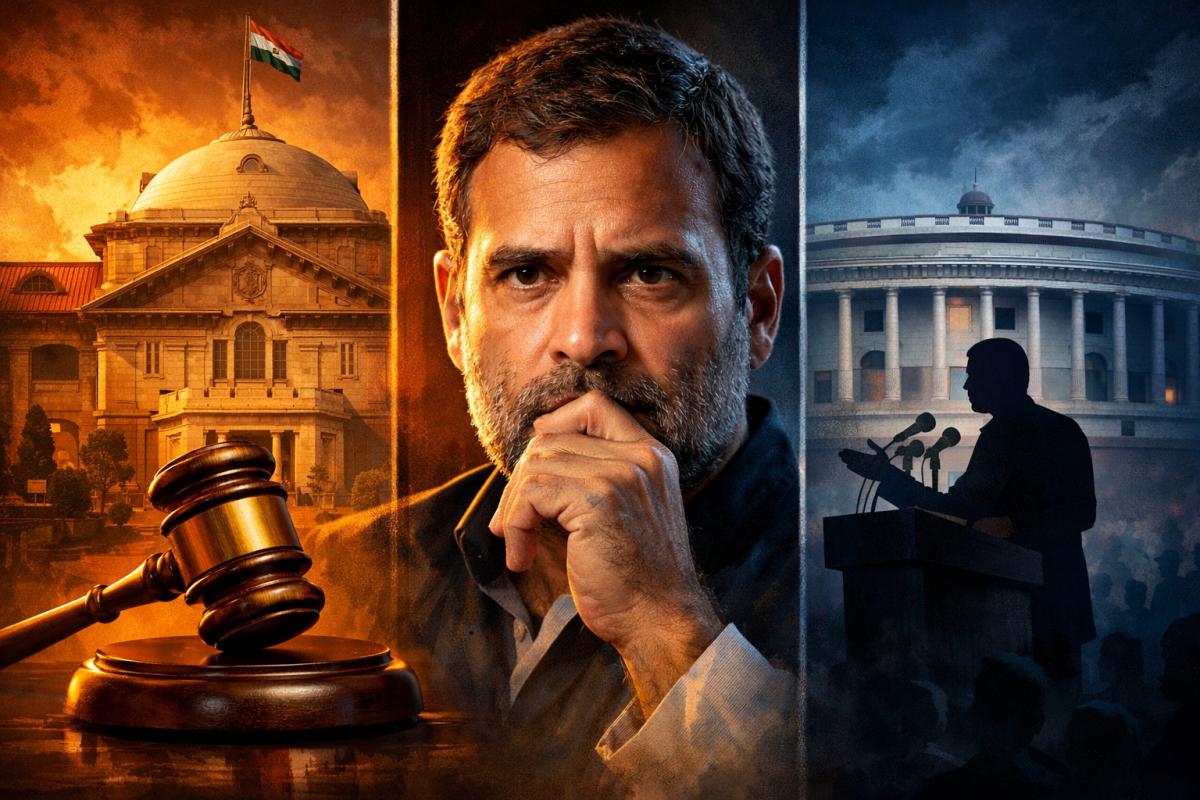

In the volatile landscape of Indian politics, statements are rarely just a collection of words; they are sparks. We have seen time and again how a single sentence can travel from the echo chambers of Parliament to the solemn corridors of a courtroom, transforming from a mere political disagreement into a full-blown constitutional confrontation.
Today, we are witnessing a controversy that perfectly encapsulates this friction. Rahul Gandhi, the Leader of the Opposition, currently finds himself navigating a precarious path between two formidable battlefields. On one side, within the walls of Parliament, a demand has been raised not only to terminate his membership but to ban him from contesting elections for a lifetime. On the other side, the legal machinery is churning, with a demand for the registration of an FIR reaching the Allahabad High Court.
What exactly happened? How did a speech ignite such a fierce duel? And most importantly, does this signal a new phase of intense scrutiny for the opposition leader? In this post, we will deep-dive into the specifics of the allegations, the procedural legalities currently playing out in the High Court, and the explosive
substantive motion
tabled in Parliament.
The Trigger: Fighting the Indian State
To understand the current storm, we must first look at the epicentre: the statement itself. The controversy stems from remarks allegedly made by Rahul Gandhi in 2025 during the inauguration of the AICC (All India Congress Committee) office.
According to the petition filed against him, Rahul Gandhi reportedly stated:
We are now fighting the BJP, the RSS, and the Indian State itself.
On the surface, this is a highly charged sentence. For supporters of the opposition, this might be read as an expression of political resistance—a claim that the lines between the ruling party and the state machinery have blurred. However, for his critics and the petitioners involved, this statement is viewed as a direct signal of confrontation against the Indian State.
It is this specific interpretation that has triggered the legal onslaught. Simran Gupta, a figure affiliated with the Hindu Shakti Dal, claimed that these remarks hurt public sentiments. This claim became the basis for a legal application demanding the registration of an FIR against Gandhi.
The Legal Battlefield: From Lower Courts to the High Court
The journey of this legal complaint is a case study in persistence. Initially, Simran Gupta filed an application in the Chambal Court demanding that an FIR be registered. However, the Chambal Court rejected this application, refusing to grant permission for the FIR.
Not satisfied with this outcome, the petitioner filed a revision plea, asking the court to reconsider its decision. This plea, too, was dismissed. In the normal course of legal events, this is often where cases of this nature hit a dead end. However, this case did not close.
Leveraging Article 227 of the Constitution, the petitioner knocked on the doors of the Allahabad High Court. This moved the controversy from a local jurisdiction to a much higher platform, significantly escalating the stakes.
Inside the Allahabad High Court Hearing
When the matter came up before the bench of Justice Sumit Gopal at the Allahabad High Court, the procedural technicalities took centre stage. The State, represented by Additional Government Advocate Rupak Chaubey, argued that the petition failed to disclose proper grounds. In simple terms, the State’s argument was that the petitioner had not clearly explained why the lower court’s order was legally wrong.
This is a crucial legal hurdle. To overturn a lower court's dismissal, one must demonstrate a legal error in that dismissal. Recognising this gap during arguments, the petitioner’s counsel, Advocate Rohit Nandan Pandey, requested time from the Court to file a
supplementary affidavit
. The purpose of this affidavit is to detail the specific grounds and explain the reasoning behind the challenge more comprehensively.
The High Court allowed this request. Justice Sumit Gopal passed an order stating that if such a supplementary affidavit is filed, the office shall restore the case and place it on record by the next date.
What Does This Mean?
It is important to clarify what this court order implies. The High Court has not yet given a final decision on whether an FIR should be registered. It has simply granted the petitioner another opportunity to present proper legal grounds. The matter is currently listed for the next hearing on March 11.
While this is currently a procedural stage, the political optics are undeniable. When a demand for an FIR against the Leader of Opposition reaches the High Court, it ceases to be a mere legal issue and transforms into a national political narrative.
The Parliamentary Battlefield: The Substantive Motion
While the courts deal with the nuances of the law, a more direct and potentially damaging battle is brewing in Parliament. This is the second front of the war Rahul Gandhi is facing.
BJP MP Nishikant Dubey has filed what is known as a
Substantive Motion
against Rahul Gandhi. This is distinct from the more commonly heard
Privilege Motion.
Dubey was explicit in stating,
There is no privilege motion; I have submitted a substantive motion.
Understanding the Substantive Motion
A substantive motion is a formal proposal requesting the House to make a decision on a specific, significant issue. It is a self-contained proposal that is drafted in such a way as to be capable of expressing a decision of the House. Crucially, this type of motion can be used to discuss and decide on the conduct of a person holding a high position.
For such a motion to pass, it requires the support of the majority of the House. If passed, the consequences can be severe, including the termination of the member's position.
The Allegations and the Demand for a Lifetime Ban
The grounds for this motion, as described by Nishikant Dubey, are deeply political and serious. He has alleged that Rahul Gandhi engages with international entities like the Soros Foundation, Ford Foundation, and USAID. Furthermore, the motion reportedly highlights Gandhi's travels to places like Thailand, Cambodia, Vietnam, and the US, alleging links with
anti-India forces.
The demands attached to this motion are extreme. Nishikant Dubey is not just seeking the termination of Rahul Gandhi's parliamentary membership; he has demanded that Gandhi be barred from contesting elections for a lifetime.
This demand is politically explosive. Contesting elections is a fundamental democratic right (subject to legal disqualifications). To demand a lifetime ban through a parliamentary motion is an exceptionally strong political stand. It suggests that the ruling party representatives view the alleged conduct not just as a breach of parliamentary etiquette, but as a fundamental threat necessitating permanent exclusion from the electoral process.
Context: The Budget Session and Economic Debates
This escalation cannot be viewed in isolation. It is occurring against the backdrop of the ongoing Budget Session of Parliament, which began on January 28 and is scheduled to run until April 2. The political temperature was already high, with the opposition protesting various issues, including farmers' concerns and trade deals.
Rahul Gandhi's recent speeches in the Lok Sabha have added fuel to the fire. Specifically, during the budget debate, he launched a scathing attack on the India-US Trade Deal, terming it a
wholesale surrender.
He claimed that Indian interests had been surrendered under this deal to
protect the BJP's financial architecture.
Using a vivid martial arts analogy, he described the situation:
First the grip is secured, then the chokehold is applied, and then the opponent gives up.
Through this imagery, he argued that India is gradually losing its bargaining power to foreign interests.
It is in this highly charged atmosphere—where the Leader of Opposition is accusing the government of surrendering national interest—that the counter-accusations of
anti-national
links and
fighting the Indian State
have gained momentum.
The Constitutional Dimension: Speech vs. Sedition?
At the heart of this controversy lies a deep constitutional question regarding Freedom of Speech under Article 19(1)(a) versus the Reasonable Restrictions under Article 19(2).
Article 19(1)(a) guarantees freedom of speech and expression. However, Article 19(2) allows the state to impose restrictions in the interest of the sovereignty and integrity of India, public order, and security of the State.
The courts have the difficult task of determining where political expression ends and unlawful provocation begins. Was Rahul Gandhi's statement about
fighting the Indian State
a rhetorical device used to highlight political grievances? Or was it, as his critics claim, a signal of confrontation that threatens public order?
This is not the first time such allegations have surfaced. The sources note that last year, a Lucknow court also directed the registration of a complaint case against Gandhi. That plea specifically alleged that his statements were
seditious and anti-national,
made deliberately with the intent to destabilise the country. Sedition, in Indian law, is an extremely serious offence, involving actions or words that incite hatred or rebellion against the State.
Conclusion: A Test for Indian Democracy
We are currently looking at a scenario where the mechanisms of political accountability (Parliament) and legal accountability (Courts) are operating in parallel.
On one hand, the Allahabad High Court will decide on March 11 whether the procedural grounds exist to register an FIR for the alleged
anti-State
remarks. On the other hand, Parliament may debate a substantive motion that seeks to strip an elected leader of his right to contest elections based on his foreign associations and conduct.
Rahul Gandhi stands in a unique and precarious position: he is the Leader of the Opposition questioning the government on trade deals and economic sovereignty, while simultaneously standing at the centre of a storm that questions his own allegiance to the State.
This situation is about more than just one individual; it is about the functioning of our democratic system. It raises questions about the threshold for political speech, the use of parliamentary motions to discipline opponents, and the role of the judiciary in mediating political conflict. As we wait for the next hearing in March and the unfolding debates in the House, one thing is clear: the sparks from these statements have indeed turned into a fire that shows no sign of dying down.

Community Insights