
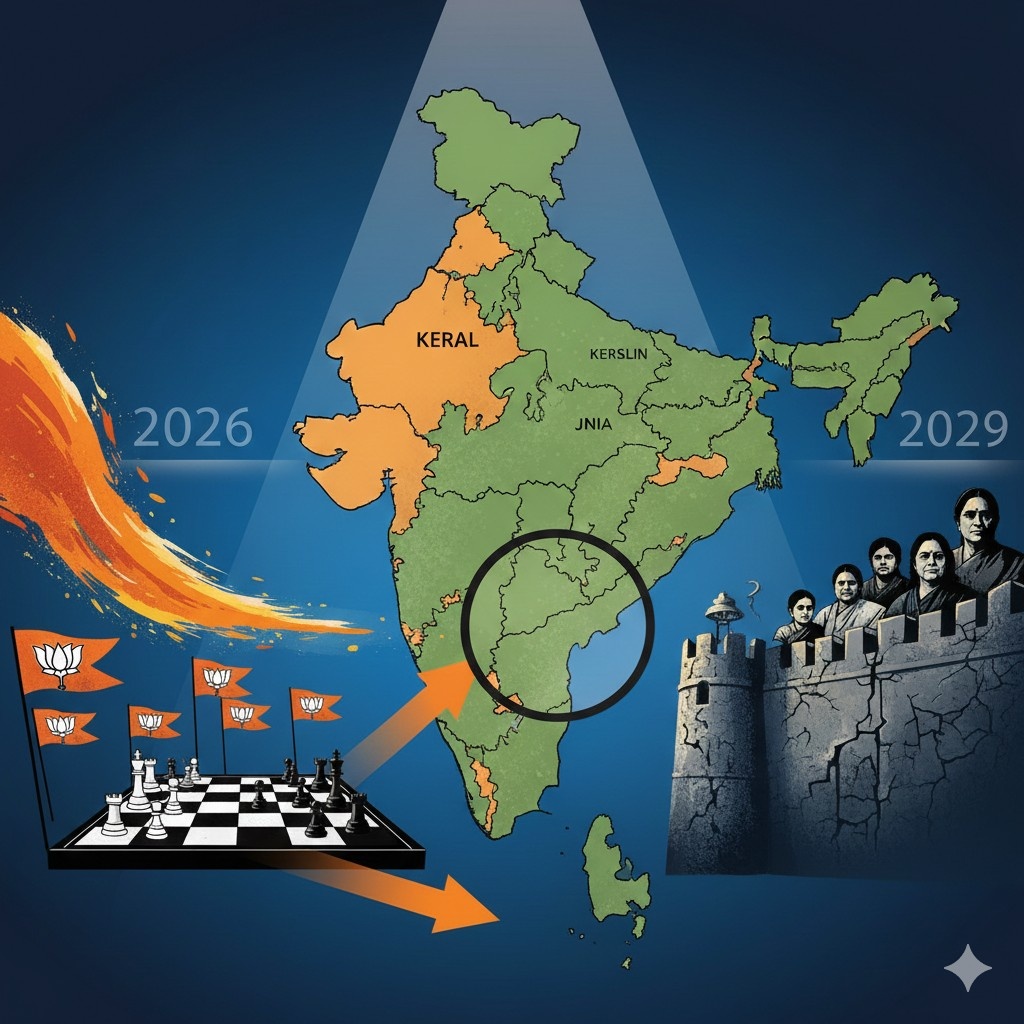

January 2026 has arrived, and with it, the undeniable acceleration of India's political pulse. The focus has shifted decisively toward the southern peninsula, setting the stage for the grand battle of 2029. Based on the latest reports, the ruling Bharatiya Janata Party (BJP) is executing a meticulous strategy to expand its footprint, while the Opposition—spanning from West Bengal to Kerala—scrambles to regain the narrative.
This deep-dive analysis explores the current state of play as of late January 2026, examining the BJP’s organizational overhaul, its aggressive push into Tamil Nadu and Kerala, and the internal dynamics fracturing the Congress party at a critical juncture.
Part I: The BJP’s New Year Momentum and Organizational Overhaul
The year 2026 began with a significant morale boost for the ruling party. The BJP has managed to capture the cash-rich Brihanmumbai Municipal Corporation (BMC), a victory achieved with the assistance of its ally, Eknath Shinde. This win in India’s financial capital was not an isolated incident; the party swept civic bodies across Maharashtra, importantly retaining power in Pune, a region traditionally known as the fiefdom of the Pawar family.
The Rise of Nitin Nabin
Capitalizing on this winning streak, the BJP made a watershed move in its national leadership. The party announced Nitin Nabin as its new national president. At just 45 years old, Nabin is the BJP’s youngest-ever president, a five-time MLA from Bihar whose election signals a generational shift and a "new style" of party functioning.
The selection of Nabin is strategic:
- Organizational Primacy: His choice emphasizes the "primacy" of the organization, a move that reportedly makes the RSS happy.
- Leadership Alignment: While Nabin heads the organization, the party remains firmly under the leadership of the BJP’s "Top Two".
- Grand Optics: The BJP mobilized its entire structure—including the Prime Minister, Union Ministers, and Chief Ministers—to launch Nabin’s presidency with immense fanfare.
This spectacle stands in stark contrast to the Opposition's recent history. Political observers have noted that if the Congress had orchestrated a similar display of strength when electing Mallikarjun Kharge in October 2022, it could have sent a much more powerful message to the Dalit community.
Part II: The "South Focus" – Breaking New Ground
Prime Minister Narendra Modi has lost no time shifting the strategic focus to the southern states, specifically Kerala and Tamil Nadu, where polls are due in April 2026. The BJP has historically not been a major player in either state, but the party is now "going all out to expand its footprint in the South".
Kerala: The New Battleground
The political landscape in Kerala is undergoing a fascinating transformation. While the Congress won across the state in local body polls with over 29% of the votes, and the incumbent CPI(M) followed with 27%, the BJP has managed to garner a significant 14.7% vote share.
The Thiruvananthapuram Breakthrough
The BJP pulled off a "stunning win" in the Thiruvananthapuram Municipal Corporation. Prime Minister Modi likened this victory to the BJP’s win in the Ahmedabad civic body in 1987—a victory in which he played a key role and which paved the way for the party's dominance in Gujarat.
Strategic Messaging and Awards
The BJP is also utilizing non-electoral tools to send political messages. On the eve of Republic Day 2026, the Modi government conferred the Padma Vibhushan posthumously on V S Achuthanandan, a stalwart of the CPI(M) and former Kerala Chief Minister. This move has become a subject of "avid discussion" in the state.
Tamil Nadu: Re-engineering the Alliance
In Tamil Nadu, the BJP is employing a two-pronged strategy: aggressive attacks on the incumbent DMK and the construction of a broader National Democratic Alliance (NDA).
- The Attack: PM Modi has sharpened his rhetoric against the DMK, accusing the party of "corruption, mafia, crime and dynasty".
- The Alliance: Besides the AIADMK (led by EPS) and the PMK, the BJP has managed to bring T T V Dhinakaran into the NDA fold. Dhinakaran is expected to reinforce the alliance's hold among the influential Thevar community.
- Leadership Shuffle: Former TN BJP chief K Annamalai, who had made the BJP a talking point in the state, stepped down last year to facilitate the tie-up with the AIADMK, but he now seems to be "back in the BJP’s scheme of things".
Part III: The Opposition’s Dilemma and Internal Strife
While the BJP consolidates its position, the Opposition faces a mix of confidence and internal confusion. The year 2026 could belong to the Opposition "if it gets it right," but several hurdles remain.
West Bengal and Assam: The Fortresses
In West Bengal, Trinamool Congress (TMC) chief Mamata Banerjee remains a formidable force and is unlikely to allow the BJP to walk all over her party. However, in Assam, the Congress faces an "uphill task" against the entrenched BJP Chief Minister Himanta Biswa Sarma.
The Tamil Nadu Puzzle: The "Third Pole"
The political equation in Tamil Nadu is complicated by the emergence of actor-turned-politician Vijay’s TVK, which has emerged as the "third pole" in the state.
- Hung Assembly Scenario: Observers believe the "best-case scenario" for the BJP would be a hung Assembly, which might allow it to "manoeuvre the situation to its advantage".
- The Bargaining Chip: The Congress is unlikely to snap ties with the DMK, but may use Vijay as a "ploy to bargain harder" for more seats and an assurance of joining the government.
Kerala: The Congress vs. Tharoor Fault Line
Perhaps the most precarious situation for the Congress lies in Kerala. While the party is well-placed to challenge the incumbent CPI(M), internal rifts threaten to derail its prospects.
The Congress leadership has "struggled to deal with the Tharoor factor". A row regarding Tharoor's stand on "Operation Sindoor" caused significant discomfort. Just as reconciliation seemed possible, Rahul Gandhi reportedly delivered a "snub" to Tharoor at an event in Kochi, leading Tharoor to skip a crucial planning meeting in Delhi. Analysts warn that any division within the party at this stage would "only dent its electoral prospects" and directly help the LDF and the BJP.
Part IV: The Road to 2029
The elections of 2026 are not merely state contests; they are the dress rehearsal for the general elections of 2029. The BJP is acutely aware that if the Opposition secures wins in these states, it would provide a massive "psychological advantage" to the anti-BJP camp, and the ruling party is prepared to "pull out all stops to prevent it".
Looking further ahead, the BJP knows it faces big tests in 2027, when Uttar Pradesh, Gujarat, and Punjab are slated for polls. The outcomes in 2026 will determine the party's trajectory and momentum going into those critical battles, which will ultimately set the stage for the "grand battle in 2029".
Conclusion
As January 2026 draws to a close, the battle lines are drawn. The BJP, reinvigorated by civic wins in Maharashtra and a new youthful president, is aggressively expanding into the South. The Opposition, while holding strong fortresses, is beset by internal contradictions. Whether the "Road to 2029" will be cleared for the BJP or blocked by a resurgent Opposition depends entirely on how these parties navigate the complex months ahead. As typically noted in Indian politics, "nothing can ever be said with certainty".
Community Insights