
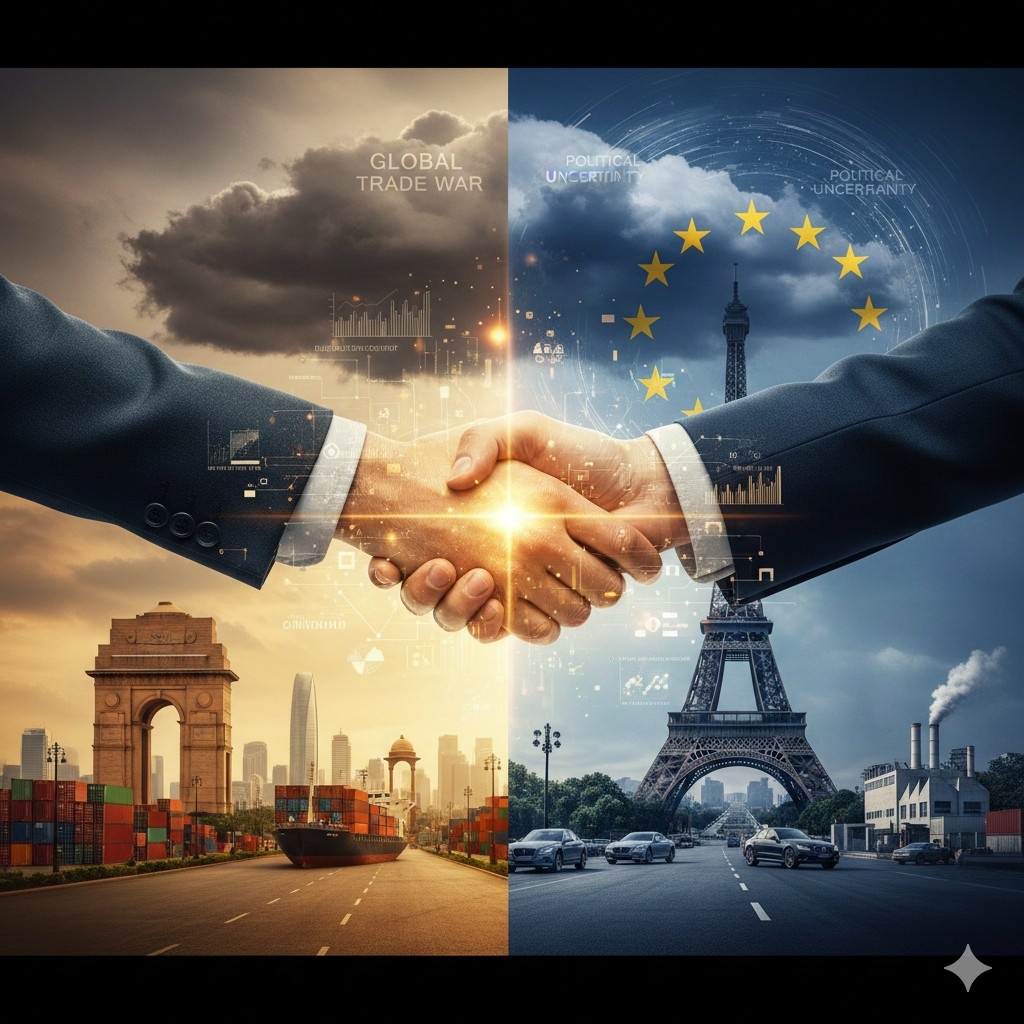

In the volatile world of international geopolitics and economics, it is rare to see a headline that promises to fundamentally reshape the global trading landscape. Yet, that is precisely what has happened with the signing of the historic Free Trade Agreement (FTA) between India and the European Union (EU). Dubbed the "Mother of All Deals" by officials on both sides, this agreement is not just a commercial contract; it is a lifeline for exporters, a strategic manoeuvre against global bullies, and a potential game-changer for the Indian economy.
However, as the dust settles on the handshakes and photo-ops between Prime Minister Narendra Modi and EU Commission President Ursula von der Leyen, it is crucial to look beyond the headlines. Is this deal truly the silver bullet for India’s economic aspirations? What did we give up to get access to European markets? And most importantly, with the shadow of Donald Trump looming over global trade, is this deal a reaction to fear or a proactive step toward a new world order?
In this detailed deep dive, we will unpack the nuances of this agreement, the winners and losers, the "Trump Factor," and the significant hurdles that remain before a single Euro is saved.
A Deal Two Decades in the Making
To understand the magnitude of this agreement, one must appreciate its history. This is not a deal struck overnight. Negotiations for an India-EU trade pact began back in 2007. For years, talks were suspended, stalled by disagreements and protectionist policies. It wasn't until 2022 that negotiations restarted in earnest, culminating in this landmark moment.
The scale of this agreement is staggering. It brings together two massive economic entities: the 27-nation European Union, a $22 trillion economic bloc, and India, a rising $4 trillion economy. Together, this trading zone encompasses nearly 2 billion people and represents 25% of the world’s GDP. It accounts for one-third of all global trade. In terms of sheer scale and significance, there is no debate—this is a monumental event.
The "Trump Factor": The Unseen Signatory
While Donald Trump was not in the room when the deal was signed, his presence was felt in every clause and concession. The sources suggest that this deal is, in many ways, a reaction to the "Global Trade and Tariff War" initiated by the US President.
Both India and the EU have been traditional allies and trade partners of the United States. However, Trump’s "America First" policy spared no one. He imposed heavy tariffs on both the EU and India, with New Delhi facing tariffs as high as 50%. While the EU managed to negotiate a temporary settlement, India has borne the brunt of these economic hits.
"Essentially, the pressure from a common adversary brought India and the EU together. This deal is a strategic move to demonstrate that India and Europe have chosen to be reliable partners to one another in an era where trust in the US is eroding."
What India Wins: A Lifeline for Exporters
For India, this agreement could not have come at a better time. Indian exporters, battered by American tariffs, see this as a potential lifeline. The deal grants India direct access to the European market—the second-largest in the world, with 450 million high-income customers.
Zero Duty Access
The most significant win for India is the preferential entry for its goods. Under the agreement, 99% of Indian exports will now receive preferential treatment. The EU is set to reduce tariffs to zero on sectors crucial for India's manufacturing and employment landscape.
| Sector | Current Tariff | New Tariff |
|---|---|---|
| Marine Products | 26% | 0% |
| Footwear | 17% | 0% |
| Textiles & Apparel | 12% | 0% |
| Gems & Jewellery | 4% | 0% |
Services and IT
Beyond physical goods, the deal promises better access for India's robust services sector. Granting "adequacy status" regarding data protection will make it much easier for Indian IT companies to handle European data. Furthermore, graduates from EU-approved institutions will be granted a guaranteed window of 9 to 12 months to seek employment in Europe.
What the EU Wins: Cracking the Indian Fortress
The European Union gains access to India's vast consumer base. India has agreed to cut tariffs on more than 96% of goods coming from the EU. This is expected to save European exporters over 4 billion Euros annually.
The Auto Sector Breakthrough
India has granted the EU the most preferential treatment ever given to a trading partner in the auto sector. Import duties on cars, which currently stand at 110%, will be slashed to 40% and eventually down to 10% over a few years. This applies to "premium" segment cars valued around ₹20 lakh, meaning brands like Volkswagen and Skoda could see significant price drops.
Wines and Lifestyle
European lifestyle products will also become cheaper. Tariffs on wines and spirits, currently at 150%, will be cut to between 20% and 40%. Processed foods, chocolates, and non-alcoholic drinks will see tariffs drop from 50% to zero.
The Protected Sectors: Farmers and EVs
Despite the broad opening of markets, India managed to draw some "red lines" to protect its most vulnerable populations:
- Agriculture and Dairy: These sectors have been completely excluded from the deal to protect local livelihoods from subsidised European products.
- Electric Vehicles (EVs): Domestic EV manufacturers will be protected for at least five years to allow the local industry to mature before facing European competition.
The Reality Check: Hurdles and "The Catch"
While the deal is historic, several hurdles remain before the benefits are realised:
- The Timeline Gap: The deal is not expected to come into force before early 2027 due to "legal scrubbing" and ratification requirements.
- The Risk of Rejection: The European Parliament has a history of rejecting deals following domestic protests, such as the recent agreement with South America.
- The Carbon Tax Trap: The EU’s Carbon Border Adjustment Mechanism (CBAM) could impose an additional levy of 10-15% on Indian steel and aluminium, potentially nullifying the tariff reductions.
- Competitive Pressures: There are concerns that, without rapid industrial upgrading, India could become a dumping ground for high-quality European-manufactured goods.
Conclusion: A Fragile New Beginning
The India-EU Free Trade Agreement is undeniably a historic milestone. It offers Indian exporters a golden opportunity to reclaim lost ground and promises Indian consumers access to world-class products at lower prices. It creates a strategic buffer against American unpredictability and Chinese aggression.
However, we must temper our excitement with caution. The signing is just the start; the "devil is in the details". Indian businesses must prepare to compete, and the government must navigate the treacherous waters of European bureaucracy to ensure this deal delivers on its massive promise.

Community Insights