

January 20, 2026 — In the annals of financial history, few trading weeks begin with a catalyst as surreal and structurally disruptive as the one facing global markets today. As American traders return to their desks following the Martin Luther King Jr. Day holiday, they are stepping into a financial landscape radically altered by a weekend of high-stakes geopolitical poker.
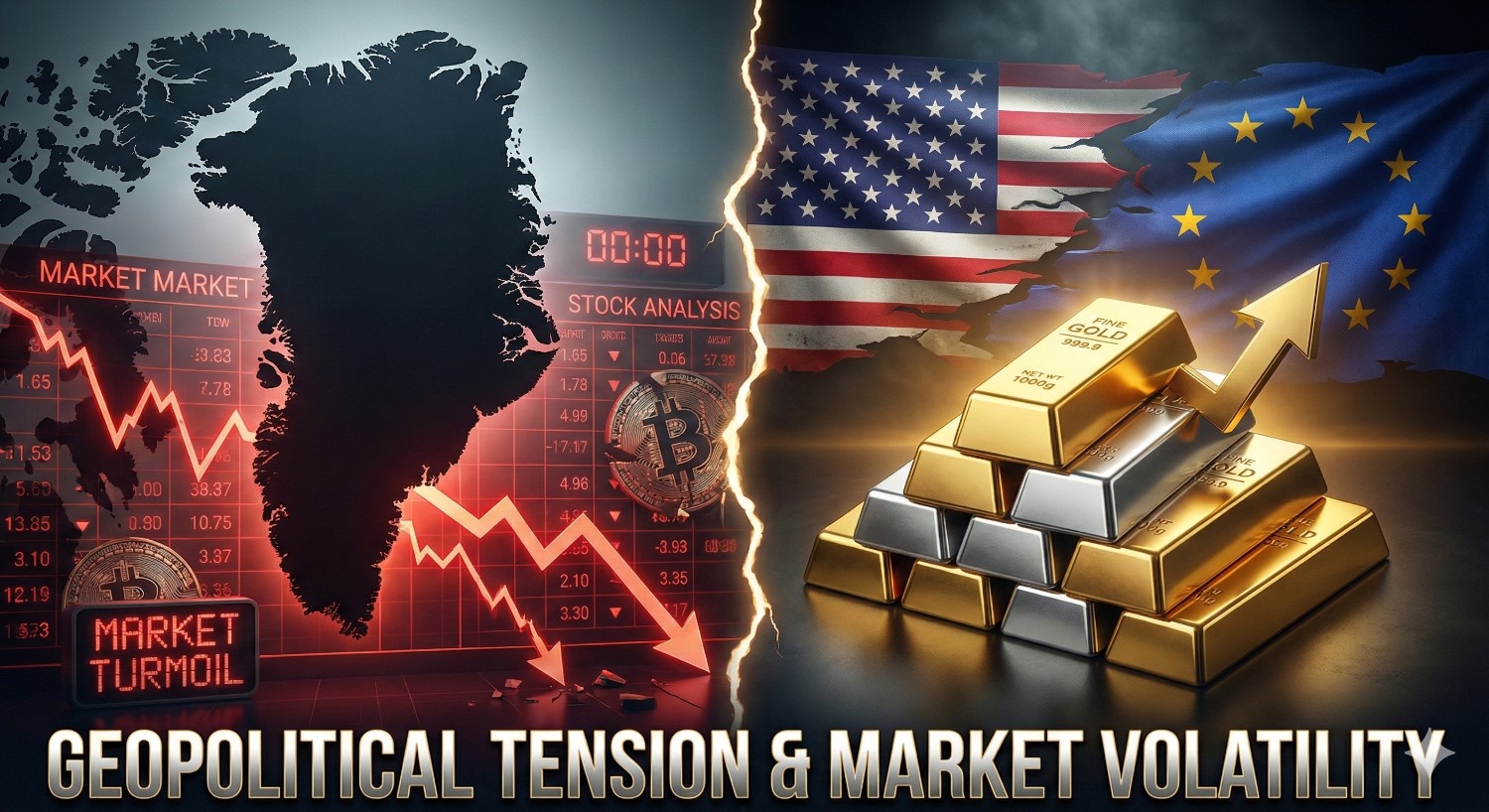
President Donald Trump has reignited global trade tensions with a ferocity reminiscent of—and perhaps exceeding—the "Liberation Day" tariffs of 2025. The flashpoint is Greenland. Following the rejection of his renewed bid to purchase the territory, the President has leveraged social media to announce a punishing tariff regime targeting eight key European nations. The reaction has been swift, binary, and brutal: equity futures are bleeding, cryptocurrencies are capitulating, and precious metals are staging a historic breakout.
This detailed market analysis explores the mechanics of this sell-off, the fracturing of the "digital gold" narrative, the sectors caught in the crossfire, and the macroeconomic storm clouds gathering over the Atlantic.
The Event: A Geopolitical Ultimatum
The immediate trigger for the current volatility is a specific and escalating threat issued by the White House. Frustrated by the diplomatic stalemate regarding the acquisition of Greenland, President Trump took to Truth Social on Saturday to deliver an ultimatum. The directive outlines a two-phase punitive economic strategy targeting Denmark, Norway, Sweden, France, Germany, the United Kingdom, the Netherlands, and Finland.
Starting February 1, 2026, these nations will face a blanket 10% tariff on all goods exported to the United States. However, the true source of market anxiety lies in the escalation clause: if a deal for the purchase of Greenland is not reached by June 1, 2026, those tariffs will more than double to 25%.
While political analysts debate the feasibility of such a land purchase, financial markets are pricing in the economic reality of the threat. This is not merely rhetoric; the use of the International Emergency Economic Powers Act (IEEPA) provides the executive branch with broad authority to regulate commerce during national emergencies. The looming question of whether the U.S. Supreme Court will uphold this use of IEEPA is currently one of the most critical tail risks hanging over the global economy.
Equities in Retreat: The Sea of Red
Because U.S. cash markets were closed Monday, the initial reaction has played out in the futures market and on international exchanges. The signals are unambiguous: risk is being repriced.
The U.S. Futures Plunge
Futures tied to the major U.S. indices have signaled a jagged opening for Tuesday. The Dow Jones Industrial Average futures have indicated a decline of between 300 and 500 points. The broader S&P 500 futures are down approximately 1.6%, while the tech-heavy Nasdaq 100 futures have taken the hardest hit, sinking nearly 1.9%.
The "Magnificent Seven"—the cohort of mega-cap tech stocks that have served as the engine of the recent bull market—are showing significant premarket weakness. Nvidia, Alphabet, Amazon, Meta Platforms, and Tesla were all trading down roughly 1% to 3% in off-hours trading. This suggests a classic "risk-off" rotation where investors trim their most profitable, high-beta positions to raise cash.
Europe's Vulnerability
European indices, trading while the U.S. slept, bore the brunt of the panic. The French CAC 40 dropped over 2%, while the German DAX fell 1.35%. These export-heavy economies are directly in the crosshairs of the new tariff regime. Germany, in particular, relies heavily on industrial exports to the U.S., making a 10-25% levy a potential recessionary trigger.
The United Kingdom’s FTSE 100 managed to outperform its continental peers slightly, closing down 0.39%. This relative resilience is attributed to the index's composition, which is heavy on mining stocks (buoyed by soaring metal prices) and defense contractors, which often rally during periods of geopolitical discord.
The Great Divergence: Crypto vs. Commodities
Perhaps the most significant development of the last 48 hours is the decoupling of cryptocurrency from the "safe haven" narrative. For years, Bitcoin proponents have argued that the asset serves as "digital gold"—a non-sovereign store of value that should appreciate during times of government instability and fiat currency debasement. This week, that thesis is facing a severe stress test, and it is failing.
The Crypto Crash
While physical gold surged, the global cryptocurrency market capitalization dropped 3% to approximately $3.21 trillion. Bitcoin failed to hold the psychological support level of $93,000, sliding toward $92,000, while Ethereum dropped below $3,200. The sell-off was broad-based, with 95 of the top 100 coins posting losses.
Several factors are driving this capitulation:
- Correlation with Risk Assets: Bitcoin is currently trading in lockstep with the Nasdaq rather than gold. As tech stocks fell, crypto followed. The Nasdaq Crypto Index slid over 2.3%, mirroring the pressure on the Nasdaq 100.
- Leverage Flush: The drop triggered a massive liquidation cascade. Nearly $500 million in leveraged long positions were wiped out in a single hour on Monday. This mechanical selling pressure exacerbates downward moves, forcing traders to sell to cover margin calls.
- Institutional Outflows: U.S.-listed spot Bitcoin ETFs saw nearly $395 million in net outflows at the end of last week, with Grayscale seeing significant redemptions. Institutional capital appears to be moving to the sidelines rather than "buying the dip" aggressively.
Technical analysts warn that Bitcoin is in a "Wave IV" corrective structure. If the $90,000 support level breaks decisively, the next downside targets sit between $71,000 and $84,000. Conversely, a reclaim of $104,000 is needed to signal a return to bullish momentum.
The Rise of True Havens: Gold and Silver
In stark contrast to the digital asset market, physical commodities are proving their worth. Investors fleeing the uncertainty of trade wars have poured capital into precious metals.
Gold has shattered records, trading above $4,700 per ounce. This move is driven by fear. Tariffs are inherently inflationary; they function as a tax on consumers and drive up the cost of goods. In an inflationary environment born of geopolitical strife, gold remains the primary hedge.
Silver, however, is the standout performer. The metal surged over 6% in some sessions, hitting a fresh all-time high above $95 per ounce. On the Indian MCX exchange, silver prices breached the Rs 3-lakh per kilogram mark. Silver benefits from a dual narrative: it is a monetary metal like gold, but it is also an industrial metal essential for electronics and green energy—sectors that nations are frantically trying to secure amid trade fragmentation.
Sector Watch: Winners and Losers
The tariff threat has created a clear bifurcation in the equity markets, creating winners and losers based on exposure to U.S. import policies and geopolitical stability.
The Winners: Defense and M&A Targets
While the broader market bleeds, defense stocks are rallying. The logic is cynical but sound: a trade war between NATO allies fractures the security alliance, potentially forcing European nations to drastically increase domestic defense spending to ensure their own security independent of the U.S. umbrella. Consequently, shares of Germany’s Rheinmetall rose approximately 3%, while the UK’s BAE Systems gained 2%. Italy's Leonardo also saw gains. Investors are betting that geopolitical instability translates to full order books for military contractors.
Idiosyncratic M&A activity is also providing pockets of green. Zurich Insurance saw shares of its target, Beazley, surge to an all-time high after tabling a £7.7 billion takeover offer. Similarly, RAPT Therapeutics skyrocketed after GSK agreed to acquire the biopharmaceutical firm for $2.2 billion. These moves remind investors that even in a macro crisis, strategic corporate consolidations continue.
The Losers: Luxury, Spirits, and Autos
The industries most exposed to the proposed tariffs are those relying on the American consumer’s discretionary spending. European luxury conglomerates are sliding as investors calculate the damage of a 25% price hike on high-end goods.
The spirits industry is particularly vocal about the threat. Stephen Davies, CEO of Welsh whisky maker Penderyn, warned that the tariffs would be disastrous. Under the U.S. three-tier system (importer, distributor, retailer), margins are already thin. A 25% tariff compounds through the supply chain, potentially making European products uncompetitive against American domestic brands. European winemakers share this fear, noting that the U.S. accounts for nearly 30% of EU wine exports. The previous "Liberation Day" tariffs caused significant disruption, and the industry fears this round could be fatal for smaller producers.
Macroeconomic Ripple Effects: Inflation and GDP
The implications of this standoff extend beyond stock tickers and into the real economy. The bond market is flashing warning signs regarding inflation and growth.
Following the tariff threats, the yield on the 10-year U.S. Treasury note jumped five basis points to roughly 4.28%. Bond yields rise when investors demand higher compensation for holding debt, usually due to inflation expectations. Tariffs are inflationary by design; they increase the cost of imports. If the U.S. imposes these levies, the cost of living will rise, potentially forcing the Federal Reserve to keep interest rates higher for longer.
This creates a complex feedback loop for the housing market. President Trump is scheduled to speak at the World Economic Forum in Davos this Wednesday, with a focus on "aggressive" housing reforms to lower costs. However, economists point out a stark contradiction: his trade policy (tariffs) drives up construction material costs and bond yields (mortgage rates), directly undermining his stated goal of making housing more affordable.
On the growth front, the outlook is darkening. Analysts at Goldman Sachs estimate the tariffs could shave 0.1% to 0.2% off real GDP across the affected European countries. Capital Economics offers a grimmer forecast for the UK, suggesting GDP could shrink by as much as 0.75% in a worst-case scenario, pushing the economy into recession. The International Monetary Fund (IMF) has already flagged these renewed trade tensions as a primary risk to global growth in 2026, warning of disruptions to supply chains and commodity prices.
Investor Sentiment: A Wall of Worry
The psychological state of the market is currently a mix of high anxiety and opportunistic greed, best illustrated by the chatter on retail trading forums.
On one side are the "Dip Buyers." Retail sentiment on platforms like Reddit suggests a segment of the market views the 1-2% drop in major indices as a "premium discount territory." The argument is that the market has climbed a "wall of worry" for months and that political headlines often create temporary shocks that resolve quickly. Some traders are betting on a "relief rally," speculating that the tariffs are a negotiation tactic that will be walked back or struck down by the courts.
On the other side are the structural bears. These investors argue that threatening NATO allies is fundamentally different from a trade dispute with China. It destabilizes the Western security framework at a time when global tensions are already high. They point to the "wrecking ball" effect on manufacturing and the potential for retaliatory tariffs from the EU—a reported €93 billion package is being considered—which would spiral into a full-blown trade war.
There is also significant focus on the U.S. Supreme Court. The legality of using the IEEPA for these specific tariffs is under review. A ruling against the administration could nullify the threat instantly, triggering a massive relief rally. However, Treasury officials have expressed confidence that the Court will not overrule the President's signature economic policy, leaving the market in a state of suspended animation.
The Week Ahead: What to Watch
As we navigate this volatile week, three key events will likely dictate the market's direction:
1. The U.S. Market Open (Tuesday):
With U.S. markets closed Monday, Tuesday's open will reveal the true depth of institutional selling. Will the "plunge protection" mentality step in, or will we see a sustained correction? Traders will be watching volume closely; a high-volume sell-off suggests institutional conviction, while low volume might indicate a temporary panic.
2. The Davos Address (Wednesday):
President Trump’s speech at the World Economic Forum will be scrutinized for any nuance in his language. The market is desperate for an "off-ramp"—a signal that the tariffs are leverage for a deal rather than a fixed policy. If he doubles down on the rhetoric, expect further weakness in equities and continued strength in gold.
3. Corporate Earnings:
Amidst the macro noise, earnings season continues. Netflix reports on Tuesday, and its guidance will be a bellwether for consumer sentiment. Furthermore, the performance of industrial giants like Fastenal (which missed revenue estimates) provides a glimpse into the actual health of the industrial economy before the tariffs even hit.
Conclusion
The events of January 2026 serve as a stark reminder of the fragility of global markets in the face of geopolitical caprice. The divergence between the crashing crypto market and soaring precious metals highlights a flight to traditional quality over digital speculation. While the threats regarding Greenland may seem bizarre to the casual observer, the financial mechanisms—tariffs, bond yields, and currency fluctuations—are very real and very dangerous.
For investors, the coming days will require a steady hand. The market is currently pricing in a worst-case scenario. If diplomacy prevails or the legal system intervenes, the rebound could be violent. However, if the trade war escalates, the "safe haven" of gold may be the only asset class that shines in a year that has begun with a storm.
Disclaimer: This blog post provides market analysis and news summary for informational purposes only. It does not constitute financial advice. Independent verification of data and consultation with a financial advisor is recommended before making investment decisions.

Community Insights