
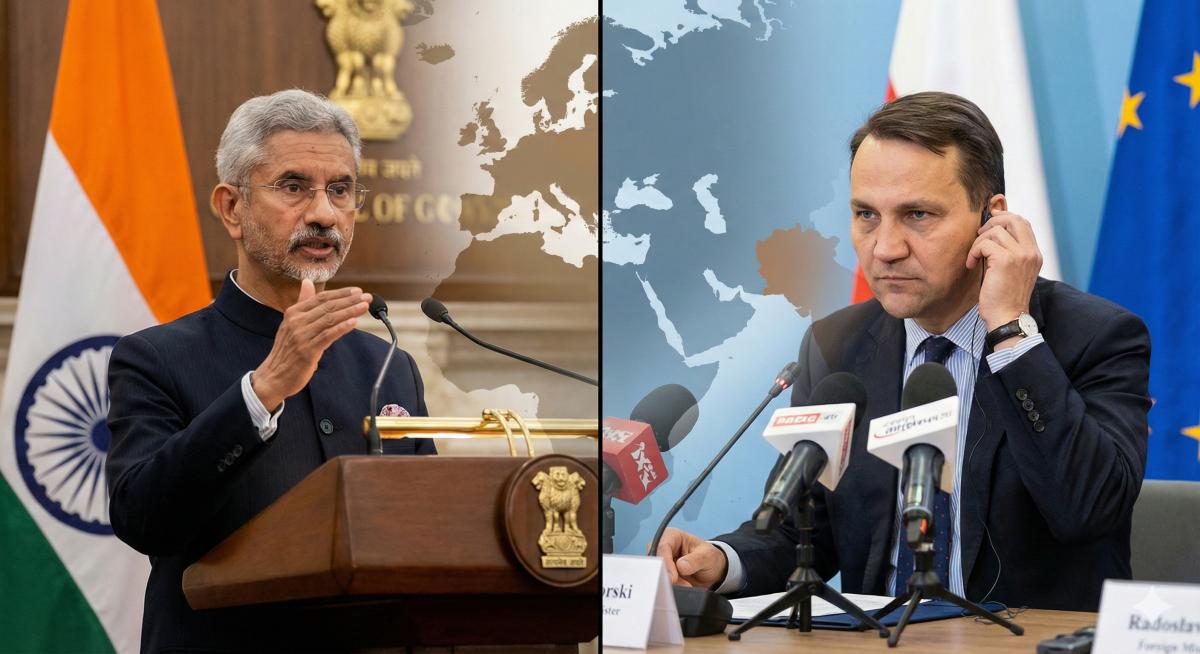
The diplomatic corridors of New Delhi witnessed an unusually sharp exchange this week as India and Poland—two nations recently elevated to a Strategic Partnership—navigated the thorny intersections of European security and South Asian geopolitics. On Monday, January 19, 2026, Indian External Affairs Minister S. Jaishankar met with his Polish counterpart, Deputy Prime Minister and Foreign Minister Radosław Sikorski. What was expected to be a routine review of bilateral ties transformed into a platform for two "blunt messages" from New Delhi to Warsaw: a zero-tolerance demand regarding terrorism in India’s neighborhood, and a rejection of Europe’s "selective targeting" of India regarding the Russia-Ukraine conflict [1], [2].
This meeting, occurring against the backdrop of a volatile global order, highlights India’s increasing assertiveness in protecting its core interests—territorial integrity and strategic autonomy—while pushing back against perceived Western hypocrisy.
The Red Line: "Don't Fuel Terror Infrastructure"
The most significant flashpoint of the meeting was Jaishankar’s pointed admonition regarding Poland’s stance on Pakistan. In a televised opening remark that left little room for ambiguity, Jaishankar stated, "Poland should display zero tolerance for terrorism and not help fuel the terrorist infrastructure in our neighbourhood" [1], [3].
This sharp diplomatic rebuke did not emerge from a vacuum. It was a direct response to a joint statement issued by Poland and Pakistan in October 2025, following Sikorski’s visit to Islamabad. That document had referenced the "Kashmir dispute" and called for a resolution in line with the UN Charter, a phrasing that New Delhi views as a violation of the Shimla Agreement and an interference in its internal affairs [4], [5]. Furthermore, the statement emphasized that "no State should provide a safe haven" to terrorists—a standard diplomatic platitude that, when issued from Islamabad, India viewed as ironically ignoring Pakistan’s own track record as a hub for cross-border militancy [4].
For India, references to Kashmir in third-party joint statements involving Pakistan are a diplomatic "red flag." Jaishankar’s warning to Poland was clear: engaging with Pakistan is one thing, but validating its narrative on Kashmir or ignoring the reality of its "terrorist infrastructure" is a non-negotiable irritant for New Delhi [4].
The "Selective Targeting" of India
Beyond the immediate neighborhood, the talks delved into the ongoing war in Ukraine, a subject that has strained India-Europe relations since 2022. Jaishankar used the meeting to reiterate India’s grievance regarding what he termed the "selective targeting" of India by European states [2].
This refers primarily to the criticism India has faced for continuing to purchase Russian oil and maintaining economic engagement with Moscow despite Western sanctions. Jaishankar described this targeting as "unfair and unjustified," pointing out the hypocrisy inherent in European nations criticizing India while they themselves have continued to import Russian energy in various forms or have only recently weaned themselves off it [3], [6].
The External Affairs Minister noted that he had raised this issue with Sikorski previously in New York and Paris, emphasizing that India’s foreign policy choices are driven by its own energy security and economic necessities, not unlike the choices made by European capitals [3], [7]. The friction was palpable, as Sikorski had earlier, during a Weimar Triangle meeting, expressed satisfaction at a reduction in Indian imports of Russian oil because such purchases were "financing the war machine of Putin" [2].
Sikorski’s Rebuttal: Shared Victimhood and "Colonial Wars"
While the Indian side was assertive, the Polish delegation did not simply acquiesce. Radosław Sikorski, a seasoned diplomat and former war correspondent, attempted to bridge the gap by framing both nations as victims of similar threats. He agreed with Jaishankar on the need to counter cross-border terrorism, noting that Poland, too, has been a "victim of arson and attempted state terrorism" [8].
Sikorski cited recent incidents of sabotage in Poland, including the blowing up of a railway line, which Warsaw attributes to hostile state activity (implicitly Russia) [8], [9]. By drawing a parallel between the "hybrid war" Poland faces from its east and the cross-border terrorism India faces from its west, Sikorski sought to create a common ground of "shared victimhood" [10].
However, on the Ukraine issue, Sikorski pushed back with a distinct narrative tailored for the Global South. He urged India to view Russia’s invasion not merely as a European territorial squabble but as a "colonial war." He argued that Russia is attempting to reassert control over a former colony, appealing to India’s own historical memory of fighting European imperialism [11]. "The times of European colonialism are over," Sikorski declared, pressing New Delhi to take a firmer moral stance against the aggressor [11].
Furthermore, the Polish delegation raised its own security concerns regarding India’s participation in the "Zapad" military exercises led by Russia and Belarus. Sikorski explicitly stated that Poland finds these drills "threatening," highlighting the complexity of a relationship where one partner’s strategic ally (Russia) is the other’s existential threat [12], [13].
The "Walkout": A Moment of Diplomatic Friction
The tension underlying these high-level talks spilled over into the public domain during a media interaction following the meeting. According to reports, the friction became visible when Sikorski was pressed by journalists on the very specific issues raised by Jaishankar.
When an NDTV journalist asked Sikorski about Pakistan’s cross-border terrorism—specifically referencing Jaishankar’s "blunt message"—the Polish Deputy Prime Minister reportedly offered no verbal response and abruptly walked away, ending the interaction [14], [15]. This "walkout" has been interpreted by observers as a sign of the deep discomfort Warsaw feels in navigating its relationship with Pakistan while trying to woo India [16].
Before the abrupt exit, Sikorski did address the "selective targeting" issue regarding tariffs. He acknowledged that Poland and the EU have also been targets of unfair tariffs, stating, "We in Europe have known something about that," likely alluding to trade disputes with the US or China [8], [17]. However, this attempt to universalize the issue did little to address India’s specific grievance about being singled out for its Russia policy.
The Bigger Picture: A Strategic Partnership in Flux
Despite the sparks flying over geopolitics, it is crucial to remember that India and Poland are in the midst of deepening their bilateral ties. The two nations share a long history, celebrated recently during the 70th anniversary of diplomatic relations [18]. In August 2024, Prime Minister Narendra Modi became the first Indian PM to visit Poland in decades, a historic trip that saw the relationship elevated to a "Strategic Partnership" [19], [20].
During the current meeting, both sides reviewed the bilateral action plan for 2024-2028. The economic fundamentals remain strong: Poland is one of India’s largest trading partners in Central Europe, with two-way trade standing at approximately $7 billion—a growth of nearly 200% over the last decade [21]. Indian investments in Poland have crossed $3 billion, driven by opportunities in IT, clean technology, and manufacturing [21], [22].
Moreover, soft power ties remain a "cherished link." Jaishankar fondly recalled the "Dobry Maharaja" (The Good Maharaja) of Nawanagar, who sheltered over 650 Polish children during World War II, a historical bond that continues to resonate with the Polish people [22].
However, the current diplomatic spat reveals the limitations of nostalgia and trade when hard security interests collide. Poland, situated on NATO’s eastern flank, views Russia as an immediate, existential threat. India, while advocating for peace, views its relationship with Russia as a cornerstone of its strategic autonomy and energy security.
Analyzing the "New India" Diplomacy
The tone of Jaishankar’s remarks is emblematic of the "New India" foreign policy doctrine. Under this approach, New Delhi is no longer willing to quietly accept criticism from the West while its own security concerns are ignored. By explicitly linking Poland’s stance on Pakistan to India’s stance on Ukraine, Jaishankar is enforcing a principle of reciprocity: If you want us to understand your security concerns in Europe, you must respect our security concerns in South Asia.
This was reinforced by Sikorski’s admission that while the two nations are "of one mind" on terrorism generally, they discussed frankly "what's on our minds" regarding their respective regional threats [12]. The mention of the Zapad exercises by Poland and the mention of the Pakistan joint statement by India proves that both sides are keeping a distinct scorecard of grievances [13].
The Road Ahead: The EU Context
This bilateral friction must also be viewed through the wider lens of India-EU relations. Poland is a significant voice within the European Union, and Sikorski’s visit comes just days before a major India-EU Summit scheduled for January 27 in New Delhi [12]. Poland has backed the proposed India-EU Free Trade Agreement (FTA), negotiations for which are reaching a critical stage [12].
Sikorski warned that "selective targeting by tariffs" risks destabilizing global trade, a message that cuts both ways [23]. As protectionism rises globally, both India and the EU need each other to diversify supply chains. However, political alignment on core security issues remains the stumbling block.
For the Strategic Partnership to truly mature, Warsaw and New Delhi will have to move beyond "blunt messages" and find a way to compartmentalize their disagreements. Poland may need to recalibrate its approach to Pakistan, realizing that for India, Kashmir is a non-negotiable red line that cannot be balanced against other interests [16]. Conversely, India will continue to face pressure from European partners like Poland to reduce its dependency on Russian military and energy supplies.
Conclusion
The meeting between S. Jaishankar and Radosław Sikorski serves as a microcosm of the current global disorder. It illustrates how regional conflicts—whether in the Donbas or in Kashmir—have global reverberations that complicate bilateral relationships thousands of miles away.
India’s message to Poland was clear: the days of a passive Indian foreign policy are over. New Delhi demands consistency. It will not tolerate being lectured on morality in Ukraine by partners who turn a blind eye to terror in South Asia. As Jaishankar noted, "selective targeting is both unfair and unjustified" [3]. Whether this blunt diplomacy leads to a realignment of Poland’s Asia policy or a cooling of ties remains to be seen, but one thing is certain—India is engaging the world on its own terms.
For more insights, visit themedium.blog.
Community Insights