
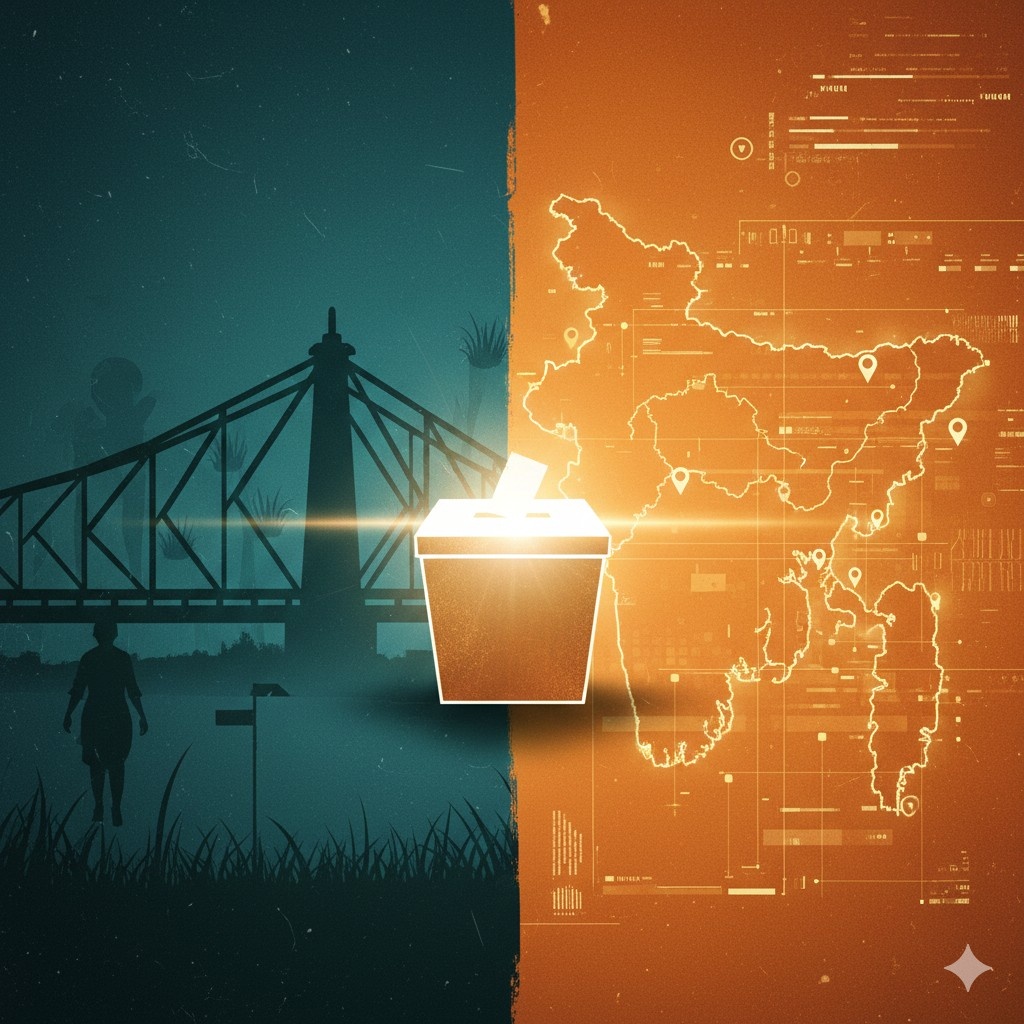

The political drumbeats in West Bengal have begun to sound long before the official bugle of the Election Commission. While the Legislative Assembly elections are scheduled for March–April 2026, the atmosphere in Kolkata and the districts suggests that the campaign is already in full swing. The stakes could not be higher. For the ruling All India Trinamool Congress (TMC), it is a battle to protect their fortress and the legacy of Mamata Banerjee. For the Bharatiya Janata Party (BJP), it is perhaps the most prestigious frontier left to conquer, a test of their organisational might against a deeply entrenched regional powerhouse.
The narrative emerging from the state is not merely one of rallies and speeches; it is a story of intricate war rooms, strategic zonal divisions, the deployment of "peacekeepers", and the drafting of seasoned political veterans from across India to manage the complex chessboard of Bengali politics.
The BJP's Strategic Overhaul: A Region-Wise Command
Following the 2024 Lok Sabha results, where the BJP saw its tally dip from 18 to 12 seats despite retaining a significant vote share, the party leadership has recognised that a "business as usual" approach will not suffice against the TMC machinery. The saffron party has unveiled a region-wise war room strategy that treats Bengal not just as a state election, but as a frontline political battlefield.
The party has calibrated its organisational deployment geographically, splitting West Bengal into distinct political zones. These include critical areas such as Rarh Banga, Hooghly, Medinipur, North Bengal, and the elusive Kolkata metropolitan area. Each zone is being supervised by leaders who possess a proven track record in navigating difficult elections or managing key organisational roles in other states.
This is a departure from the noise-heavy campaigns of the past. Instead of relying solely on public spectacles, the focus has shifted to silent, microscopic management. General Secretary (Organisation) functionaries—the vital bridge between the party and the RSS—have been pitched into the fray. The aim is to strengthen the booth-level presence, which remains the BJP’s Achilles' heel in many rural constituencies compared to the TMC's omnipresent grassroots network.
The Arrival of the 'Pravasi Sadasyas'
In a move that highlights the national significance of this election, the BJP has deployed a legion of "pravasi sadasyas" (migrant members) or observers from other states to manage the preparations. These are not junior cadres but seasoned ministers and strategists from the Hindi heartland and beyond.
Leaders such as Uttar Pradesh Minister J.P.S. Rathore, known for his election management in UP, have been assigned specifically to high-stakes districts like Purba Medinipur. Former UP Minister Suresh Rana has been tasked with overseeing areas in North 24 Parganas, including Sandeshkhali, a region that recently became a flashpoint for political controversy. Their mandate is clear: resolve internal differences at the mandal and district levels.
This strategy addresses a critical internal weakness. The Bengal BJP has often been plagued by factionalism and a disconnect between the old guard and new entrants. By bringing in "neutral" outsiders who report directly to the central leadership, the party hopes to bridge gaps and enforce discipline without being accused of favouring one local faction over another. These leaders act as conduits, noting down complex issues and ensuring that the machinery functions as a cohesive unit rather than a collection of disjointed fiefdoms.
The 'Peacekeeper' Controversy
Perhaps the most novel—and controversial—element of the pre-election buildup is the BJP's deployment of groups referred to as "peacekeepers". According to party sources, these are trained volunteers tasked with maintaining calm, assisting voters, and supporting party workers during the intense campaigning period. The stated objective is to prevent the kind of clashes that have historically marred West Bengal elections.
However, this move has sparked a fierce debate. Critics and political opponents argue that deploying a parallel security force, however informal, amounts to political positioning in contested areas. They contend that law and order is the prerogative of the state police and the administration. The ruling TMC views these "peacekeepers" with deep suspicion, interpreting their presence as a challenge to the state's authority and a potential source of friction rather than resolution.
For the average resident in volatility-prone districts, the presence of these teams creates a mixed sentiment—a hope for safety competing with the fear of escalated confrontation between rival cadres.
Bridging the Leadership Divide: The Return of Dilip Ghosh
A significant development in the BJP's camp is the "return" of Dilip Ghosh to the forefront. Known for his firebrand rhetoric and aggressive style, Ghosh was the state president during the party's meteoric rise between 2016 and 2019. However, he had largely stayed away from state activities in recent months following internal reshuffles.
Union Home Minister Amit Shah, during his strategic meetings in Kolkata, has reportedly signalled a thaw in relations, urging the state brass to utilise Ghosh’s experience. Shah’s message to the party was unequivocal: put aside internal differences and work as a team. The recognition that Ghosh holds considerable sway in the Medinipur belt and retains a loyal following among the grassroots cadre suggests that the BJP is consolidating all its assets. The party realises it cannot afford to alienate its most successful former state president if it hopes to cross the majority mark of 148 seats.
TMC’s Counter-Strike: The Fortress Holds
While the BJP manoeuvres, the Trinamool Congress remains a formidable opponent, deeply rooted in the state’s socio-political fabric. The TMC leadership has dismissed the BJP’s ambitious claims of securing a two-thirds majority as "hollow assertions". Senior TMC leaders have gone on record predicting that the BJP will struggle to cross even the 50-seat mark in the 294-member assembly.
The TMC’s confidence stems from its resounding victory in 2021, where it bagged 215 seats, and its ability to hold its ground in the 2024 general elections. The party continues to rely on the charisma of Chief Minister Mamata Banerjee, the "Street Fighter" image that resonates with the rural electorate, and a slew of welfare schemes that have created a loyal beneficiary base.
Furthermore, the TMC is aggressively countering the BJP's narrative on industrial decline. Leaders are highlighting statistics regarding MSME sector growth and investment to debunk the opposition's claims. On the issue of women's safety—a primary attack line for the BJP—the TMC has pointed to its legislative efforts, such as the Aparajita Bill, and accused the central government of stalling measures that would ensure harsher punishments for crimes against women.
The ruling party is also adept at playing the "outsider" card. By highlighting the influx of BJP leaders from UP, Bihar, and other states, the TMC reinforces its narrative of being the only true representative of Bengali culture and interests, framing the election as a battle between Bengal’s own daughter and a legion of "tourists".
The Arithmetic of Power
The mathematics of the 2026 election is as fascinating as the rhetoric. In the 2021 assembly polls, the TMC secured approximately 48 per cent of the popular vote, while the BJP hovered around 38 per cent. For the BJP to win, it requires a massive swing of at least 5 to 6 per cent—a daunting task in a polarised environment.
The BJP’s strategy relies heavily on consolidation. They are eyeing the Matua community with renewed focus, especially in the border districts. The implementation of CAA rules and the narrative of "infiltration" are being used to galvanise this vote bank. Amit Shah has explicitly instructed party workers to increase the number of voter revision camps, specifically targeting the Matua community, fearing that many eligible names have been deleted from the electoral rolls.
Conversely, the Left Front and the Congress, once the titans of Bengal politics, are fighting for relevance. Their ability—or inability—to form a cohesive alliance or split the anti-incumbency vote could end up being the spoiler that decides the fate of marginal seats. In 2021, the consolidation of the anti-TMC vote behind the BJP was near absolute; whether that trend holds or fractures will be key.
The Battle for Kolkata and the Urban Voter
Historically, the BJP has struggled to penetrate the Kolkata metropolitan area, which remains a TMC citadel. Recognising this, the new strategy involves specific targets for the city's 28 assembly seats. The BJP is attempting to convince the urban, educated voter that the city is not immune to the "demographic changes" and corruption allegations that they highlight in rural areas.
However, the urban voter in Bengal has traditionally been swayed by cultural affinity and secular credentials, areas where the TMC has maintained a stranglehold. The deployment of suave, articulate leaders to manage the Kolkata zone indicates that the BJP is trying to alter its image from a purely rustic, Hindi-heartland party to one that can appeal to the bhadralok (gentlefolk) sensibilities.
The Role of New Leadership
The appointment of Nitin Nabin as the new BJP national president has also injected fresh energy into the state unit. In his very first meetings, Nabin has emphasised "booth-level readiness" over grand narratives. His instructions are precise: counter the opposition's "fake narratives" about central government schemes and ensure the cadre is battle-ready. This shift from ideological abstraction to organisational pragmatism marks a new phase in the BJP’s approach.
Conclusion: A Marathon, Not a Sprint
As we look toward 2026, it is evident that West Bengal is witnessing a clash of two distinct political cultures. On one side is the TMC’s organic, often chaotic, but deeply entrenched mass politics led by a charismatic matriarch. On the other is the BJP’s structured, resource-heavy, and strategically micro-managed election machine.
The deployment of observers, the creation of war rooms, and the focus on internal discipline suggest that the BJP has learnt from its 2021 mistakes. They are no longer banking solely on a "Modi Wave" but are attempting to build a sustainable organisational alternative. However, they face a ruling party that has mastered the art of survival and knows the pulse of its people intimately.
The next few months will see the rhetoric sharpen. Issues of corruption, infiltration, development, and Bengali identity will be debated in every tea stall and television studio. But the real war will be fought in the silent tabulation of booth committees and the quiet maneuvering of the "peacekeepers" and "pravasi" strategists. The Battle for Bengal is not just about who rules the Writers' Building; it is about who can best interpret the complex, emotional, and volatile soul of West Bengal.
Community Insights