
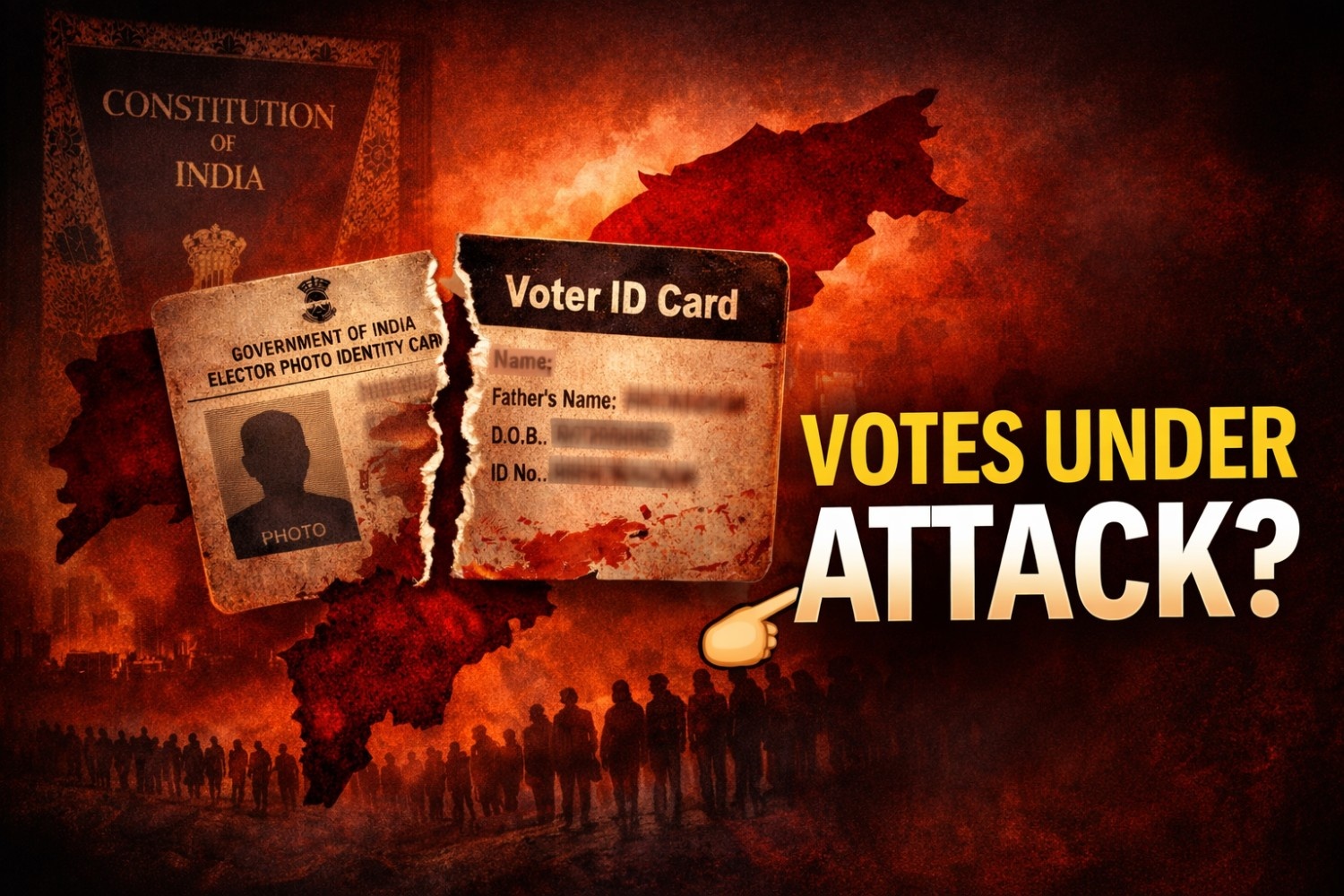

In the complex and often volatile landscape of Indian politics, the state of Assam has once again found itself at the epicentre of a national storm. This time, the controversy is not merely about political rhetoric or election campaigning; it strikes at the very heart of the constitutional promise of India. It involves the Chief Minister of a state, the Supreme Court of India, a controversial legal precedent from 2005, and the future of millions of citizens known as “Miya Muslims.”
As we look toward the 2026 elections, the unfolding events in Assam are being described by the Opposition not just as administrative overreach, but as a full-blown constitutional crisis. From open calls to “trouble” a specific community to the alleged weaponisation of voter lists, the situation raises profound questions about the sanctity of the electoral process and the definition of citizenship in modern India.
In this deep dive, we unpack the layers of this controversy, examining the Chief Minister’s aggressive strategy, the legal defences employed, and the potential fallout for Indian democracy.
The Spark: “Trouble the Miya Muslims”
The current political firestorm was ignited by a series of startling statements made by Assam Chief Minister Himanta Biswa Sarma. While political rhetoric in India often touches on sensitive communal lines, the Chief Minister’s recent remarks have been characterised by an unprecedented directness.
According to reports and transcripts discussed by Law Chakra, the Chief Minister openly urged his supporters to “trouble the Miya Muslims” as a political strategy to force them out of the state. The rhetoric moved beyond vague threats and into explicit, actionable language.
Trouble the Miya Muslims by any means… if they face trouble, they will go from Assam. If I want to give trouble to Miya, I go at 12 am, it’s not an issue. We are directly against the Miya Muslims. We are not hiding anything.
The term “Miya,” historically used for Bengali-speaking Muslims in Assam, has evolved into a charged political identity. The community has long lived under suspicion through processes like the NRC, Foreigners Tribunals, and detention camps. These statements suggest a shift from bureaucratic scrutiny to overt political hostility.
The Strategy: Weaponising the Voter List
Beyond rhetoric, the controversy centres on an alleged administrative strategy described by the Opposition as electoral engineering. At the heart of this is the Special Revision of Electoral Rolls.
The Chief Minister reportedly encouraged BJP workers to use Form 7, a provision that allows objections to voter entries. He publicly claimed that nearly 45 lakh Miya voters would be removed during this process.
Opposition leader Debabrata Saikia wrote to the Chief Justice of India, warning that the exercise had moved beyond administrative correction into deliberate disenfranchisement. According to the letter, the process is being used as a tool of intimidation, harassment, and selective targeting.
- Genuine voters allegedly marked as doubtful
- Claims of voters being declared dead or migrated
- Burden of proof shifted entirely onto individuals
The Defence: The 2005 Supreme Court Judgment
In response to criticism, the Chief Minister cited the 2005 Supreme Court judgment in the Sarbananda Sonowal case. He argued that his statements reflect the Court’s own language and warnings, not political exaggeration.
The silent and invidious demographic invasion of Assam may result in the loss of the geostrategically vital districts of Lower Assam… It will then only be a matter of time when a demand for their merger with Bangladesh may be made.
By invoking this judgment, the administration frames its actions as a matter of national security and constitutional duty rather than communal politics. The concern, according to this argument, is the protection of Assam’s identity and India’s territorial integrity.
The Constitutional Clash: Security vs Suffrage
This defence has triggered a sharp constitutional debate. Critics argue that the Chief Minister is selectively quoting the judgment while ignoring its limits. The Court never authorised collective punishment or the targeting of a community based on language or religion.
The Opposition claims violations of multiple constitutional provisions:
- Article 14: Equality before the law
- Articles 19 and 21: Freedom and personal liberty
- Article 326: Universal adult suffrage
Public declarations about cutting votes from a specific community, critics argue, amount to an admission of intent to manipulate the electorate on communal lines.
The Human Cost: “Miya” as Identity and Insult
Amid legal and political battles, the human consequences are profound. For many Bengali-speaking Muslims, “Miya” is both a reclaimed identity and a source of stigma. Citizenship for this community remains perpetually conditional.
Families who have lived in Assam for generations face repeated demands to prove belonging. Each electoral or citizenship exercise renews fear, uncertainty, and psychological trauma.
| Process | Impact on Community |
|---|---|
| NRC | Mass documentation burden |
| Foreigners Tribunals | Risk of detention and statelessness |
| Electoral Roll Revision | Loss of voting rights |
The Road to 2026: Polarisation as Policy
Political analysts describe the strategy as high-risk polarisation. As the 2026 elections approach, the narrative is being shaped around binaries: indigenous versus infiltrator, protector versus threat.
Supporters view these actions as enforcement of the Assam Accord and cultural survival. Critics see them as the normalisation of exclusion, justified through legal language and nationalist framing.
The Role of the Judiciary
The judiciary now stands at the centre of this confrontation. A PIL is before the Gauhati High Court, while the Supreme Court has been urged to take suo moto cognisance.
The irony is stark: a past Supreme Court judgment is used to justify present executive actions, while the current Supreme Court is asked to restrain them. The decision will test the independence of electoral processes and the limits of executive power.
Conclusion
The Assam controversy is not merely a regional dispute; it is a national test of democratic values. It asks whether demographic anxiety can override constitutional rights, and whether citizenship and voting can be selectively enforced.
If the vote becomes a tool to reward or punish communities, the foundation of Indian democracy is at risk. The Supreme Court’s response will shape not only Assam’s future, but the boundaries of state power and minority rights across India for years to come.
Community Insights