
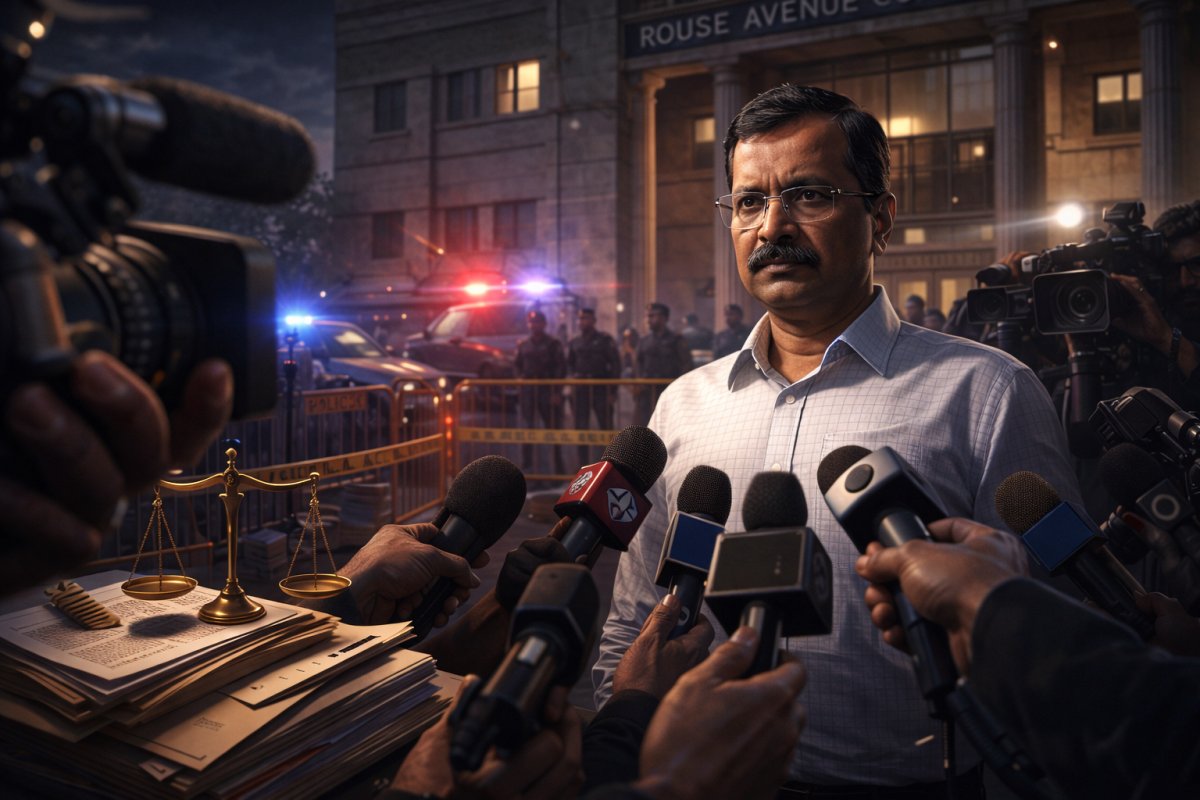

The intersection of politics, administrative governance, and criminal jurisprudence in India has rarely witnessed a saga as dramatic and consequential as the legal battles of Arvind Kejriwal. The national convener of the Aam Aadmi Party (AAP) and former Chief Minister of Delhi evolved from an IRS officer and anti-corruption activist into one of India's most influential political figures. His tenure has been marked by intense confrontations with investigative agencies, constitutional authorities, and political rivals.
From navigating criminal defamation in the digital era to facing allegations in administrative and corruption cases, and ultimately securing a historic discharge in the Delhi Excise Policy case on February 27, 2026, Kejriwal’s legal journey represents a crucial chapter in India's evolving constitutional and political framework.
Overview of Major Legal Battles
| Case | Year | Nature | Outcome |
|---|---|---|---|
| Social Media Defamation Case | 2018–2024 | Criminal Defamation (Retweet Liability) | Delhi High Court allowed trial to proceed |
| Chief Secretary Assault Case | 2018–2023 | Assault and Criminal Conspiracy Allegations | Kejriwal and most accused acquitted |
| Delhi Excise Policy Case | 2022–2026 | Corruption and Money Laundering Allegations | Discharged by trial court in 2026 |
Part 1: The Defamation Doctrine and the Perils of the Digital Age
One of Kejriwal’s early legal battles involved criminal defamation arising from a social media retweet. In May 2018, YouTuber Dhruv Rathee published a video alleging attempts to bribe individuals to defame him. The video named a social media operator, who subsequently filed a criminal defamation complaint after Kejriwal retweeted the video.
The legal question centered around whether a retweet constitutes publication under criminal defamation law.
Key Legal Arguments Presented
- Kejriwal argued he was not the original author.
- He claimed lack of mens rea (criminal intent).
- Defense stated retweeting alone should not trigger criminal liability.
However, the Delhi High Court ruled that retweeting defamatory content can qualify as publication, particularly when performed by influential public figures.
Public figures with large audiences must exercise greater responsibility when sharing content, as their actions can amplify reputational harm significantly.
Legal Implications of the Judgment
- Expanded scope of digital defamation liability
- Established accountability standards for public officials online
- Highlighted risks of social media amplification
Part 2: The 2018 Chief Secretary Assault Case
In February 2018, Delhi Chief Secretary Anshu Prakash alleged he was assaulted during a late-night meeting at the Chief Minister’s residence. The allegations triggered protests among bureaucrats and resulted in criminal charges against Kejriwal, Manish Sisodia, and several AAP legislators.
Charges Filed
- Criminal conspiracy
- Criminal intimidation
- Voluntarily causing hurt
AAP leaders denied the allegations, claiming the case was politically motivated.
Court Outcome
After extensive proceedings, the court acquitted Kejriwal and several others due to insufficient evidence, although charges remained against specific individuals directly accused of assault.
The verdict reinforced the principle that criminal liability must be supported by clear and credible evidence.
Part 3: The Delhi Excise Policy Case – Origins of the Controversy
In 2021, the Delhi government introduced a new excise policy aimed at privatizing liquor sales and increasing government revenue. However, allegations soon emerged claiming procedural irregularities and corruption.
Objectives of the Policy
- Increase government revenue
- Eliminate illegal liquor networks
- Improve retail transparency
- Modernize liquor licensing system
Investigative Agency Allegations
- Policy manipulation for private benefit
- Formation of liquor cartels
- Kickbacks worth approximately ₹100 crore
- Use of funds for election campaigns
The Central Bureau of Investigation (CBI) and Enforcement Directorate (ED) launched probes. Several high-profile arrests followed.
| Person | Agency | Year Arrested |
|---|---|---|
| Manish Sisodia | CBI / ED | 2023 |
| Arvind Kejriwal | ED | 2024 |
Kejriwal became the first sitting Chief Minister arrested under corruption and money laundering allegations.
Part 4: The Historic Discharge by the Rouse Avenue Court
On February 27, 2026, Special Judge Jitendra Singh delivered a landmark judgment discharging Kejriwal, Sisodia, and other accused in the CBI corruption case.
Major Judicial Findings
- No direct evidence linking Kejriwal to corruption
- No proof of bribe demand or receipt
- Policy decisions alone do not establish criminal intent
- Approver testimony lacked corroboration
The court described the prosecution theory as speculative and unsupported by admissible evidence.
Key Legal Principles Reinforced
- Presumption of innocence
- Requirement of evidence beyond suspicion
- Distinction between policy decisions and criminal acts
Part 5: Criticism of Investigation and Use of Approvers
The court criticized heavy reliance on witness testimony without supporting documentation.
- Lack of financial transaction proof
- No verified communication evidence
- Weak conspiracy framework
The court also recommended departmental review of investigative conduct.
Part 6: Political Funding and Electoral Integrity
Investigators alleged illegal election funding linked to policy corruption. However, the court clarified:
- Political funding is regulated by election law
- Election Commission holds primary jurisdiction
- Investigative agencies cannot assume political oversight roles without evidence
| Issue | Court Observation |
|---|---|
| Election Funding | No direct criminal link established |
| Policy Changes | Administrative decisions alone not criminal |
| Agency Jurisdiction | Must remain within legal limits |
Part 7: The PMLA Challenge and Constitutional Liberty
The Enforcement Directorate’s money laundering investigation raised serious constitutional questions regarding prolonged detention and the relationship between predicate offenses and laundering charges.
Legal Concerns Highlighted
- Pre-trial detention impact on liberty
- Dependence of money laundering charges on corruption charges
- Balance between investigation and constitutional rights
Liberty once lost cannot be fully restored, emphasizing the importance of judicial oversight.
Part 8: Political and Legal Aftermath
The discharge triggered major political reactions across India. AAP leaders described the judgment as vindication, while investigative agencies moved to challenge the decision in higher courts.
Immediate Developments
- CBI filed appeal in Delhi High Court
- Legal teams prepared defense strategies
- Political debates intensified nationwide
Potential Future Legal Steps
- High Court review
- Possible Supreme Court involvement
- Continuation of related investigations
Conclusion
The legal journey of Arvind Kejriwal represents one of the most significant intersections of politics and law in modern India. From confronting criminal defamation issues in the digital age to facing corruption allegations in one of the country’s most high-profile investigations, his cases have shaped legal interpretation of political accountability, digital responsibility, and constitutional protections.
The 2026 discharge in the Delhi Excise Policy case stands as a pivotal judicial moment emphasizing the necessity of evidence-based prosecution and protection of personal liberty. While appeals and related investigations continue, the case has already influenced legal discourse on investigative power, administrative decision-making, and democratic safeguards. Ultimately, the courts remain the final arbiters in maintaining the balance between state authority and individual rights, ensuring that justice is guided by law rather than speculation.

Community Insights