
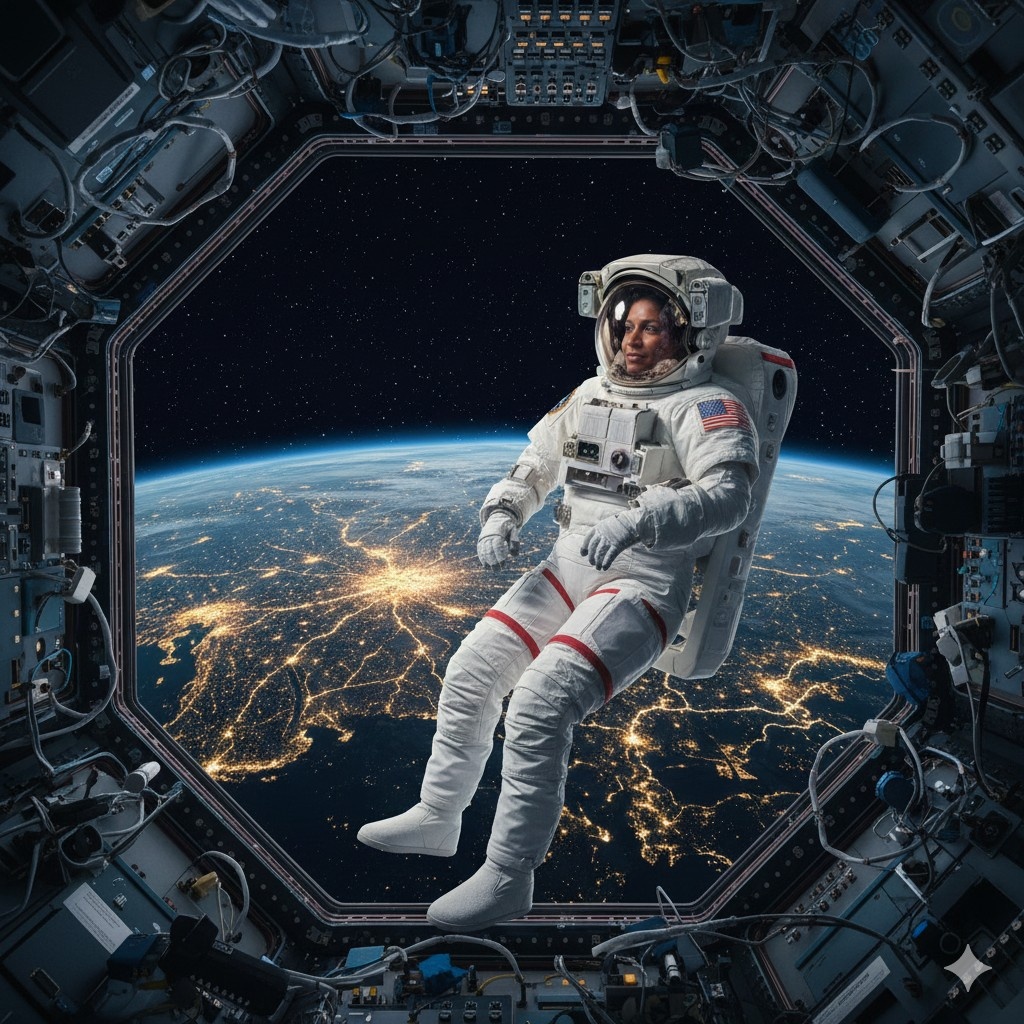
Space travel is often romanticised as the ultimate adventure—a silent ballet of floating bodies and breathtaking views. However, as legendary astronaut Sunita Williams recently revealed in a candid conversation following her latest mission, the reality is far more visceral, noisy, and psychologically demanding. What was intended to be a mere 10-day test flight aboard the Boeing Starliner evolved into an unplanned 286-day odyssey, testing the limits of human endurance, training, and the ability to find beauty in uncertainty. Here is an in-depth look at her extended stay on the International Space Station (ISS), the challenges of a mission gone awry, and the profound lessons she brought back to Earth.
The Mission That Changed
When Sunita Williams and her colleague Butch Wilmore launched, the plan was straightforward: a short-duration test flight to certify the Starliner spacecraft. However, spaceflight is an unforgiving business where returning home is often just a byproduct of survival, not a guarantee. The mission took a dramatic turn when the spacecraft experienced significant technical failures. Specifically, five thrusters failed during the approach, a scenario that forced the crew and mission control into crisis management mode.
Williams describes the moment the thrusters began to fail as a situation where she and Butch simply looked at each other, acknowledging that things were "not so good". Yet, panic was not an option. Drawing on a military background and years of compartmentalisation training, they focused on the immediate task: docking. The complexity of the problem meant that a 10-day sprint turned into a nine-month marathon. They knew early on that they would not be returning as planned, but the full extent of the delay unrolled slowly, requiring immense patience as teams on the ground debated the safety of their return vehicle.
The risks were not theoretical. In one harrowing incident during the mission, a satellite in orbit disintegrated, creating a debris field that threatened the ISS. The crew was woken in the middle of the night and ordered to retreat to their respective spacecraft, which serve as "safe havens" or lifeboats. Williams recounts the surreal nature of that night: the crew gathering near the bathroom for what might have been the last time, hugging each other, and saying, "Hopefully I’ll see you on Earth." It was a stark reminder that while they live in a "controllable box," the environment outside is hostile and unpredictable.
Life Inside the "Fishbowl"
Contrary to the silent vacuum depicted in films, the interior of the ISS is a cacophony of machine noise. Williams describes the station as a living organism that creaks, moans, and pops as it expands and contracts in the intense heat of the sun. The ventilation systems, pumps, and fans create a constant hum that becomes the soundtrack to their lives. Over time, astronauts develop a hypersensitivity to these sounds, learning to diagnose the station's health simply by the rhythm of a valve opening or a motor kicking in.
The sensory experience of space extends to smell. Williams notes that space smells like "us" and the food they eat. With up to 12 people on board during handover periods, the air fills with the scents of humanity, garlic, and fish. While the ventilation system eventually moves these odours around, intense smells can linger. She humourously recalls that even flatulence is a logistical issue; without gravity to disperse air quickly, if you fly through a module behind someone who has just passed wind, you will certainly know about it.
Basic human functions also become complex engineering challenges. Crying in space, for instance, offers no cathartic release of tears rolling down one’s cheek. Instead, the water accumulates in a blob over the eye, blinding the astronaut until it is wiped away with a tissue—much like a fish in an aquarium. Hygiene is equally pragmatic; there are no showers. Astronauts rely on sponge baths and sweat heavily during workouts because the water clings to their bodies rather than dripping off. Williams admits that one of the things she missed most was the simple sensation of running water—standing at a sink to wash her face.
The Astronaut Mindset: Compartmentalisation and Calm
How does one cope with the knowledge that their return ticket is broken? Williams emphasises the power of "living in the moment." When faced with the overwhelming reality of the thruster failure, she applied a method similar to that seen in the film The Martian: solving one problem at a time. She explains that looking at the mountain as a whole is paralysing; one must only focus on the next foothold. This ability to compartmentalise—to fix one thing without worrying about the next ten—is drilled into astronauts during their training.
This mindset is not innate but cultivated through years of rigorous preparation, including time at the National Outdoor Leadership School (NOLS). There, astronauts are taken out of their comfort zones—sleeping in tents, rafting, and managing personal hygiene in the wild—to learn how they react to stress and how to function as a team. Williams, who describes herself as someone who likes organisation, had to learn to tolerate crewmates who might be messier, understanding that she cannot change others, only her reaction to them.
Despite her incredible achievements, Williams is candid about her insecurities. She confesses to suffering from "imposter syndrome" throughout her career, constantly wondering if she could pass the next check ride, master the robotic arm, or endure a spacewalk. She believes that acknowledging these doubts is crucial. If you don't doubt yourself occasionally, you aren't being introspective enough. Her advice to the younger generation is profound in its simplicity: you don't need to know what you want to be when you are 17. Resilience comes from pivoting when doors close and being open to opportunities you never imagined.
A View of the World
One of the few compensations for being stranded in orbit is the view. Williams describes the Earth with the reverence of an artist. Observing India from space offered unique surprises during this mission. In the daytime, the Himalayas appear majestic, looking as if the tectonic plates had just crashed into each other to form the peaks. The runoff from rivers creates swirling patterns of colour along the coastline. At night, India is "spectacular," with cities lit up in a way that resembles a network of connected nerves, pulsing with life.
A particularly mysterious sight was the fishing boats off the west coast of India. From 250 miles up, Williams could see vast patches of green light in the Arabian Sea. Initially confused, she realised these were fleets of fishing vessels using powerful lights to attract catch. Seeing these human activities from such a distance reinforced a sense of connection.
The celestial phenomena were equally stunning. Due to high solar activity, the crew witnessed auroras that defied description. Unlike previous missions where the lights were visible in the distance, this time the ISS flew through the aurora. Williams describes seeing not just green, but pinks and purples, visualising the immense energy of the universe interacting with the planet's magnetic field. She also mentions the work of her colleague Don Pettit, who managed to capture long-exposure photographs of city lights and star trails, and even documented rare "blue jets" and "red sprites"—lightning shooting upwards from thunderclouds.
The Influence of Fatherhood and Heritage
Throughout her journey, the spirit of her late father remained a guiding force. A neuroscientist who migrated to the United States from India, his story is one of sheer determination. He left his home without a safety net, travelling by boat to a new country to practice medicine. Williams views her own accomplishments—guided by the structured path of the military and NASA—as relatively straightforward compared to the "brave and courageous" path her father forged entirely on his own.
She credits him with teaching her to "stop and observe." While her mother provided her with a Slovenian stubbornness and energy, her father possessed a quiet ability to be one with the world, a trait Williams found essential when gazing out of the Cupola window. He was also the one who introduced her to the Bhagavad Gita and the Upanishads, texts she carried with her to space. Even after his passing, she feels his "spark" is still with her, part of the universe she explores.
This multicultural upbringing—half Indian, half Slovenian—shaped her worldview long before she left the atmosphere. Growing up as one of the few Indian families in her town, she learned to bridge cultures, a skill that proved invaluable in the international environment of the space station. Whether sharing a "wedge grilled cheese" (a tribute to her father’s favourite vegetarian meal) or celebrating holidays with Russian cosmonauts, food and tradition became the glue that held the crew together.
The Return and the Physical Toll
Returning to gravity is a violent affair. After 286 days of floating, the human body forgets the relentless pull of the Earth. Williams describes the landing in the ocean as feeling like a "bobbing cork." The neurovestibular system, which shuts down in space because the inner ear no longer needs to sense balance, goes into shock. Upon landing, she felt nauseous for 24 to 48 hours, requiring assistance to walk and simply to keep her head upright. The simple act of pulling a heavy spacesuit over one’s head can induce sickness.
Rehabilitation is a slow process. For days, astronauts cannot drive; they might drop a pen and be surprised when it falls to the floor rather than floating in mid-air. It takes about a month of physical therapy to retrain the small stabilising muscles in the neck and back. Yet, the return is also a sensory rediscovery. Williams recalls the overwhelming smell of dirt and sagebrush upon opening the hatch after her first mission—the distinct scent of a living planet.
Food also takes on a new significance. One of her first meals back was a grilled cheese sandwich made with her husband’s homemade bread. After months of eating tortillas and canned food (and suffering through the lack of good cheese in orbit), the texture and flavour of fresh bread were a luxury beyond measure.
Are We Alone?
When asked the inevitable question about extraterrestrial life, Williams is pragmatic. "Absolutely," she answers. Given the billions of stars and the sheer scale of the universe, she finds it statistically impossible that Earth is the only host for life. She points to the resilience of life on our own planet—organisms thriving in deep-sea thermal vents or in the vacuum of space (microbes have been found surviving on the exterior of the ISS)—as proof that life finds a way. While she doesn't claim to have seen aliens, she believes the universe is teeming with possibilities, perhaps on the watery moons of Jupiter or beneath the surface of Mars.
The Ultimate Lesson: People are Good
Despite the technical marvels and the celestial views, Sunita Williams’ most significant takeaway from her unplanned year in space is deeply human. She observed the narrative on Earth—the worry, the political noise, and the sensationalism surrounding their "stranded" status. Yet, upon her return, she was met with a different reality. strangers from all walks of life, regardless of nationality or politics, approached her with genuine warmth, saying, "I’m so glad you’re back."
This outpouring of care reinforced her belief that, at our core, human beings are good. We care about each other. Watching the world from above, where borders vanish and the planet appears as a single, fragile entity, Williams realised that the conflicts and divisions that consume us on the surface are trivial. Her message is a plea for us to listen to one another and remember that, much like a crew on a spacecraft, we are all stuck on this ship together.
Sunita Williams’ 286 days in space were not just a test of a new spacecraft; they were a testament to the endurance of the human spirit. From fixing thrusters to finding peace in the face of uncertainty, her journey offers a masterclass in resilience. As we look to the future of space exploration, her story reminds us that the most important technology we take with us to the stars is our humanity.

Community Insights