
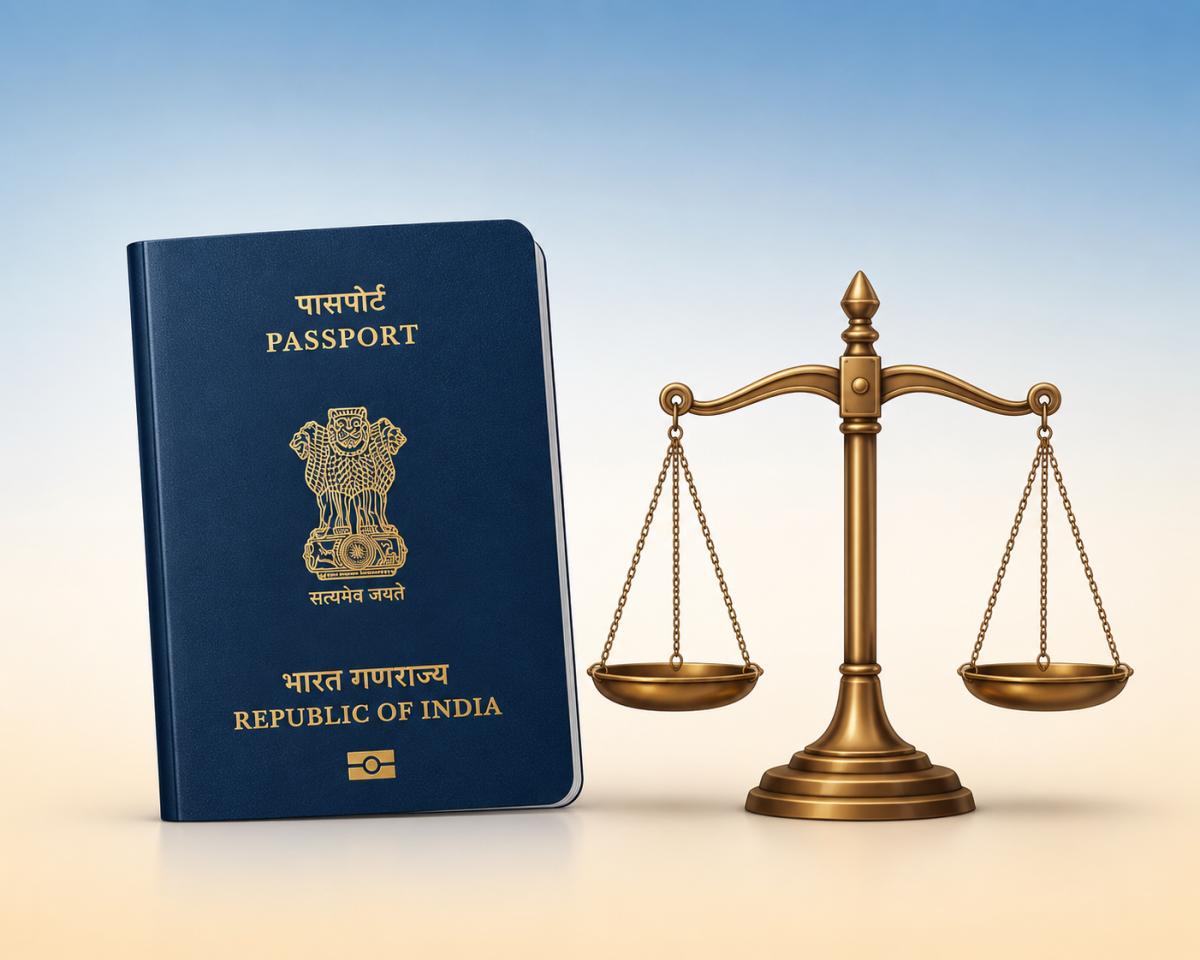

Every few years, a wave of collective anxiety sweeps across the Indian internet, triggered by a seemingly baffling headline: "The Government declares that an Indian passport is not proof of citizenship."
To the average citizen, this sounds like an existential riddle. If a document issued by the Ministry of External Affairs (MEA), bearing the National Emblem, allowing you to cross international borders, and securing you the protection of Indian embassies worldwide isn't definitive proof of your citizenship—then what on earth is?
This exact debate was reignited following statements from the MEA on Passport Seva Divas, where it was clarified that an Indian passport is primarily a travel document and should not be treated as conclusive proof of nationality. For political commentators and social media influencers, it was prime clickbait material, leading to viral videos and frantic "rage-baiting."
However, beneath the sensationalism lies a fascinating, decades-old intersection of constitutional law, refugee crises, humanitarian exceptions, and a critical distinction between evidence and conclusive proof.
Let’s unpack the legal framework, the history of Indian citizenship, and the real reason why an Indian passport can legally be handed to someone who isn't officially an Indian citizen.
1. The Core Misunderstanding: Conclusive Proof vs. Strong Evidence
To understand the government’s stance, we have to look closely at legal terminology. When the Ministry of External Affairs or Indian courts state that a passport is not "conclusive proof" of citizenship, they are not saying it is useless or meaningless.
In Indian law, there is a strict hierarchy of evidence:
- Prima Facie / Strong Evidence: This means a document creates a strong presumption of a fact. An Indian passport is incredibly strong prima facie evidence that you are an Indian citizen. Under normal circumstances, any bank, employer, or local authority will accept your passport as confirmation of your identity and nationality.
- Conclusive Proof: This means a document is legally bulletproof and absolute. It cannot be challenged or overturned by a secondary dispute, and its mere existence shuts down any legal questioning of the status it represents.
An Indian passport is not conclusive proof because citizenship in India is governed exclusively by the Constitution of India and the Citizenship Act, 1955. A passport is simply an administrative product of a completely different statute: the Passports Act, 1967.
If a legal dispute arises regarding an individual's nationality—for instance, if someone is suspected of obtaining documents through fraud or illegal migration—the courts cannot blindly accept a passport as a final verdict. Instead, they must trace the individual's eligibility back to the parent statute: the Citizenship Act.
2. The Legal Loophole: Section 20 of the Passports Act, 1967
The ultimate reason why a passport cannot be defined as absolute, definitive proof of citizenship is that the law itself explicitly allows non-citizens to hold an Indian passport.
If a passport automatically equaled citizenship, then by definition, a non-citizen could never hold one. Yet, if you open the statutory text of the Passports Act, 1967, and look at Section 20, you will find an extraordinary provision titled:
"Issue of passports and travel documents to persons who are not citizens of India."
The text of Section 20 states:
"Notwithstanding anything contained in the foregoing provisions relating to issue of a passport or travel document, the Central Government may issue, or cause to be issued, a passport or travel document to a person who is not a citizen of India if that Government is of the opinion that it is necessary so to do in the public interest."
| THE PASSPORTS ACT, 1967 | |
|---|---|
| Standard Case Issued to Indian Citizens (Strong evidence of citizenship) |
Section 20 Exception Issued to Non-Citizens (Humanitarian / Public Interest) |
Parliament deliberately created this window to give the sovereign government flexibility in navigating international diplomacy, humanitarian crises, and global conventions. It allows India to grant travel papers to stateless individuals, refugees, or persons in legal limbo so they can exercise their basic human rights, such as traveling abroad for education or employment.
Because Section 20 explicitly decouples the document from the status of citizenship, a passport cannot legally serve as an absolute, uniform proof of nationality for everyone who holds one.
3. The Humanitarian Reality: The Sri Lankan Refugee Case Study
To see Section 20 in active, real-world operation, we have to look at the tragic history of the Sri Lankan Civil War and its legal ripples in Indian courtrooms.
In 1983, horrific ethnic violence erupted in Sri Lanka. Seeking safety, tens of thousands of Sri Lankan Tamils fled across the Palk Strait to India. The Indian government welcomed them on humanitarian grounds, establishing dedicated refugee camps across Tamil Nadu.
Over the decades, children were born inside these refugee camps. These children grew up speaking Tamil, studying in Indian schools, and embedding themselves into local communities. However, under the law, their legal status was incredibly fragile.
The Myth of Birthright Citizenship
Many people assume that if you are born on Indian soil, you automatically become an Indian citizen. This is known as jus soli (right of the soil), a legal principle famously practiced in countries like the United States.
India, however, systematically moved away from pure jus soli through progressive amendments to the Citizenship Act, 1955:
| Birth Date Range | Citizenship Eligibility Criteria in India |
|---|---|
| Jan 26, 1950 – July 1, 1987 | Pure Jus Soli: Anyone born in India is a citizen, regardless of parental nationality. |
| July 1, 1987 – Dec 3, 2004 | At least one parent must be a citizen of India at the time of the child's birth. |
| Dec 3, 2004 – Present | Both parents must be Indian citizens, OR one parent a citizen and the other not an illegal immigrant at the time of birth. |
Because the children of Sri Lankan refugees were born after the 1987 cut-off date, and their parents entered India without formal visas (classifying them legally as illegal immigrants, despite their refugee status), these children could not claim Indian citizenship by right of birth. Furthermore, because they were born in India and disconnected from Sri Lanka, their births were often never registered with the Sri Lankan High Commission.
They became stateless persons—citizens of nowhere.
Landmark Judgment: Harina v. Regional Passport Officer (Madras High Court)
This legal dead-end was brought before the Madurai Bench of the Madras High Court in cases like Harina v. Regional Passport Officer.
Harina, a young woman born in an Indian refugee camp to Sri Lankan parents, wished to travel abroad for employment and to build a life out of poverty. She was neither a recognized citizen of Sri Lanka nor an official citizen of India.
Justice G.R. Swaminathan invoked Section 20 of the Passports Act, 1967. The High Court observed that the Right to Life and Liberty under Article 21 of the Indian Constitution—which includes the right to earn a livelihood and the right to travel abroad—applies to all persons, not just citizens.
The court ruled that providing a travel document to a stateless refugee to allow her to seek global opportunities serves the ultimate public interest and aligns with ancient Indian values like Vasudhaiva Kutumbakam (the world is one family). The Union Government was thus directed to utilize its powers under Section 20 to issue her a passport, despite her non-citizen status.
When you look at a citizen like Harina, the legal reality becomes clear: she holds a valid Indian passport, yet she is not an Indian citizen. This is precisely why the passport cannot be called "conclusive proof."
4. What Do the Courts Say? Precedents from Across India
The MEA's recent statements are not part of a hidden agenda or a sudden policy shift; they simply restate a deeply entrenched judicial consensus. Indian High Courts have addressed this question repeatedly over the decades.
The Bombay High Court Ruling (2013)
In 2013, the Bombay High Court categorically ruled that the mere possession of an Indian passport does not automatically strip away the government's right to investigate an individual's true citizenship status. The court emphasized that if a passport was obtained via falsified village birth records, forged school certificates, or identity theft, the document itself cannot be used as a shield to block an investigation under the Citizenship Act.
The Supreme Court and the Burden of Proof
The Supreme Court of India, most notably in cases concerning illegal migration frameworks (such as Sarbananda Sonowal v. Union of India, 2005), has consistently affirmed that the ultimate authority on nationality remains the Constitution and the Citizenship Act, 1955.
If an individual's citizenship is formally challenged by the state, the individual cannot simply hold up a passport and say, "The case is closed." They must show the underlying, foundational records that qualified them to receive that passport in the first place.
5. The Million-Dollar Question: If a Passport Isn't Conclusive Proof, What Is?
This debate naturally triggers a wave of public frustration. If a passport, a voter ID card, and an Aadhaar card are all routinely dismissed by legal purists as "not conclusive proof of citizenship," then what is? Does India even have a single, definitive document that proves citizenship?
The short, surprising answer is: No, India does not have a single, standalone "National Citizenship Card."
| HOW INDIAN CITIZENSHIP IS PROVED |
|---|
| Citizenship is not a single card; it is an evidentiary chain: [ Birth Certificate ] + [ Parents' Land Records ] + [ Electoral Rolls ] = ESTABLISHED CITIZENSHIP (Citizenship Act) = Enables issuance of Passports & National IDs |
When asked directly in Parliament whether everyday identification documents count as definitive proof of nationality, the Ministry of Home Affairs (MHA) clarified that citizenship is determined on a case-by-case basis by looking at a combination of contemporaneous records.
To establish your citizenship beyond any legal doubt in a court of law, you must present a chain of evidence that matches the criteria of the Citizenship Act, 1955:
- A Timeline-Compliant Birth Certificate: Issued by a municipal corporation or government body showing you were born in India before July 1, 1987.
- Parental Lineage Records: If you were born after 1987, you need your birth certificate plus official legacy documents (such as land deeds, government service records, matriculation certificates, or ancestral electoral roll entries) proving your parents were Indian citizens at the time of your birth.
- Certificates of Naturalization or Registration: For those who acquired citizenship later in life through formal legal application.
For 99.9% of Indians, this distinction between prima facie evidence and conclusive proof has absolutely zero impact on daily life. Your passport will still clear your immigration checks, open your bank accounts, and serve as your primary identity document.
The government’s clarification is a textbook example of legal housekeeping. It preserves the integrity of the Citizenship Act, and keeps the door open for crucial humanitarian exceptions like the one granted by the Madras High Court. Your passport isn't being devalued—the law is simply acknowledging that compassion can sometimes transcend paperwork.
Conclusion
The distinction between a passport as strong evidence and conclusive proof of citizenship reflects India's balanced approach to legal integrity and humanitarian values. While the passport remains a powerful and trusted travel document for the vast majority of Indians, this legal nuance safeguards the constitutional framework of citizenship while allowing flexibility for exceptional cases. Understanding this framework helps dispel myths and fosters informed citizenship in a diverse democracy.


Community Insights