
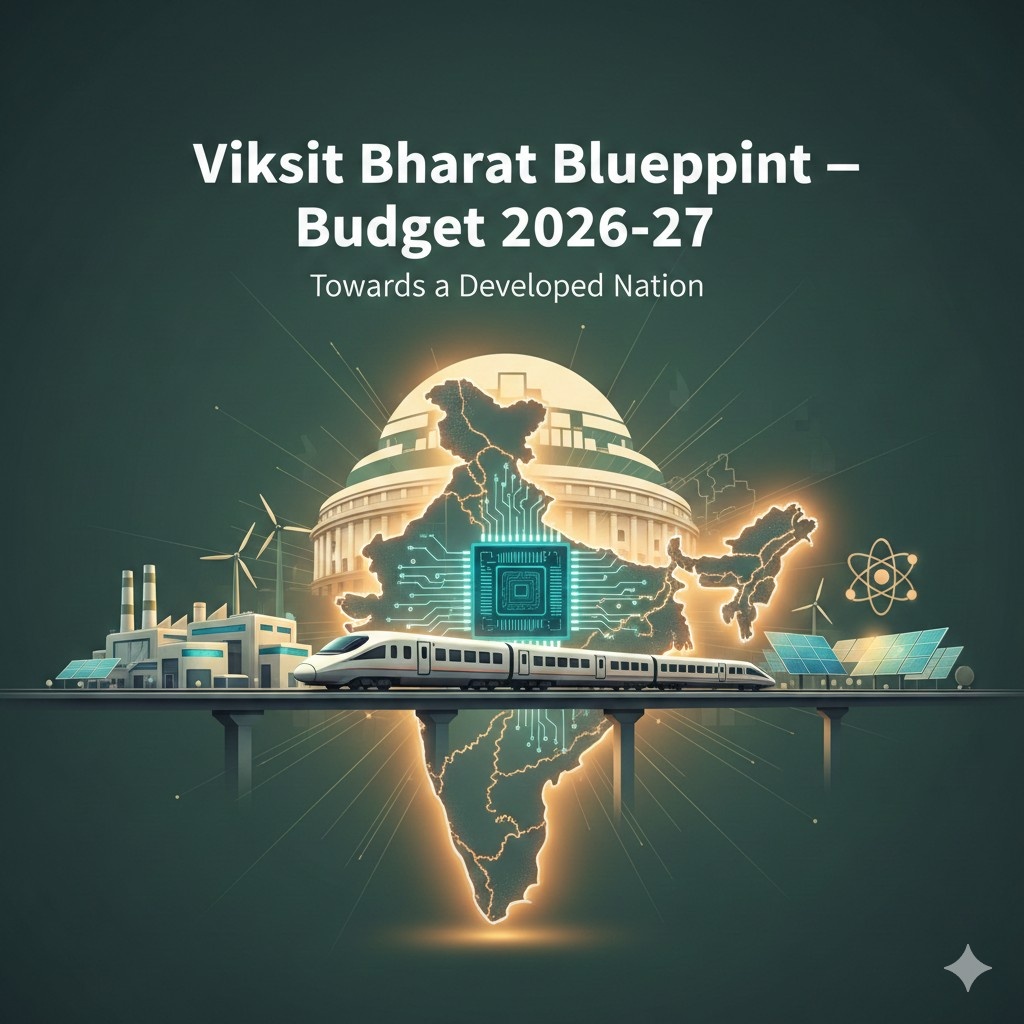

On a historic Sunday in Parliament, Union Finance Minister Nirmala Sitharaman presented her record ninth consecutive Budget, unveiling a fiscal roadmap designed to propel India toward its centenary vision of Viksit Bharat (Developed India). Delivered for the first time from the newly inaugurated Kartavya Bhawan, the Union Budget 2026–27 is anchored in the spirit of Yuva Shakti (Youth Power) and is structured around three core duties, or Kartavyas.
While the salaried class may have felt a sense of déjà vu regarding tax slabs, the budget packs significant structural reforms, a massive infrastructure push, and a pivot toward next-generation industries like biopharmaceuticals, AI, and the “Orange Economy.”
This extensive analysis decodes the fine print of Budget 2026–27 and its impact on individuals, industry, and India’s long-term strategic trajectory.
Part 1: The Macro Framework – Stability Meets Ambition
The overarching theme of this year's budget is balancing fiscal discipline with aggressive capital expenditure. The government has signaled a shift from intent to execution, aiming to shield the economy from global volatility.
The Three Kartavyas
The philosophical pillars of the budget are:
1. Accelerate and sustain economic growth
2. Fulfill aspirations by building human capacity
3. Sabka Saath, Sabka Vikas through inclusive access
Fiscal Math and Capex
The government has maintained fiscal consolidation while increasing asset-creating expenditure.
Key numbers:
Fiscal Deficit: 4.3% of GDP (FY27)
Capital Expenditure: ₹12.2 lakh crore
Total Expenditure: ₹53.5 lakh crore
Net Tax Receipts: ₹28.7 lakh crore
Real GDP Growth Projection: 6.8%–7.2%
Part 2: Personal Finance and Taxation – The Fine Print
Income Tax Slabs: No Change
No changes were announced in income tax slabs under either regime.
New Tax Regime: Zero tax up to ₹4 lakh; 30% beyond ₹24 lakh
Old Tax Regime: Basic exemption remains ₹2.5 lakh
The Section 87A rebate remains unchanged, allowing tax-free income up to ₹12 lakh under the new regime.
The New Income Tax Act, 2025
A landmark reform, the New Income Tax Act will come into force from April 1, 2026.
It introduces a unified “tax year,” eliminating the distinction between assessment year and previous year, significantly simplifying compliance.
TCS Rationalisation on Foreign Spends
The government reduced TCS rates to ease the burden on international transactions.
Overseas tour packages: 2% flat
Foreign education and medical remittances: Reduced from 5% to 2%
Other LRS remittances: 20% unchanged
Capital Markets: STT and Buybacks
To curb speculative trading:
STT on futures increased to 0.05%
STT on options premium raised to 0.15%
Share buybacks will now be taxed as capital gains in the hands of shareholders.
Part 3: Industry and Manufacturing – The “Shakti” Push
Biopharma SHAKTI
A ₹10,000 crore initiative over five years to position India as a global biologics hub.
Includes new NIPERs, upgraded institutes, and a nationwide clinical trials network.
Semiconductor Mission 2.0
The Electronics Components Manufacturing Scheme outlay has been increased to ₹40,000 crore to strengthen full-stack semiconductor capabilities.
MSME Growth Engine
Measures include:
₹10,000 crore SME Growth Fund
Expanded TReDS participation
“Corporate Mitras” for affordable compliance support
Part 4: Infrastructure – Connecting the Dots
High-Speed Rail Corridors
Seven new high-speed rail corridors were announced, connecting major economic hubs including Mumbai–Pune, Hyderabad–Bengaluru, and Delhi–Varanasi.
Freight and Waterways
New freight corridors and 20 National Waterways aim to reduce logistics costs and enhance multimodal transport.
Investment Vehicles
An Infrastructure Risk Guarantee Fund and CPSE REITs will boost private sector participation.
Part 5: Agriculture and Rural Development
Subsidy Rationalisation
Total subsidy expenditure reduced by 4.47% to ₹4.10 lakh crore.
Food subsidy: ₹2.27 lakh crore
Fertiliser subsidy: ₹1.70 lakh crore
Rural Employment Transition
₹95,692 crore allocated to the new VB-G RAM G scheme, alongside ₹30,000 crore for MGNREGA during the transition phase.
Bharat VISTAAR and Allied Sectors
An AI-driven agri advisory platform, fisheries expansion, and livestock credit support were announced.
Part 6: Education and Skilling – Fueling the Future
The education budget rose to ₹1.39 lakh crore, an 8% increase.
Institutes and Infrastructure
Five university townships, new NID, NIPERs, NIMHANS-2, and girls’ hostels in every district were announced.
The Orange Economy
AVGC Content Creator Labs will be set up in 15,000 schools and 500 colleges to create 2 million professionals by 2030.
Part 7: Defence – Post-Operation Sindoor Boost
The defence budget rose 15% to ₹7.85 lakh crore.
Capital outlay increased 22% to ₹2.19 lakh crore, with focus on aircraft and aero-engines.
Part 8: Social Welfare and Health
Healthcare Expansion
Five regional medical hubs, expanded trauma care, and upgraded mental health institutes were announced.
Divyangjan Support
₹300 crore allocated for skilling, education, and assistive technology.
Purvodaya Regional Focus
East Coast Industrial Corridor, Buddhist tourism circuits, and North-East development received targeted support.
Conclusion: A Budget for the Long Haul
Union Budget 2026–27 prioritizes long-term capital formation over short-term populism. With stable taxation, aggressive capex, and a future-oriented focus on technology, defence, and creative industries, the budget lays the foundation for sustained growth.
Execution will determine success — particularly in infrastructure delivery, MSME scaling, and agricultural transformation.
Key Takeaways at a Glance
| Category | Key Announcement |
|---|---|
| Taxation | No slab change; New Tax Act from April 1, 2026; TCS cut to 2% |
| Markets | STT hiked on F&O; Buybacks taxed as capital gains |
| Economy | Fiscal deficit at 4.3%; Capex ₹12.2 lakh crore |
| Infrastructure | 7 high-speed rail corridors; 20 new waterways |
| Industry | ₹10k cr Biopharma; ₹40k cr Electronics; ₹10k cr SME Fund |
| Rural | VB-G RAM G alongside phased MGNREGA |
| Defence | ₹7.85 lakh crore allocation (15% hike) |
Disclaimer: This article is for informational purposes only and does not constitute financial advice.


Community Insights