
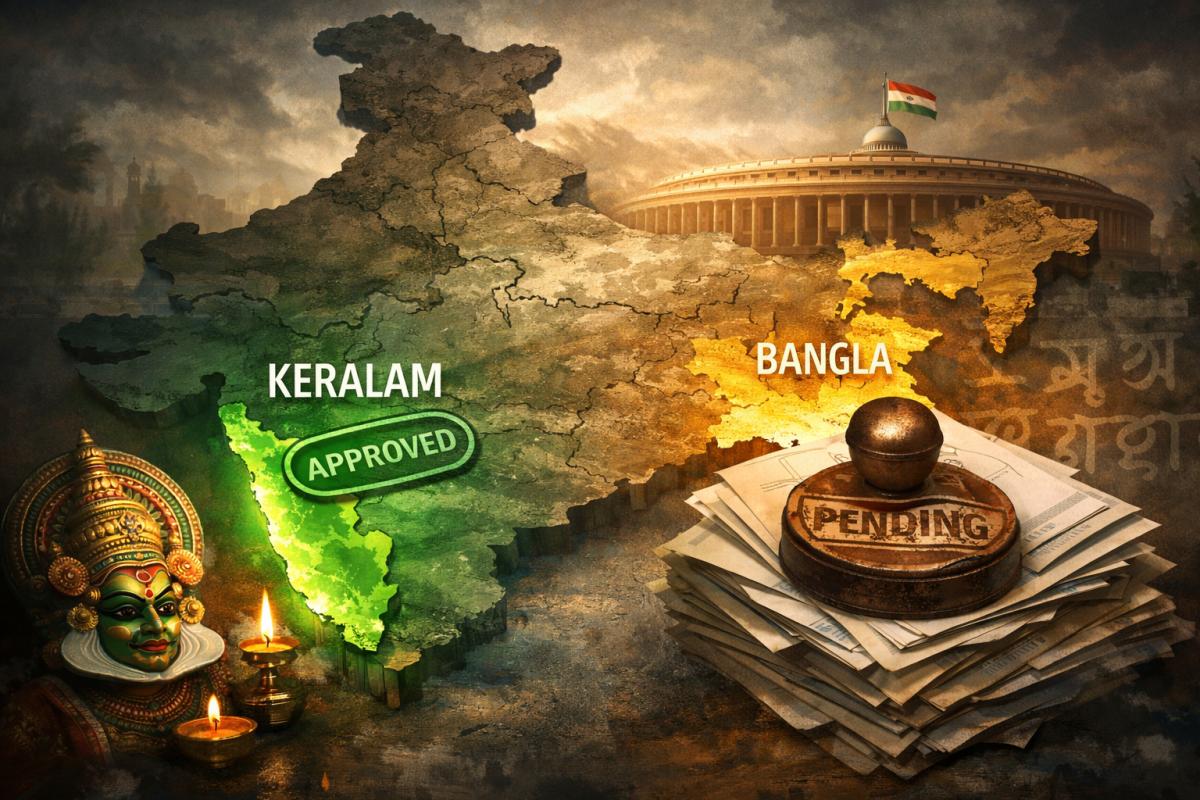

The political landscape of India often witnesses fierce battles over identity, language, and heritage. Recently, an administrative decision by the Union government regarding the renaming of a southern state has sparked a massive political controversy in the east. West Bengal Chief Minister Mamata Banerjee has openly accused the Union government of ignoring her state's repeated requests to be officially renamed "Bangla," a grievance that was sharply triggered by the recent approval of Kerala's name change.
This blog post dives deep into the unfolding political drama, the history behind West Bengal's quest for a new name, and the underlying tensions between state and central governments over cultural identity.
The Catalyst: Kerala’s Successful Transition to 'Keralam'
The immediate trigger for the current political firestorm was the Union cabinet's approval of the renaming of Kerala to "Keralam". This approval came nearly two years after the Kerala state assembly unanimously passed a resolution on June 24th, 2024, seeking this exact change.
The movement to change the name was deeply rooted in linguistic and historical pride. Chief Minister Pinarayi Vijayan, who moved the resolution, argued that the state is natively known as "Keralam" in the Malayalam language. Furthermore, he highlighted that the demand for a unified, Malayalam-speaking "Keralam" is not a recent political stunt, but a historical movement dating all the way back to India's freedom struggle. It is also worth noting the political timing of this approval: the move comes just ahead of the assembly elections in Kerala, scheduled for April to May, which adds an interesting layer of political context to the Union government's decision.
Mamata Banerjee’s Frustration: A Tale of 'Anti-Bengal' Bias?
While Mamata Banerjee offered her congratulations to her "brothers and sisters" in Kerala for successfully achieving their name change, her remarks quickly pivoted to sharp accusations against the Union government. Banerjee accused the ruling Bharatiya Janata Party (BJP) and the central government of harboring an "anti-Bengal" sentiment.
Her primary question is one of administrative fairness: why does a similar renaming proposal for her own state remain stalled and pending, despite multiple resolutions passed by the West Bengal assembly?.
Key Arguments Presented by Mamata Banerjee
- Geographical and Historical Accuracy: She argued that the prefix "West" is an outdated historical hangover. Since "East Bengal" no longer exists as a political entity within India (having become East Pakistan and eventually the independent nation of Bangladesh), there is no logical point in keeping the word "West" in front of Bengal.
- Cultural Identity: The Chief Minister emphasized that she wants the name "Bangla" to serve as a true reflection of Bengali culture, education, and identity.
- The Alphabetical Disadvantage: On a highly practical administrative level, Banerjee pointed out that having a state name starting with the letter "W" places Bengal at the very bottom of alphabetical lists. Consequently, West Bengal's representatives end up speaking or appearing last in state-specific events, including crucial national Chief Ministers' conferences.
The TMC's Attack on the BJP's Intentions
The Trinamool Congress (TMC) amplified the Chief Minister's accusations, taking to their official X (formerly Twitter) account to launch a scathing critique of the BJP's leadership. They accused Prime Minister Narendra Modi and Home Minister Amit Shah of hypocrisy, claiming that the leaders descend on Bengal every election season pretending to deeply love the state's soil, culture, and people—sarcastically referring to them as "Bangla Bodrodhis".
According to the TMC, this refusal to approve the name "Bangla" exposes the fact that the BJP leadership shows no actual respect for West Bengal's heritage, language, icons, or dignity. The party firmly stated that Bengal will not tolerate such "vindictive discrimination," and that a legitimate demand made by a state cannot be arbitrarily denied simply because the central leadership refuses to give it a green light.
Interestingly, Mamata Banerjee also introduced a conspiracy regarding political alliances. She alleged that the Kerala government only received their renaming approval because of a "current political understanding" between the BJP and the Communist Party of India (Marxist) (CPI-M) in Kerala, pointing to the approval as direct evidence of this covert alliance.
A History of Rejection: West Bengal’s Long Quest
To understand the depth of Mamata Banerjee's frustration, one must look at the long, stalled history of West Bengal's renaming efforts. This is not a new fight for the Chief Minister.
| Year | Attempt | Details |
|---|---|---|
| 2011 | The 2011 Attempt | Soon after coming to power in 2011, Banerjee first proposed changing the state's name. At that time, she suggested "Paschim Banga" or "Paschim Bango". However, the central government turned this proposal down, arguing that it amounted to only a minor alteration rather than a meaningful change. |
| 2016 | The 2016 Attempt | Five years later, the state government tried a different approach by proposing three separate names based on language: "Bangla" in Bengali, "Bengal" in English, and "Bengal" in Hindi. The Center rejected this proposal as well, establishing the rule that a state cannot have separate official names in different languages, and that the chosen name must remain uniform across all official usage. |
| 2018 | The 2018 Attempt | Learning from past rejections, the West Bengal assembly passed another resolution in July 2018. This time, they sought to rename the state simply as "Bangla" across all three languages to satisfy the Center's uniformity requirement. This is the proposal that remains pending today. |
The Union Government’s Defense: Roadblocks and Red Tape
While the TMC views the delay as purely vindictive, government sources have cited several specific administrative and geopolitical reasons for the holdup in approving the name "Bangla".
The most prominent concern is international diplomacy. Reports suggest that the proposed name "Bangla" is phonetically very similar to the neighboring country of "Bangladesh". Officials worry that this similarity could create significant confusion on the international stage. Additionally, government sources point out that legally and administratively, renaming a massive, populous state like West Bengal is an incredibly complex and time-consuming process, which inherently contributes to the lengthy delay.
Conclusion
Kerala's successful transition to "Keralam" has opened a brand new chapter in the ongoing national debate over state renaming. For West Bengal, the approval of a southern state's request while their own gathers dust is seen as a slight against their cultural identity. Whether the delay is a matter of legitimate international concern over phonetic similarities with Bangladesh, complex bureaucratic red tape, or a symptom of the bitter political rivalry between the TMC and the BJP, the demand for "Bangla" remains a powerful flashpoint highlighting the deep, ongoing tensions between West Bengal and the Union government.


Community Insights