
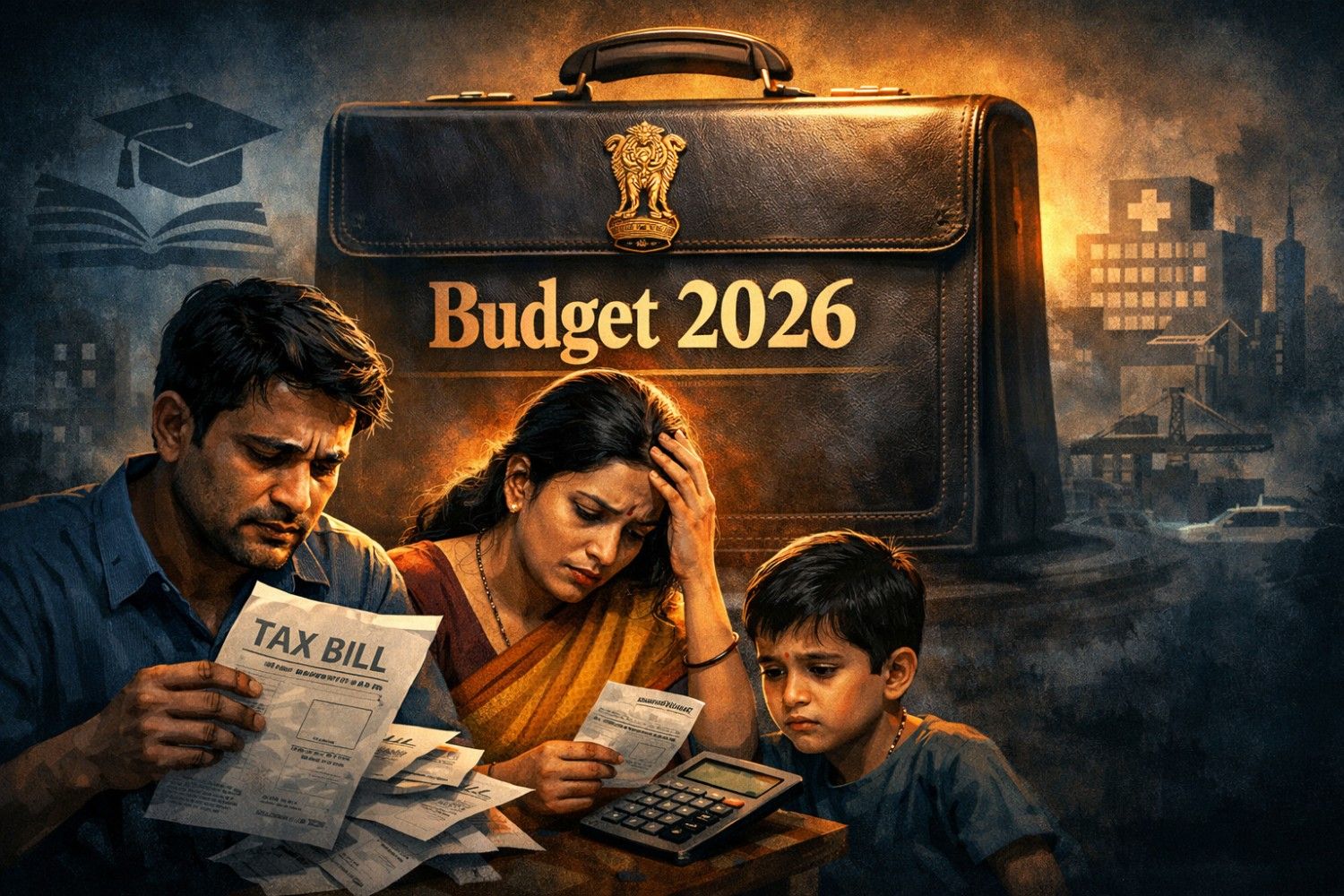

Every year, on the 1st of February, the eyes of the nation turn toward the Finance Minister. It is a day of high stakes, frantic calculations, and immense expectations. This year, Finance Minister Nirmala Sitharaman presented the Budget for 2026-27, a financial roadmap that comes at a pivotal moment for India and the world. With global supply chains disrupted, the rise of Artificial Intelligence transforming systems, and the shadow of trade wars looming under leaders like Trump, this budget was hyped to be one of the most significant in recent history.
But as the dust settles and we move past the headlines, a crucial question remains: Beyond the flashy announcements, what does the data actually say? Did the middle class finally get the relief they were hoping for, or was this another exercise in optical illusions?
In this detailed analysis, we will peel back the layers of the Budget Speech to look at the hard numbers—the allocations, the taxes, and the spending patterns—to understand the real direction in which the country is heading.
The Sunday Surprise and Historical Context
Before diving into the mathematics of the budget, there is an interesting historical footnote to this year's presentation. For the first time in Indian history, the Union Budget was presented on a Sunday, a holiday.
Historically, budgets were presented at 5:00 PM, a tradition held over from British colonial times to align with the time in London. It was the Atal Bihari Vajpayee government that changed this in 1999, shifting the time to 11:00 AM IST. In that same year, the scheduled date fell on a Sunday, so the government pre-poned it to Saturday. However, this year, the government stuck to the date, ensuring that a large number of people could watch the presentation live.
But while the timing was accessible, was the content accessible to the common man’s needs?
The Middle Class and Income Tax: A Tale of Disappointment
The most pressing question for every salaried Indian and middle-class taxpayer is always the same: "Will there be relief in income tax?" Given that consumption in the economy is declining and there is a desperate need to boost spending power, expectations were sky-high.
The straightforward answer, unfortunately, is nothing.
Despite the hype, neither the Income Tax slabs nor the tax rates were changed. The government did introduce a few measures for "ease of compliance." For instance, the deadline to file revised returns with a nominal fee has been extended from December 31st to March 31st. Additionally, some minor offenses were decriminalized, and a new Income Tax Act 2025 is scheduled to come into force on April 1, 2026.
However, while there was no relief, there was certainly an increase in the burden for a specific segment of investors. The government raised the Securities Transaction Tax (STT) on Futures and Options (F&O) trading.
- The tax on Futures trading was hiked from 0.02% to 0.05%.
- The tax on Options trading saw an increase from 0.1% to 0.15%.
This effectively means that stock market investors trading in these derivatives will pay significantly higher taxes. As the source notes, "the Government of India is earning more than the broker" in these transactions. The market reaction was immediate and brutal. By the time the budget speech concluded, the Sensex had crashed by 2,800 points, with Nifty also showing heavy losses.
The Macro Picture: Where Does the Money Come From?
To truly understand the budget, one must look at the total pot of money. The total budget size for 2026-27 is ₹53.47 lakh crore (₹53.47 trillion), which is an increase of 5.57% compared to last year's estimate of ₹50.65 lakh crore.
But where is this money sourced from? The breakdown reveals a shifting burden in the Indian economy:
- Borrowing (24%): A quarter of the government's spending is funded by loans. This figure has remained consistent with the previous year.
- Income Tax (21%): This is the second-largest source.
- Corporate Tax (18%): This contributes significantly less than personal income tax.
- GST and Others (15%): Goods and Services Tax makes up a smaller portion.
| Revenue Source | Share (%) |
|---|---|
| Borrowing | 24% |
| Income Tax | 21% |
| Corporate Tax | 18% |
| GST and Others | 15% |
The most striking revelation here is that Income Tax and GST—taxes largely borne by the common people—add up to 36% of revenue, whereas Corporate Tax is only at 18%. This indicates that individual taxpayers are contributing significantly more to the nation's coffers than companies are.
Historical data shows this wasn't always the case. Under previous governments, corporate tax contributions were much higher, often matching individual contributions. However, a pattern has emerged where companies have received higher relief while the pressure on individual taxpayers has steadily increased.
Where Does the Money Go? The Debt Trap
Understanding expenditure is just as critical. The largest expense for the central government is transferring the states' share of taxes, which is standard procedure.
However, the second-largest expense is alarming: Interest Payments. About 20% of the total budget expenditure goes solely toward paying off interest on past loans. This means one-fifth of the revenue earned is effectively dead money, not used for development but for servicing debt. Only after setting aside these interest payments and state shares does the government have funds left for education, health, defense, and infrastructure.
Sector Analysis 1: Education – A Broken Promise?
If you listened only to the speech, the education sector seemed poised for a revolution. The Finance Minister announced:
- Five university townships near major industrial corridors to link education with industry.
- Girls' hostels in every district for STEM institutions.
- Upgrades to four telescope facilities for astrophysics.
- Content creator labs in 15,000 schools and 500 colleges to promote animation, gaming, and visual effects.
- A National Institute of Design for Eastern India.
These are excellent ideas on paper. But budgets are about numbers, and the numbers tell a different story.
The allocation for education is ₹1.39 trillion. While this is an 8.3% increase from last year’s ₹1.29 trillion, it is woefully inadequate when viewed as a percentage of GDP.
Back in 1964, the Kothari Commission recommended that India spend 6% of its GDP on education. The New Education Policy of 2020 reiterated this goal. Yet, more than 60 years after the initial recommendation, India is spending not even 3% of its total budget on education.
The Myth of Overpopulation and Unemployment
There is a common misconception that the fierce competition for college seats and high unemployment in India is due to overpopulation. However, the data suggests the root cause is the education budget. Countries like the Netherlands, which are more densely populated than India, do not face the same crisis in college admissions because their governments spend adequately to build sufficient schools and universities.
In India, the shortage is artificial. Over the last decade, nearly 90,000 government schools have shut down. There is a severe shortage of teachers, and infrastructure is crumbling. The intense difficulty of competitive exams is a symptom of not having enough good colleges, not just of having too many students. This budget, despite the flashy announcements, fails to provide the transformative funding needed for school-level reforms or teacher training.
Sector Analysis 2: Healthcare – Ignoring the Basics
The healthcare sector narrative follows the same pattern: impressive announcements versus insufficient funding.
The budget mentioned:
- Upgrading institutions for allied health professionals (physiotherapists, dietitians).
- Training 150,000 caregivers.
- Customs duty exemptions for 17 cancer drugs.
- Setting up five regional medical hubs for medical tourism.
However, the total allocation for health is ₹1.05 trillion, a modest 6.4% increase from last year.
The World Health Organization (WHO) recommends that nations spend 5% of their GDP on health. India is stuck at around 2%. The budget focuses on high-end initiatives like medical tourism but seems to neglect the affordable, accessible, and quality primary healthcare that the ordinary citizen desperately needs.
The pattern is stark: Education needs 6% but gets less than 3%; Health needs 5% but remains at 2%.
Sector Analysis 3: The Urban Infrastructure Shock
Perhaps the most shocking aspect of Budget 2026 is the reduction in spending for urban development, despite the rhetoric of empowering cities.
The government spoke of "City Economic Regions," promising ₹50 billion over 5 years to each region. They also announced seven high-speed rail corridors connecting major hubs like Mumbai-Pune, Hyderabad-Bengaluru, and Delhi-Varanasi.
Yet, when you look at the allocation for Urban Development, the number has actually decreased.
- Last year: ₹967.77 billion.
- This year: ₹855.22 billion.
- Result: An 11.6% decrease.
The Pollution Pretence
The situation regarding pollution control is even more concerning. For a country battling severe air quality issues, specifically in Delhi, the allocation was reduced to ₹10.91 billion (down from the previous year's revised estimate of ₹13 billion).
But the allocation isn't the only problem; utilization is. In 2024-25, the government allocated ₹8.58 billion for pollution control but spent only ₹160 million—less than 2% of the funds. This massive underutilization suggests a severe lack of intention to actually solve the pollution crisis.
The Unemployment Crisis: Indirect Solutions to a Direct Problem
Unemployment remains one of India's biggest challenges, with millions entering the workforce annually. The budget's approach to this is entirely indirect.
We saw a long list of schemes:
- Focus on strategic sectors like Biopharma, Semiconductors, and Rare Earths.
- Mega textile parks and a "Samarth 2.0" skilling program.
- A ₹100 billion SME growth fund.
- Upskilling for 10,000 tourism guides.
While supporting MSMEs and manufacturing is positive, these measures lack concrete targets. There is no large-scale direct employment program to absorb the 10-12 million young people entering the job market right now. Indirect measures take years to yield results, and the crisis is immediate. An "Education to Employment Standing Committee" was announced, but without timelines or implementation plans, it remains just another committee.
Agriculture and Defence: Missed Opportunities
Defence:
The defence budget was increased to ₹5.95 trillion, accounting for 11% of the total budget. However, the market reacted negatively, crashing the shares of defence manufacturers because there were no specific policy announcements to support the industry despite the monetary hike.
Agriculture:
For a sector that supports more than half the population, the budget offered very little. The allocation saw a marginal rise to ₹1.63 trillion.
- New schemes focused on niche areas: 500 reservoirs for fisheries, sandalwood, cocoa, and cashew farming.
- The Reality: Core issues affecting the vast majority of farmers—such as MSP reforms, fertilizer costs, and farm worker welfare—were not discussed.
- As the source poignantly summarizes: "There are schemes for turtles, lions, but not for farmers".
Navigating Global Threats: Trade Wars and AI
Finally, the budget attempted to address the uncertain global environment caused by AI revolutions and potential trade wars initiated by the Trump administration.
To counter supply chain disruptions, the government launched Semiconductor Mission 2.0 and increased the outlay for electronics component manufacturing to ₹400 billion. To boost exports, duty concessions were announced on seafood, leather, and textiles.
The Data Center Risk
However, a controversial move involves offering foreign companies a 20-year tax holiday to set up data centers in India. While data centers are essential for the AI revolution, they are resource-intensive. In the US, communities are already protesting data centres over water pollution and sediment issues.
Inviting these companies to India—a country already facing water scarcity and pollution—with tax incentives raises serious environmental concerns. While foreign corporations may benefit from tax breaks until 2047, the common people may suffer the consequences of resource depletion. Furthermore, while AI is acknowledged, there is no significant allocation to protect the millions of jobs at risk of displacement by automation.
Conclusion: A Pattern of Optics
When you zoom out, Budget 2026 reveals a clear pattern. It is filled with pleasant speeches, headline-grabbing announcements, and ambitious schemes for "University Townships" and "Smart Cities." But the actual numbers—the percentage of GDP spent on health and education, the decrease in urban development funds, and the lack of direct job creation—tell a story of stagnation.
It feels reminiscent of budgets from a decade ago that promised 100 Smart Cities, leaving us to wonder about the actual implementation years later. The government has the means, but the allocation and intent seem disconnected from the immediate struggles of the common man, the farmer, and the unemployed youth.
As citizens, while we dissect the national budget, it is equally important to manage our household budgets to survive these economic uncertainties. But regarding the nation's financial roadmap, the data suggests that for the middle class and the poor, the wait for substantial relief continues.

Community Insights