
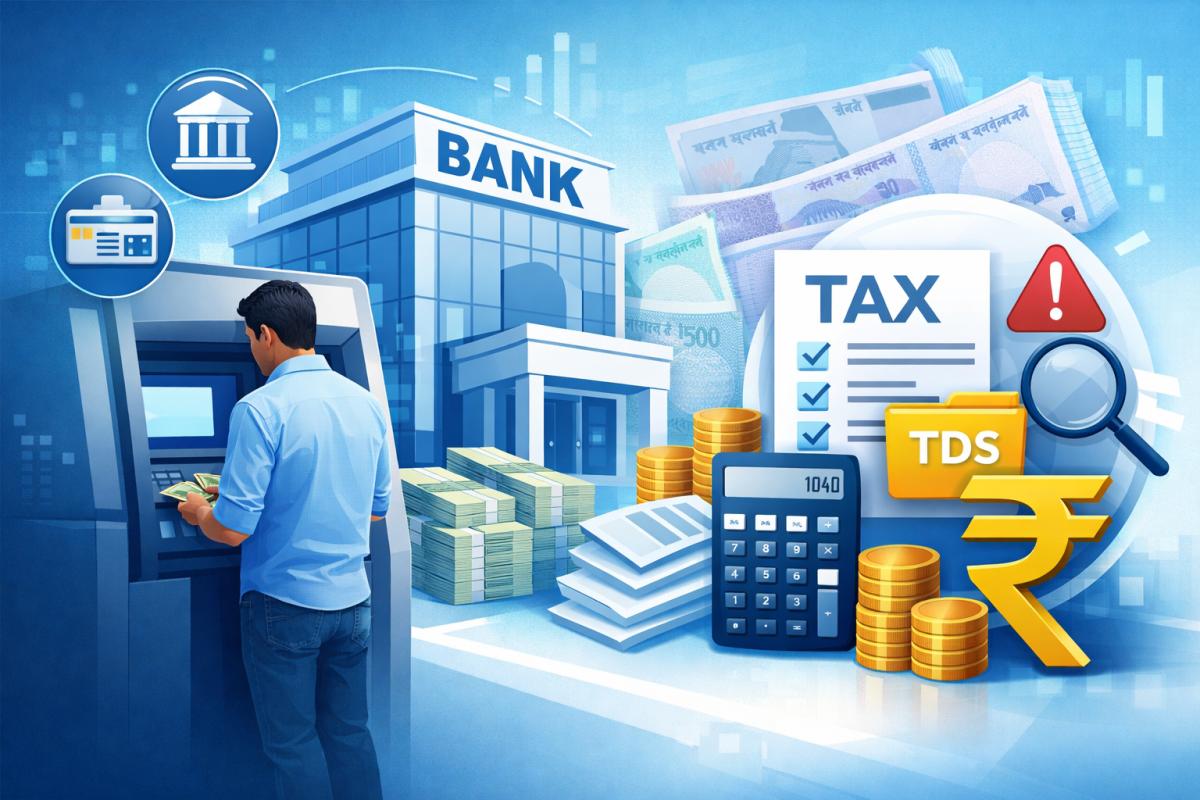

From 1 April 2026, several financial rules related to bank transactions, cash withdrawals, and income tax reporting have become important for Indian citizens. These rules are designed to improve transparency, reduce tax evasion, and encourage digital transactions. Many people are confused about the new limits and believe that the government has restricted cash withdrawals directly. In reality, the rules focus on monitoring large cash transactions rather than banning them completely.
The Government of India and the Income Tax Department monitor high-value financial activities through PAN reporting and banking data. Banks, financial institutions, and taxpayers must follow specific guidelines related to large deposits, withdrawals, and cash payments. If individuals ignore these rules, they may receive an Income Tax notice or face penalties.
This article explains the new bank transaction rules effective from April 2026, including cash withdrawal limits, PAN requirements, tax rules, penalties, and how you can avoid problems with the Income Tax Department.
Why New Bank Transaction Rules Were Introduced
The Indian government has been strengthening financial regulations to track large cash transactions and curb black money circulation. Excessive use of cash can make financial activities difficult to track, which may lead to tax evasion.
To ensure better transparency, the Income Tax Department collects financial transaction data from banks. Large withdrawals, deposits, or high-value purchases are automatically reported through systems like the Annual Information Statement (AIS).
The new rules help authorities:
- Track high-value cash transactions
- Prevent tax evasion and black money circulation
- Encourage digital payments
- Increase financial transparency
- Improve tax compliance
Therefore, the new rules do not completely stop cash usage, but they ensure that unusually large transactions are monitored and reported.
ATM Cash Withdrawal Limits in India
One of the most common questions people ask is whether there is a fixed government limit on ATM withdrawals. The answer is no. The Reserve Bank of India allows individual banks to decide their own withdrawal limits depending on the type of account and debit card.
Generally, ATM withdrawal limits in India vary widely depending on the bank and card variant.
| Debit Card Type | Typical Daily Withdrawal Limit |
|---|---|
| Basic RuPay Debit Card | ₹10,000 – ₹25,000 |
| Classic Debit Card | ₹25,000 – ₹40,000 |
| Gold / Platinum Debit Card | ₹50,000 – ₹1,00,000 |
| Premium Debit Cards | Up to ₹2,00,000 or more |
In general, most banks allow ₹10,000 to ₹1,00,000 per day depending on the account and card type. Some premium debit cards allow even higher withdrawal limits. :contentReference[oaicite:0]{index=0}
Therefore, the ATM withdrawal limit is determined by the bank and not fixed by the government.
Cash Withdrawal Tax Rules (Section 194N)
Another important rule is related to TDS (Tax Deducted at Source) on large cash withdrawals. The Income Tax Act includes provisions to discourage extremely large withdrawals from bank accounts.
Under Section 194N, if a person withdraws a very large amount of cash during a financial year, the bank must deduct TDS on that withdrawal.
| Cash Withdrawal Amount in Financial Year | TDS Rate |
|---|---|
| Up to ₹1 Crore | No TDS |
| Above ₹1 Crore | 2% TDS |
For individuals who have not filed Income Tax Returns for the last three years, the rules are stricter.
| Withdrawal Amount | TDS Rate |
|---|---|
| Up to ₹20 Lakh | No TDS |
| ₹20 Lakh to ₹1 Crore | 2% |
| Above ₹1 Crore | 5% |
These rules continue to apply from FY 2026–27 unless changed by future budgets. :contentReference[oaicite:1]{index=1}
PAN Mandatory for Large Cash Transactions
New draft income tax rules propose stricter PAN reporting for high-value transactions. If a person withdraws or deposits large amounts of cash, quoting the PAN number becomes mandatory.
Under the proposed rules:
- PAN must be provided if cash deposits or withdrawals exceed ₹10 lakh in a financial year
- If transactions exceed ₹20 lakh, PAN verification may also be required
These rules aim to prevent anonymous high-value cash dealings and strengthen financial transparency. :contentReference[oaicite:2]{index=2}
Cash Transaction Limit Under Income Tax Law
Another important provision is Section 269ST of the Income Tax Act. This rule restricts large cash payments between individuals and businesses.
According to this law, a person cannot receive cash of ₹2 lakh or more:
- From a single person in one day
- In a single transaction
- For a single event or occasion
If someone receives more than ₹2 lakh in cash under these conditions, the penalty can be equal to the amount received. :contentReference[oaicite:3]{index=3}
ATM Transaction Charges and Free Limits
Apart from withdrawal limits, ATM usage also has transaction charges. Banks allow a limited number of free transactions each month.
- Up to 5 free transactions per month at your bank's ATM
- Additional transactions may incur charges
After exceeding the free limit, customers may be charged around ₹23 per transaction. :contentReference[oaicite:4]{index=4}
Recent Changes in Bank Withdrawal Policies
Apart from government tax rules, individual banks sometimes revise their own withdrawal limits. For example, some banks have recently reduced ATM limits for certain debit cards to improve risk management and encourage digital banking.
Example: A major public sector bank recently reduced ATM withdrawal limits on certain cards from ₹1.5 lakh to ₹75,000 per day starting April 2026.
Such changes are decided by individual banks and can vary depending on account types, debit cards, and customer profiles.
Digital Payment Limits in India
As part of the move toward a digital economy, payment systems such as UPI have expanded their transaction limits.
For certain categories such as tax payments, UPI transaction limits have been increased to as much as ₹5 lakh per transaction. This allows people to complete large payments digitally instead of relying on cash. :contentReference[oaicite:5]{index=5}
Digital payments provide advantages such as:
- Instant transactions
- Better security
- Automatic transaction records
- No need to carry large amounts of cash
Common Situations That May Trigger an Income Tax Notice
Even though withdrawing cash is legal, extremely large or unusual transactions may attract attention from tax authorities.
Some situations that may trigger scrutiny include:
- Frequent large cash deposits
- Withdrawal of huge amounts without clear income source
- High-value purchases using cash
- Multiple transactions designed to avoid reporting thresholds
Banks automatically report high-value transactions to the Income Tax Department through systems like the Statement of Financial Transactions (SFT).
Tips to Avoid Problems with Income Tax Department
To stay compliant with tax laws and avoid unnecessary notices, individuals should follow some best practices.
- Always file your Income Tax Return on time
- Avoid large cash transactions when possible
- Use digital payments for high-value purchases
- Maintain records of all major transactions
- Ensure PAN is linked with your bank account
Following these steps will help maintain transparency and reduce the risk of tax scrutiny.
Advantages of the New Financial Monitoring System
While many people worry about stricter monitoring, these rules also bring several benefits to the financial system.
- Reduction in black money circulation
- Improved tax compliance
- Better financial transparency
- More secure banking ecosystem
- Growth of digital payment infrastructure
In the long term, these reforms help build a more reliable financial system and improve government revenue collection.
Future of Cash Transactions in India
India is gradually moving toward a more digital economy. The growth of UPI, mobile banking, and online payment platforms has significantly reduced dependence on cash.
However, cash will still remain an important part of the economy, especially in rural areas and small businesses. Instead of eliminating cash usage, the government aims to regulate and monitor large transactions more effectively.
The trend clearly shows that financial systems are becoming more transparent and technology-driven.
Conclusion
The bank transaction rules effective from 1 April 2026 focus primarily on monitoring high-value financial activities rather than restricting normal banking transactions. ATM withdrawal limits are still determined by individual banks, while tax rules mainly apply when extremely large amounts of cash are withdrawn or exchanged.
Key rules include TDS on withdrawals above ₹1 crore, mandatory PAN reporting for large cash transactions, and restrictions on receiving ₹2 lakh or more in cash in a single transaction. These regulations aim to reduce tax evasion, improve transparency, and encourage digital payments across India.
For ordinary banking customers, there is no reason to worry as long as transactions are legitimate and income tax returns are filed properly. By understanding these rules and maintaining proper financial records, individuals can easily avoid penalties and manage their money safely within the legal framework of the Indian financial system.

Community Insights