
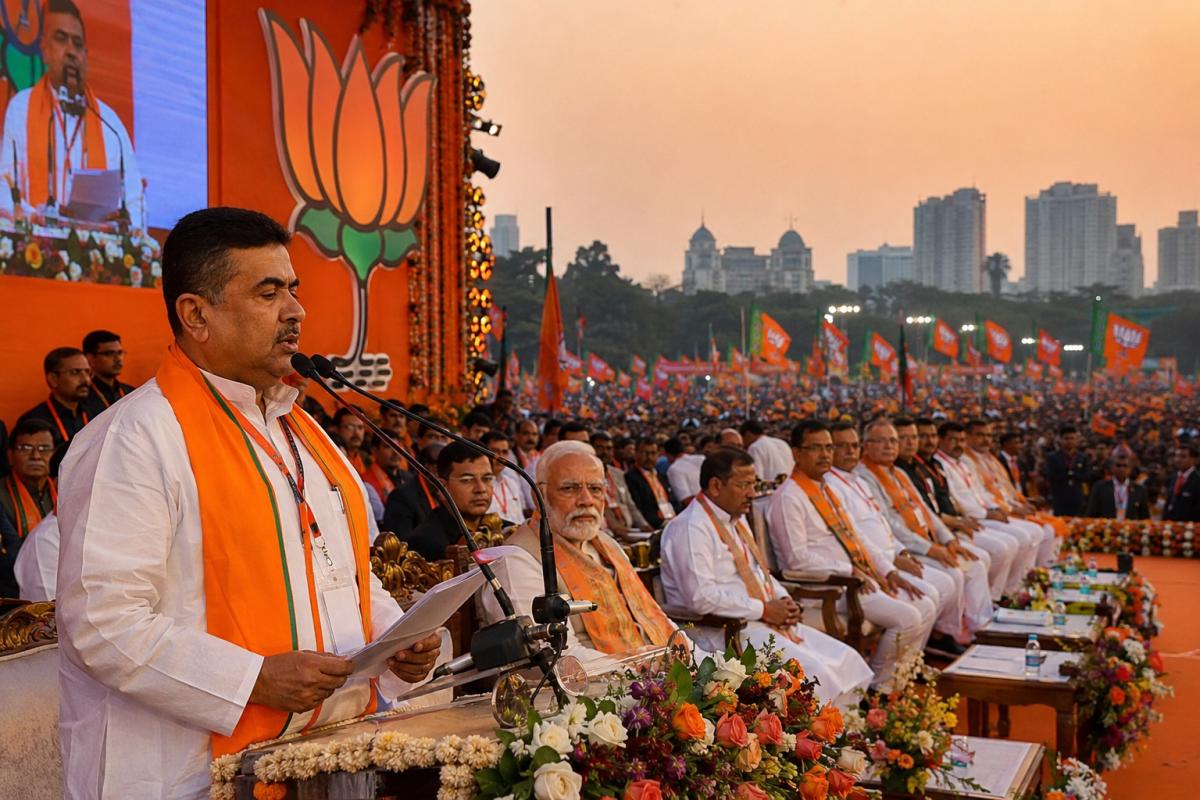

West Bengal witnessed one of the most dramatic political transformations in its modern history as Suvendu Adhikari took oath as the first-ever Bharatiya Janata Party (BJP) Chief Minister of the state. The swearing-in ceremony, held at Kolkata’s iconic Brigade Parade Ground, marked the end of more than 15 years of Trinamool Congress (TMC) rule and opened an entirely new chapter in Bengal politics.
The event was not merely a transfer of power. It symbolized a larger ideological and political shift in a state that had historically resisted the BJP’s rise for decades. For years, West Bengal remained one of the last major states where the BJP struggled to establish a strong electoral base. That narrative has now changed dramatically.
The oath-taking ceremony was attended by Prime Minister Narendra Modi, senior BJP leaders, National Democratic Alliance allies, and thousands of supporters from across the state. Massive crowds gathered to witness what BJP leaders described as a “historic victory of democratic change” in Bengal.
The Rise of Suvendu Adhikari
Suvendu Adhikari’s political journey has been one of the most fascinating stories in contemporary Indian politics. Once considered a close associate of Mamata Banerjee and an influential Trinamool Congress leader, Adhikari gradually emerged as one of the BJP’s strongest faces in West Bengal.
Born into a politically influential family from Purba Medinipur, Adhikari started his political career in the Congress before eventually joining the Trinamool Congress during its rise against the Left Front government. He became one of the architects of the anti-land acquisition movements in Nandigram and Singur, movements that played a crucial role in bringing Mamata Banerjee to power in 2011.
However, political differences and ideological conflicts eventually led to a dramatic split between Adhikari and the TMC leadership. His decision to join the BJP before the 2021 elections changed Bengal’s political equation significantly.
In the 2021 Assembly elections, Suvendu Adhikari defeated Mamata Banerjee in the high-profile Nandigram contest, instantly becoming the BJP’s most prominent leader in the state. Since then, he steadily strengthened his political position and expanded BJP’s organizational network across Bengal.
The 2026 West Bengal Election: A Turning Point
The 2026 West Bengal Assembly election will likely be remembered as one of the most significant elections in the state’s political history. BJP secured a commanding majority in the 294-member assembly, reportedly crossing the 200-seat mark and ending the Trinamool Congress’s long dominance.
For years, political observers believed Bengal’s political culture and identity politics made it difficult for the BJP to capture power in the state. Yet the 2026 result proved that the political landscape of Bengal was changing rapidly.
Several factors contributed to the BJP’s victory:
- Strong anti-incumbency sentiment against the TMC government
- Growing BJP organizational structure across districts
- Polarized voting patterns
- Aggressive campaigning by Prime Minister Narendra Modi and Amit Shah
- Suvendu Adhikari’s influence in rural Bengal
- Promises related to governance, employment, and law and order
- Expansion of BJP support among younger voters
The election result also reflected a broader national trend where BJP has continued expanding into regions previously considered politically difficult for the party.
The Swearing-In Ceremony at Brigade Parade Ground
The swearing-in ceremony itself became a grand political spectacle. Brigade Parade Ground, often associated with mass political rallies in Bengal, was transformed into a celebration venue for BJP supporters.
Thousands of party workers carrying saffron flags gathered from various districts. Chants supporting Prime Minister Narendra Modi and Suvendu Adhikari echoed across the venue as leaders arrived for the ceremony.
Prime Minister Narendra Modi’s presence at the event highlighted the national significance of BJP’s Bengal victory. Several NDA chief ministers and senior party leaders also attended the ceremony.
Political analysts described the event as more than a state-level oath-taking ceremony. It was projected as a symbolic moment representing BJP’s successful expansion into eastern India.
Cabinet Ministers Sworn In Alongside Adhikari
Along with Suvendu Adhikari, several BJP leaders also took oath as cabinet ministers in the new Bengal government.
| Minister | Position | Political Significance |
|---|---|---|
| Dilip Ghosh | Cabinet Minister | One of BJP’s earliest major faces in Bengal |
| Agnimitra Paul | Cabinet Minister | Prominent BJP woman leader from Asansol |
| Nisith Pramanik | Cabinet Minister | Strong organizational presence in North Bengal |
| Ashok Kirtania | Cabinet Minister | Represents BJP’s expansion in border regions |
| Kshudiram Tudu | Cabinet Minister | Important tribal representation in cabinet |
The initial cabinet was relatively small, but BJP leaders indicated that further expansion would happen later. The composition of the cabinet suggested an attempt to balance regional representation, caste equations, and organizational loyalty.
Why This Victory Matters Nationally
West Bengal has historically been politically unique. For decades, the state was dominated first by the Left Front and later by the Trinamool Congress. BJP’s victory therefore carries significance far beyond state politics.
The win strengthens BJP’s position in eastern India and further consolidates its national political influence. Political experts believe the Bengal victory could reshape the national opposition landscape before the next Lok Sabha elections.
For Prime Minister Narendra Modi and BJP leadership, winning Bengal had long been a major political goal. The state was often viewed as one of the final frontiers for the party’s expansion.
“People’s power has prevailed and BJP’s politics of good governance has triumphed.”
This statement by Prime Minister Narendra Modi after the election result reflected the importance BJP attached to this victory.
The Fall of Trinamool Congress Dominance
The defeat of the Trinamool Congress marks the end of a major political era in West Bengal. Mamata Banerjee, who came to power in 2011 by ending 34 years of Left Front rule, had built a powerful political machinery over the last decade and a half.
Her government introduced multiple welfare schemes, including:
- Lakshmir Bhandar
- Kanyashree
- Swasthya Sathi
- Duare Sarkar
- Sabooj Sathi
Despite these welfare programs, BJP managed to build a strong anti-incumbency wave across many regions of the state.
Political observers noted that issues like corruption allegations, political violence, unemployment, and governance concerns played an important role in voter behavior.
The election result also demonstrated that welfare politics alone may no longer guarantee electoral success if voters seek broader political change.
Challenges Before the New BJP Government
While the BJP’s victory is historic, governing West Bengal will not be easy. Suvendu Adhikari now faces enormous administrative, economic, and political challenges.
1. Restoring Law and Order
Law and order remains one of the biggest challenges in Bengal politics. Political clashes and allegations of violence have frequently dominated headlines over the years.
The BJP government will face immediate pressure to ensure stability and administrative neutrality.
2. Economic Growth and Industrialization
West Bengal has struggled to attract large-scale industrial investment compared to several other Indian states.
The new government is expected to focus heavily on:
- Industrial expansion
- Infrastructure projects
- Job creation
- Investment-friendly policies
- Technology sector growth
3. Managing Political Polarization
The 2026 election revealed increasing religious and political polarization in Bengal politics. Several reports suggested clear voting divisions among communities during the elections.
The new government will need to maintain social harmony and ensure inclusive governance to avoid further divisions.
4. Administrative Transition
Reports emerged that several bureaucrats associated with the previous administration resigned from advisory positions following the BJP victory.
This indicates that the administrative transition may involve major restructuring within the state government.
5. Delivering Election Promises
Like every newly elected government, BJP now faces the challenge of translating campaign promises into real governance outcomes.
Voters will expect visible improvements in:
- Employment opportunities
- Road and transport infrastructure
- Women’s safety
- Education quality
- Healthcare accessibility
- Rural development
BJP’s Strategy in Bengal
The BJP’s rise in Bengal did not happen overnight. The party gradually expanded its organizational structure over the last decade.
Its strategy included:
- Building grassroots cadre networks
- Expanding influence in rural districts
- Focusing on Hindu identity politics
- Using central leadership aggressively in campaigns
- Strengthening booth-level management
- Targeting anti-incumbency sentiment
Suvendu Adhikari played a central role in this expansion because of his understanding of Bengal’s regional political dynamics.
Reaction Across India
The BJP victory in Bengal triggered strong political reactions across the country.
Supporters celebrated the result as a historic achievement and proof of BJP’s growing national dominance. Party workers described it as the “final breakthrough” in eastern India.
Opposition leaders, meanwhile, expressed concern about the shrinking political space for regional parties and the increasing centralization of political power.
International media outlets also covered the Bengal election extensively because of its broader implications for Indian national politics.
Impact on National Politics
The Bengal result is expected to significantly impact national political calculations ahead of future parliamentary elections.
Several analysts believe the BJP’s victory could:
- Further strengthen Narendra Modi’s leadership nationally
- Weaken opposition unity efforts
- Expand BJP’s influence in eastern India
- Change coalition politics across multiple states
- Increase BJP confidence ahead of 2029 Lok Sabha elections
At the same time, opposition parties may attempt to reorganize and create stronger alliances to counter BJP’s expanding dominance.
Suvendu Adhikari’s Leadership Style
Suvendu Adhikari is widely known as an aggressive grassroots politician with strong organizational skills. Unlike leaders dependent mainly on urban political narratives, Adhikari built much of his influence through direct engagement with district-level political workers and rural networks.
His supporters describe him as:
- Highly strategic
- Administratively sharp
- Strong at booth-level politics
- Capable of mass mobilization
- Politically resilient
Critics, however, argue that his politics can sometimes deepen polarization. As Chief Minister, he will now be judged not as an opposition leader but as the head of the government responsible for governance and stability.
Can BJP Sustain Its Bengal Momentum?
Winning an election and governing successfully are very different challenges. The BJP now faces the difficult task of converting electoral success into long-term political stability in Bengal.
Historically, Bengal politics has been highly dynamic. Public opinion can shift rapidly depending on governance performance.
The BJP government’s success will depend on:
- Administrative efficiency
- Economic performance
- Handling social tensions
- Maintaining party unity
- Delivering visible development
If the government performs effectively, BJP could establish itself as a long-term force in Bengal politics. If not, regional political forces may regain momentum in future elections.
A New Political Era for West Bengal
The swearing-in of Suvendu Adhikari as West Bengal’s first BJP Chief Minister marks a defining moment in the state’s political evolution.
For decades, Bengal politics revolved around ideological battles between the Left and regional parties. The BJP’s rise has fundamentally altered that political structure.
Whether this transformation becomes permanent or temporary will depend largely on how the new government performs over the next five years.
What remains undeniable is that Bengal politics has entered a completely new phase.
Conclusion
Suvendu Adhikari taking oath as the first BJP Chief Minister of West Bengal is more than just a routine political event. It represents a historic political realignment in one of India’s most politically significant states.
The BJP’s victory ended years of Trinamool Congress dominance and established the party as a major governing force in eastern India. For supporters, this moment symbolizes political change and a new development-oriented future. For critics, it raises important questions about polarization, opposition space, and the future direction of Bengal politics.
The coming years will determine whether the BJP government can successfully govern a state with deep political traditions, strong regional identity, and complex social dynamics. Suvendu Adhikari now carries the responsibility not only of leading a government but also of shaping the future political narrative of West Bengal.
Regardless of political opinion, May 9, 2026, will be remembered as one of the most historic dates in the political history of West Bengal.

Community Insights