
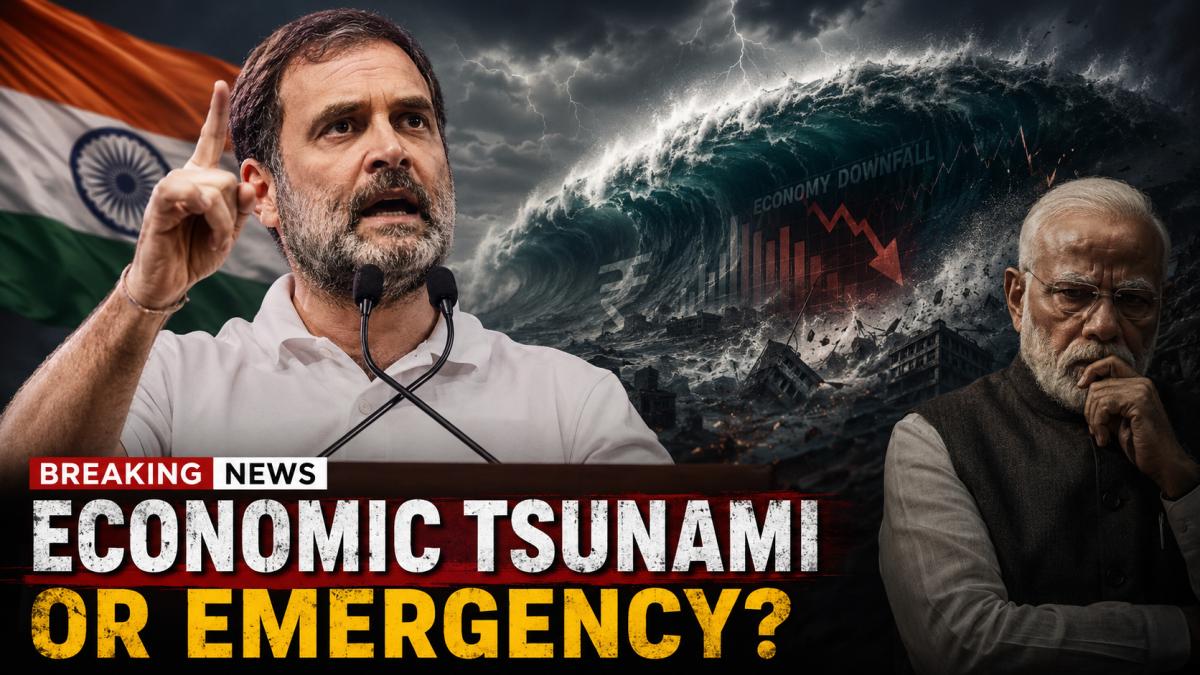

In the ever-volatile arena of Indian politics, few statements have sparked as much debate, anger, and introspection as the recent remarks by Leader of Opposition Rahul Gandhi. Addressing an All India Congress Committee event focused on tribal leaders, Gandhi dropped what many are calling a political bombshell: a dire warning of an impending "economic tsunami" that could either bring down the Narendra Modi government or force the imposition of Emergency-like measures.
This isn't just another opposition critique. It's a sweeping assessment of the current political and economic landscape, one that touches on institutional decay, public discontent, and the fragility of power. As someone who's followed Indian politics for years, I find myself both fascinated and concerned by the implications. Let's dive deep into what Rahul Gandhi actually said, the context surrounding it, the reactions it elicited, and what it might mean for India's future.
The Speech That Shook the Nation
On June 4, 2026, at the Indira Bhawan in New Delhi, Rahul Gandhi stood before tribal leaders and Congress workers. His tone was urgent, almost prophetic. He spoke not just as a politician but as someone claiming insider knowledge from various arms of the system.
"A terrible economic tsunami is coming now. The reason is that the protection system of India, which acted as a shock absorber from the international economy, has been removed by the BJP. Either the Modi government will fall, or Emergency will be imposed."
Gandhi went further, asserting that Prime Minister Narendra Modi would not remain in office for another year. He claimed that the once ironclad control Modi exercised over institutions — from the Election Commission to intelligence agencies and even the judiciary — is crumbling. "Insiders are now coming to me," he alleged, painting a picture of internal revolt.
This wasn't a casual remark. It was delivered with the conviction of someone who believes the ground is shifting beneath the ruling dispensation. For Congress supporters, it was a rallying cry. For the BJP, it was irresponsible fear-mongering at best and an attempt to destabilize the country at worst.
Breaking Down the Key Claims
- Economic Tsunami: Gandhi highlighted vulnerabilities like the rupee crossing 90 against the dollar, rising unemployment (around 5.2% in recent reports), and the risk of India's per capita GDP falling behind neighbors like Bangladesh.
- Institutional Revolt: He claimed cracks are appearing in key pillars of governance, with people from within the system leaking information to the opposition.
- Modi's Isolation: In a personal jab, Gandhi said Modi avoids eye contact in meetings, signaling discomfort and weakening authority.
- Emergency Warning: Perhaps the most controversial part — the suggestion that the government might resort to authoritarian measures to suppress public anger triggered by economic distress.
These points weren't pulled out of thin air. They build on Congress's long-standing narrative about crony capitalism, institutional erosion, and neglect of the common man under Modi rule.
Context: India's Economic Realities in 2026
To understand why Gandhi's words resonate (or provoke), we need to look at the broader economic picture. India remains one of the fastest-growing major economies, with projections of 7-7.5% GDP growth for FY26. Yet, beneath the headline numbers, there are worrying signs that opposition leaders love to amplify.
| Indicator | Current Status (2026) | Concern Raised by Rahul Gandhi |
|---|---|---|
| Rupee vs USD | Above 90 | Record lows exposing import dependence |
| Unemployment Rate | ~5.2% | Youth joblessness fueling discontent |
| Per Capita GDP | Risk of lagging Bangladesh | Failure of 'Viksit Bharat' narrative |
| Global Shocks | Middle East tensions | Removal of economic 'shock absorbers' |
The government, of course, paints a rosier picture. Recent data on E-way bills, manufacturing PMI, and services sector strength suggest resilience. BJP leaders point to schemes like ECLGS 5.0 for MSMEs and massive investments in coal gasification as proof of proactive governance.
Yet, for millions of ordinary Indians — farmers struggling with input costs, youth hunting for jobs, and middle-class families battling inflation — the ground reality feels different. Rahul Gandhi's "tsunami" metaphor captures that anxiety effectively.
Historical Parallels: Emergency in Indian Politics
Invoking "Emergency" is never light. It immediately takes us back to 1975, when Indira Gandhi imposed it amid political turmoil. That dark chapter saw suspension of civil liberties, press censorship, and forced sterilizations. Congress has spent decades living down that legacy.
By suggesting the Modi government might impose "something like Emergency," Rahul Gandhi is treading dangerous rhetorical ground. Is it a genuine warning or political hyperbole? Critics argue it's the latter — a desperate attempt by a dynastic party to regain relevance.
On the flip side, concerns about democratic backsliding, media control, and institutional autonomy have been raised by analysts across the spectrum for years. Whether those fears justify such stark language is debatable.
BJP's Sharp Counterattack
The ruling party didn't hold back. Senior leaders called Rahul's speech "classic fear-mongering" and accused him of selling panic. They reminded the public that the only Emergency in India's history was imposed by Congress under Indira Gandhi.
BJP spokesperson Amit Malviya and others highlighted India's economic fundamentals: strong PMI readings, infrastructure push, and digital economy growth. They contrasted it with the UPA era's policy paralysis, high inflation, and scams.
"Stop selling panic. India is not the vulnerable economy of 2013. We have strengthened safeguards, not removed them,"
said one prominent BJP voice. They also mocked Gandhi's claims of insider information, suggesting it's more wishful thinking than reality.
Political Implications: What Does This Mean for 2029?
With general elections still a few years away, Rahul Gandhi's statement is clearly aimed at shaping the narrative early. Congress has been on a comeback trail post-2024, gaining ground in states and positioning itself as the primary opposition voice.
By focusing on economic distress and institutional health, the party hopes to consolidate anti-BJP votes. Tribal outreach, in particular, signals an attempt to expand beyond traditional strongholds.
- For Congress: It energizes the cadre and gives Rahul a decisive, aggressive image.
- For BJP: It provides ammunition to portray opposition as negative and anti-national.
- For the Public: Heightened polarization, but also increased scrutiny on governance.
Analysts are divided. Some see this as Rahul finally finding his political voice after years of struggle. Others view it as another episode in the long saga of dynastic entitlement clashing with merit-based governance narratives.
The Role of Institutions in Modern India
Gandhi's emphasis on "institutional revolt" deserves separate attention. In a democracy, independent institutions are the bedrock. Allegations of compromised autonomy in the Election Commission, CBI, ED, and even higher judiciary have circulated for years.
Whether these are genuine cracks or perceived biases is hard to judge without concrete evidence. But the fact that a Leader of Opposition is receiving "tips" from insiders suggests deep divisions within the system. Or it could simply reflect normal bureaucratic discontent amplified for political gain.
One thing is clear: trust in institutions is eroding across the board. Restoring that trust — regardless of who is in power — should be a national priority.
Public Reaction and Social Media Storm
As expected, social media exploded. #RahulGandhiPrediction and #EconomicTsunami trended within hours. Supporters hailed him as a truth-teller, while critics called him out for spreading despair.
Memes, video clips, and heated debates flooded platforms. Some compared it to past opposition predictions that never materialized. Others pointed to real economic indicators validating the concerns.
Independent analysts urged caution. While economic challenges exist, labeling them a "tsunami" might be exaggeration. India's structural strengths — young population, digital infrastructure, and reform momentum — provide buffers that shouldn't be ignored.
Voices from Across the Spectrum
Journalists, economists, and political commentators weighed in:
- Pro-Congress voices praised the boldness and called for accountability on economic mismanagement.
- BJP allies dismissed it as election-year rhetoric designed to distract from Congress's internal issues.
- Neutral observers noted that both sides have valid points but urged data-driven debate over sensationalism.
This diversity of opinion reflects India's vibrant (if noisy) democracy.
Looking Ahead: Challenges and Opportunities
India stands at a crossroads. The next few years will test the resilience of our economy and democracy. Global headwinds — from geopolitical tensions to climate change impacts — add complexity.
If Rahul Gandhi is right, we could see significant political upheaval. If the BJP is correct, India will continue its growth trajectory, proving naysayers wrong once again.
Either way, the common citizen wants jobs, affordable prices, good governance, and respect for democratic norms. Grand predictions aside, delivering on these basics matters most.
Conclusion
Rahul Gandhi's prediction about the Modi government's potential fall or the imposition of Emergency-like measures has thrust Indian politics into yet another intense phase of confrontation. It highlights deep ideological divides, economic anxieties, and questions about institutional health that cannot be wished away.
Whether this proves to be prescient analysis or mere political posturing, only time will tell. As citizens, our role is to stay informed, demand accountability from all sides, and participate actively in shaping the nation's future. Democracy thrives not on fear but on informed debate and collective effort. Let's hope the coming months bring clarity rather than chaos, progress rather than division.

Community Insights