
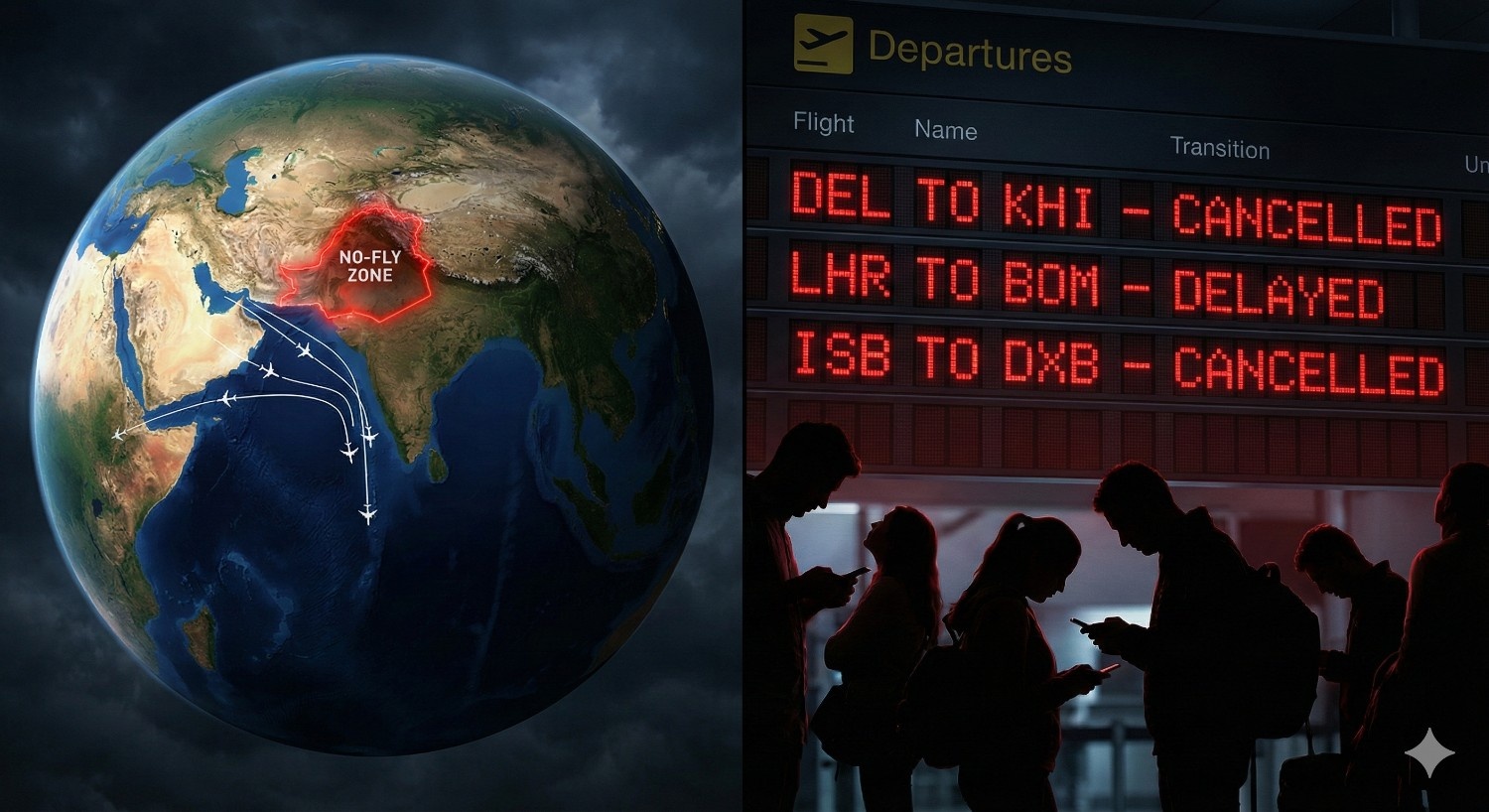

The aviation sector in South Asia is currently navigating one of its most challenging periods in recent history. As we move through January 2026, the industry is grappling with a "perfect storm" of geopolitical tensions, operational meltdowns, and infrastructure bottlenecks. The headline dominating the news is the continued closure of airspace between India and Pakistan, a diplomatic lever pulled in 2025 that has calcified into a long-term logistical nightmare. However, beyond the borders, domestic issues involving major carriers like IndiGo and infrastructure challenges in Mumbai and Delhi have compounded the stress on passengers and airlines alike.
This detailed analysis explores the current state of affairs, the heavy economic price being paid by airlines, and the legal frameworks that govern—or fail to govern—such international aviation disputes.
The Geopolitical Gridlock: Airspace as a Weapon
On 20 January 2026, the Pakistan Airports Authority (PAA) issued a Notice to Airmen (NOTAM) extending the ban on Indian-registered aircraft from using its airspace until 24 February 2026. This decision marks the continuation of a standoff that began in April 2025. To understand the gravity of this extension, one must look at the chain of events that precipitated it.
The crisis originated following a terror attack in Pahalgam in April 2025. In a significant retaliatory diplomatic manoeuvre, India suspended the Indus Waters Treaty, a longstanding water-sharing agreement. Pakistan responded by closing its airspace to Indian aircraft on 24 April 2025. The situation escalated rapidly in May 2025 with India’s "Operation Sindoor" and subsequent aerial engagements, leading to a brief but intense military confrontation. Although a ceasefire was brokered by the United States on 10 May 2025, the aviation sanctions have remained in place, becoming a tool of protracted diplomatic pressure.
The current ban is comprehensive. It applies to all aircraft owned, operated, or leased by Indian entities, including military flights, and covers the Flight Information Regions (FIRs) of both Karachi and Lahore. This effectively creates a massive "no-fly zone" for Indian carriers directly to the west, forcing them to take circuitous routes to reach Europe and North America.
Historical Precedence
This is not the first time the skies have been closed between the two neighbours. Aviation history in the subcontinent is littered with such disruptions. Following the 1971 hijacking of an Indian Airlines Fokker F-27, India banned Pakistani overflights, a dispute that eventually found its way to the International Civil Aviation Organisation (ICAO) Council and the International Court of Justice (ICJ). Similarly, airspace closures occurred during the 1999 Kargil conflict and following the 2019 Balakot airstrikes. However, the duration and economic intensity of the 2025-26 ban are proving to be particularly damaging due to the increased volume of modern air traffic.
The Economic Toll: A Heavy Price for Diverting
The closure of Pakistani airspace has fundamentally altered the economics of long-haul flying for Indian carriers, particularly Air India, which is the only Indian airline with a substantial wide-body fleet operating to the West.
Operational Nightmares for Air India
Before the ban, flights from Delhi to destinations like Chicago or San Francisco would utilise a northern route through Pakistani airspace, often accessing polar routes. Without this access, aircraft are forced to fly south to avoid Pakistan, skirting the Arabian Sea and Iranian airspace, or taking longer eastern routes.
The consequences are stark:
- Flight Duration: The re-routing has added between three to six hours to total trip times for flights to North America.
- Technical Stops: Routes that were previously non-stop now require refuelling halts. Air India has established Vienna and Copenhagen as primary refuelling hubs. For instance, the Delhi-Chicago flight, which previously covered about 12,500 kilometres, now travels nearly 15,000 kilometres, pushing total travel time over 19 hours.
- Financial Hemorrhage: The carrier estimates that the airspace closure impacts its profit before tax by approximately $455 million annually. Fuel costs alone have risen by as much as 29 per cent on affected routes.
The situation is so critical that Air India has reportedly lobbied the Indian government to engage with China, seeking permission to use sensitive military airspace in the Xinjiang region to shorten flight paths—a desperate measure highlighting the severity of the operational constraints.
Losses on the Other Side of the Border
It is not only Indian aviation that suffers. Aviation is a revenue generator for transit countries through overflight fees. Data from previous closures suggests that Pakistan loses a significant amount of revenue daily when Indian traffic is barred. Reports based on 2019 figures indicated losses of approximately $232,000 per day in overflight charges. In the current scenario, with the ban prolonged, the cumulative loss of foreign currency revenue for the Pakistan Civil Aviation Authority is substantial, though the political calculus in Islamabad seemingly outweighs these economic considerations.
Domestic Turbulence: The IndiGo Crisis
While international routes are squeezed by geopolitics, the domestic sector in India has faced its own meltdown, centred around the country’s largest carrier, IndiGo. In December 2025, the airline faced a massive operational collapse, cancelling over 4,000 flights in the first nine days of the month alone.
The Causes of the Meltdown
The crisis was not triggered by external factors like airspace bans, but rather internal management and regulatory shifts. The Directorate General of Civil Aviation (DGCA) had implemented stricter Flight Duty Time Limitation (FDTL) norms to combat pilot fatigue. IndiGo, operating on a "lean" staffing model with minimal crew buffers, found itself unable to cope with the new rest requirements. The result was a severe shortage of available pilots, leading to mass cancellations that left lakhs of passengers stranded.
Regulatory Backlash
The fallout has been severe. The Competition Commission of India (CCI) has launched a probe into the airline. With a domestic market share exceeding 60 per cent, IndiGo faces allegations of abusing its dominant position. Complainants have alleged that the airline engaged in "predatory" practices, such as cancelling flights and then offering tickets for later dates at significantly higher prices, essentially capitalising on the chaos it created.
Furthermore, a parliamentary panel has scrutinised the airline's management and the DGCA, labelling their responses to the crisis as "evasive and unconvincing." The situation highlights a critical vulnerability in the Indian aviation market: an over-reliance on a single dominant player, where operational failure in one company cascades into a nationwide transport paralysis.
Safety Scares and Infrastructure Bottlenecks
Amidst the financial and diplomatic chaos, safety and infrastructure issues remain a constant concern. January 2026 has seen incidents that remind us of the precarious nature of flight operations.
In a terrifying incident mid-January, an Air India Express flight (IX 398) from Jeddah to Kozhikode was forced to make an emergency landing at Kochi airport. The pilots detected a failure in the landing gear system mid-air. Given that Kozhikode is a "tabletop" airport—where the runway sits atop a plateau with deep gorges on either side—the risk of a landing mishap was considered too high. The flight diverted to Kochi, where it landed under full emergency protocols. Inspections later revealed that the aircraft’s tyres had burst, likely due to debris on the runway at Jeddah. The incident, while ending safely, underscores the high-stakes decisions pilots must make when infrastructure limitations (like tabletop runways) meet mechanical failure.
Meanwhile, infrastructure upgrades are causing their own disruptions. Mumbai Airport, the second busiest in the country, announced the suspension of freighter flights from August 2026 to May 2027 to re-carpet its main runway and rebuild the apron area. While necessary for long-term safety, this move threatens to weaken Mumbai’s position as a critical logistics hub and has drawn sharp criticism from cargo operators.
Furthermore, the persistent fog in North India during the winter months of 2025-26 has continued to wreak havoc. In late December 2025 alone, Delhi’s Indira Gandhi International Airport saw hundreds of flights delayed and dozens cancelled daily due to low visibility, overwhelming the terminals and testing the patience of travellers already wary of airline reliability.
The Legal Framework: Can International Law Help?
Given the severity of the India-Pakistan airspace dispute, one might ask: what is the role of international law in resolving this?
The primary governing document for international civil aviation is the Chicago Convention on International Civil Aviation (1944). Under this convention, the ICAO Council has the authority to act as a judicial organ in disputes between member states. Historically, both India and Pakistan have utilised these mechanisms. For instance, in the 1971 case regarding the suspension of overflights, India appealed to the ICJ regarding the jurisdiction of the ICAO Council.
However, the efficacy of these legal bodies is often limited by the principle of state sovereignty. While Article 84 of the Chicago Convention allows for dispute settlement, and the International Air Services Transit Agreement (IASTA) promotes the freedom of overflight, nations often cite "national emergency" or "security" (under Article 89) to justify airspace closures. As noted by legal experts, while the ICJ and ICAO provide a framework, they lack immediate enforcement power. The resolution of aviation disputes is frequently more political than judicial.
In the current scenario, while international law encourages the peaceful settlement of disputes and the freedom of air transit, the bilateral relationship has deteriorated to a point where legal obligations are being overshadowed by national security posturing. The ICJ’s contribution in past aviation cases—such as the Aerial Herbicide case or the Aerial Incident of 1999—demonstrates that while the Court can interpret the law, it relies on the consent and cooperation of states to effect change.
Conclusion: A Sector in Search of Stability
As we look ahead to the rest of 2026, the Indian aviation sector stands at a crossroads. The extension of the airspace ban by Pakistan until late February suggests that the geopolitical thaw required to normalise operations is not imminent. Airlines will continue to bleed cash on longer routes, a cost that will inevitably be passed down to the consumer in the form of higher fares.
Simultaneously, the domestic crisis involving IndiGo serves as a wake-up call regarding market dominance and the fragility of airline rostering systems. The intervention of the Competition Commission of India may lead to structural changes in how airlines are regulated, preventing a single carrier's operational failure from crippling the entire network.
For the passenger, the immediate future promises longer flight times, higher ticket prices, and the potential for delays due to both fog and infrastructure repairs. However, the resilience of the sector is notable. Despite wars, bans, and financial crises, the demand for air travel in the region continues to grow. The hope remains that diplomatic channels will eventually reopen the skies, and robust management will stabilise domestic carriers, allowing the focus to shift back to what matters most: safe, efficient, and affordable connectivity.


Community Insights