


In this comprehensive article, we dive deep into the Cisco Command-Line Interface (CLI), one of the most critical skill sets for anyone preparing for the CCNA 200-301 certification. The CLI is not just a part of certification — it represents the backbone of how networking professionals interact with routers and switches daily.
This guide covers everything from basics to practical commands, configuration examples, shortcuts, troubleshooting tips, and real world use-cases. Whether you’re a novice or need a refresher before your exam, this serves as your detailed Day 4 CCNA CLI training resource.
Why Learn the Cisco CLI?
Before diving into commands and examples, understanding why the CLI matters is essential:
- Industry Standard – Network devices from Cisco and many other vendors are configured using the CLI.
- Efficient and Powerful – Compared to GUIs, CLI offers granular control and scripting capabilities.
- Exam Relevance – CCNA 200-301 tests your ability to navigate and leverage the CLI effectively.
- Real-world Application – Network automation and troubleshooting still require strong CLI proficiency.
Understanding Cisco CLI Basics
The Cisco CLI is a text-based interface that accepts commands typed by a user. Unlike graphical tools, it operates over a terminal session and gives direct access to the device’s operating system — usually Cisco IOS (Internetwork Operating System).
When you connect (via console, SSH, or Telnet), the CLI presents you with prompts that change based on mode and context. Each mode in the Cisco CLI has a specific role and set of accessible commands.
Networking Modes in the CLI
| Mode | Prompt | Purpose |
|---|---|---|
| User EXEC | Router> | Basic monitoring (show commands) |
| Privileged EXEC | Router# | Advanced diagnostics and system commands |
| Global Configuration | Router(config)# | Configure system wide settings |
| Interface Configuration | Router(config-if)# | Configure interface parameters (IP, description) |
Each mode gives access to specific commands — and advancing between modes is a key skill. For example:
To enter Privileged EXEC from User EXEC, you typeenable. To enter Global Configuration from Privileged EXEC, you typeconfigure terminal.
CLI Navigation: Moving Between Modes
A major part of CLI fluency is moving between modes and understanding where you are. Cisco provides shortcuts that make this faster:
- Enter mode: Type the command and press Enter.
- Back out: Use
exitorend. - Cancel command entry: Use
Ctrl + C. - Command completion: Use
Tabor?to autocomplete or list options.
Getting Started: Hello World of Cisco CLI
Let’s start with a few essential commands you’ll use every day:
show version– Displays system software and hardware details.show running-config– Shows current configuration.show interfaces– Lists interface status and statistics.show ip interface brief– Compact interface IP view.
The show family of commands is crucial for real-time diagnostics and verification. As soon as you log in to a device, these commands help you assess status and health.
Command Structure and Syntax Rules
Cisco commands generally follow this structure:
command [options] [arguments]Square brackets mean optional. For example:
show ip interface briefHere, “ip” and “interface” refine the scope of the show command. Cisco CLI allows hierarchical commands that narrow down the output, reducing noise.
Configuring Interfaces: Putting Knowledge to Work
Let’s walk through a typical interface configuration — one of the most important tasks in CLI:
enable
configure terminal
interface GigabitEthernet0/1
description Connection to LAN
ip address 192.168.10.1 255.255.255.0
no shutdown
exit
end
write memory
Explanation:
enable– Enter Privileged EXEC mode.configure terminal– Enter Global Config mode.interface …– Choose the interface to configure.description– Add a label for documentation.ip address– Assign IP and subnet.no shutdown– Reactivates interface.write memory– Saves configuration to NVRAM.
CLI Best Practices for CCNA Learners
Developing strong CLI habits not only accelerates learning but also strengthens your exam performance and real-world abilities. Here are some proven tips:
- Practice on Emulators – Tools like Cisco Packet Tracer or GNS3 recreate environments for hands-on work.
- Use Notes and Cheat Sheets – Build your own summaries of frequently used commands.
- Memorize Essential Modes – Know exactly when to use each mode without hesitation.
- Use Tab Key – It completes commands and saves time.
- Use
?as a Friend – It lists available options and reduces errors.
Time-Saving CLI Shortcuts
Beyond basic commands, advanced navigation helps speed up configurations:
Ctrl + A– Move cursor to beginning of the line.Ctrl + E– Move cursor to end of the line.Up/Down Arrow– Scroll through command history.| include– Filter output (e.g.,show running-config | include ip).
Exam Tips for the CLI Section
The CCNA 200-301 exam does not just test your ability to memorise commands. It evaluates whether you can:
- Navigate quickly through modes and configurations.
- Identify errors and fix them using show/debug commands.
- Demonstrate understanding of network services and interface configurations.
Always approach CLI questions by asking yourself:
- “What mode am I in?”
- “What am I trying to accomplish — view, configure, or debug?”
- “What verification commands should I use afterwards?”
Common Mistakes & How to Avoid Them
Even seasoned learners make mistakes. Here’s how to avoid frequent pitfalls:
- Misplaced Commands – If a command fails, check that you are in the correct mode.
- No Commit – Forgetting
write memorywill lose config after reboot. - Syntax Errors – Use
?frequently to check valid syntax. - Neglecting Verification – Always confirm settings with
showcommands.
Real-World CLI Use Cases
Here are examples of how CLI skills apply beyond exams:
- Network Design – Configuring distribution and core network switches.
- Security – Implementing ACLs, Port Security, and VLAN segmentation.
- Remote Troubleshooting – Using SSH/Telnet for remote fixes.
- Automation – Integrating CLI commands in Python or scripts for scaling operations.
A Deep Dive Into CLI Troubleshooting Commands
Troubleshooting is one of the highest-level skills tested by the CCNA, and the CLI provides powerful tools:
| Command | Purpose |
|---|---|
show ip route |
Displays the routing table |
show ip arp |
Shows ARP entries |
debug ip packet |
Shows IP packet debug (use carefully) |
ping |
Tests reachability |
traceroute |
Traces path across network |
CLI for VLAN and Trunking
Virtual LANs are fundamental for segmented networks. Here’s an example CLI for VLAN setup:
enable
configure terminal
vlan 10
name SALES
exit
interface GigabitEthernet0/2
switchport mode access
switchport access vlan 10
end
write memory
This demonstrates how the CLI handles VLAN context and interface tagging — another topic CCNA often tests.
Best CLI Labs to Practice
Practice makes perfect. Here’s a structured lab progression:
- Basic Commands Practice – Learn
showand navigation commands. - Interface Configuration – Assign IP, activate, and verify.
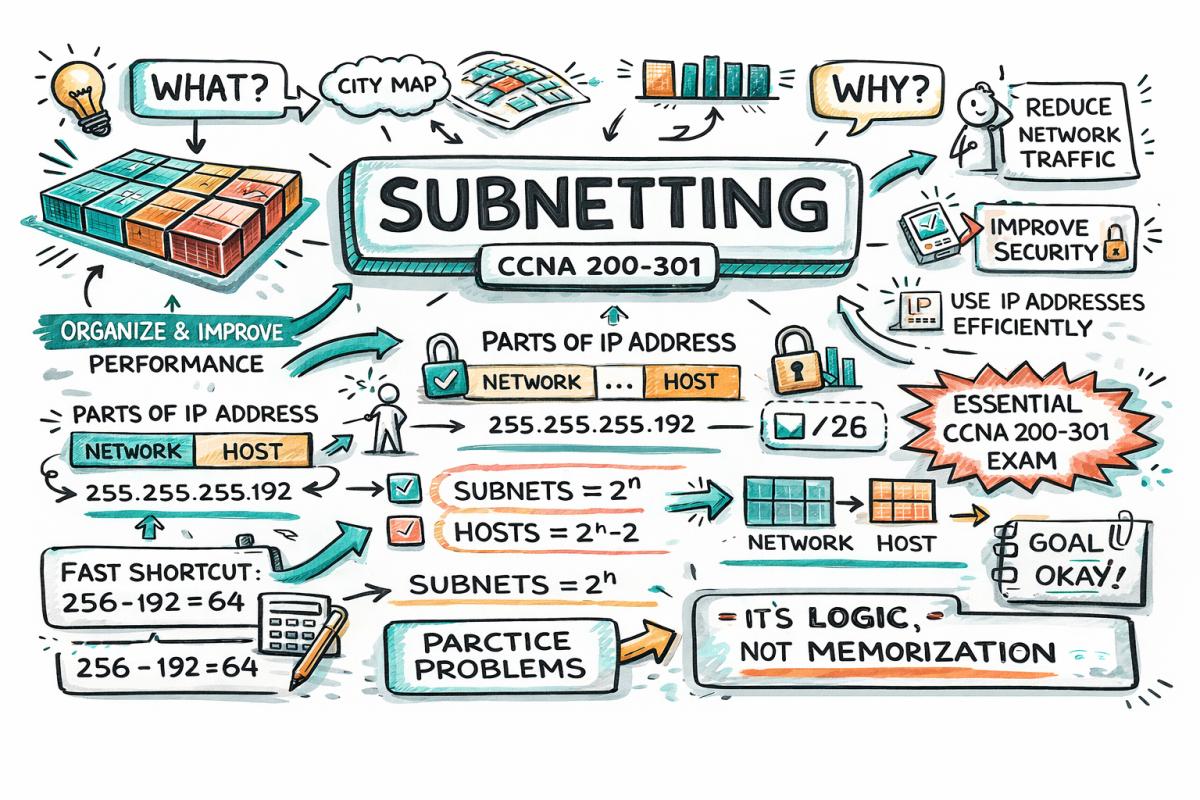
- Subnetting and IP Planning – Use CLI to assign IP schemes.
- Routing Protocols – Configure RIP/EIGRP/OSPF frameworks.
- Security Labs – Implement ACLs and secure access.
Conclusion
The Cisco Command-Line Interface is a cornerstone skill for anyone pursuing CCNA certification and networking careers. As this guide shows, learning the CLI is not just about memorising commands — it’s about understanding the structure, navigating modes with confidence, configuring devices accurately, troubleshooting intelligently, and applying knowledge in real network environments.
By mastering the CLI, you enhance your ability to perform complex tasks efficiently and prepare yourself for both the CCNA exam and real-world networking challenges. Use the examples, best practices, and lab suggestions in this article to build a strong foundation that will serve you throughout your IT career.

Community Insights