
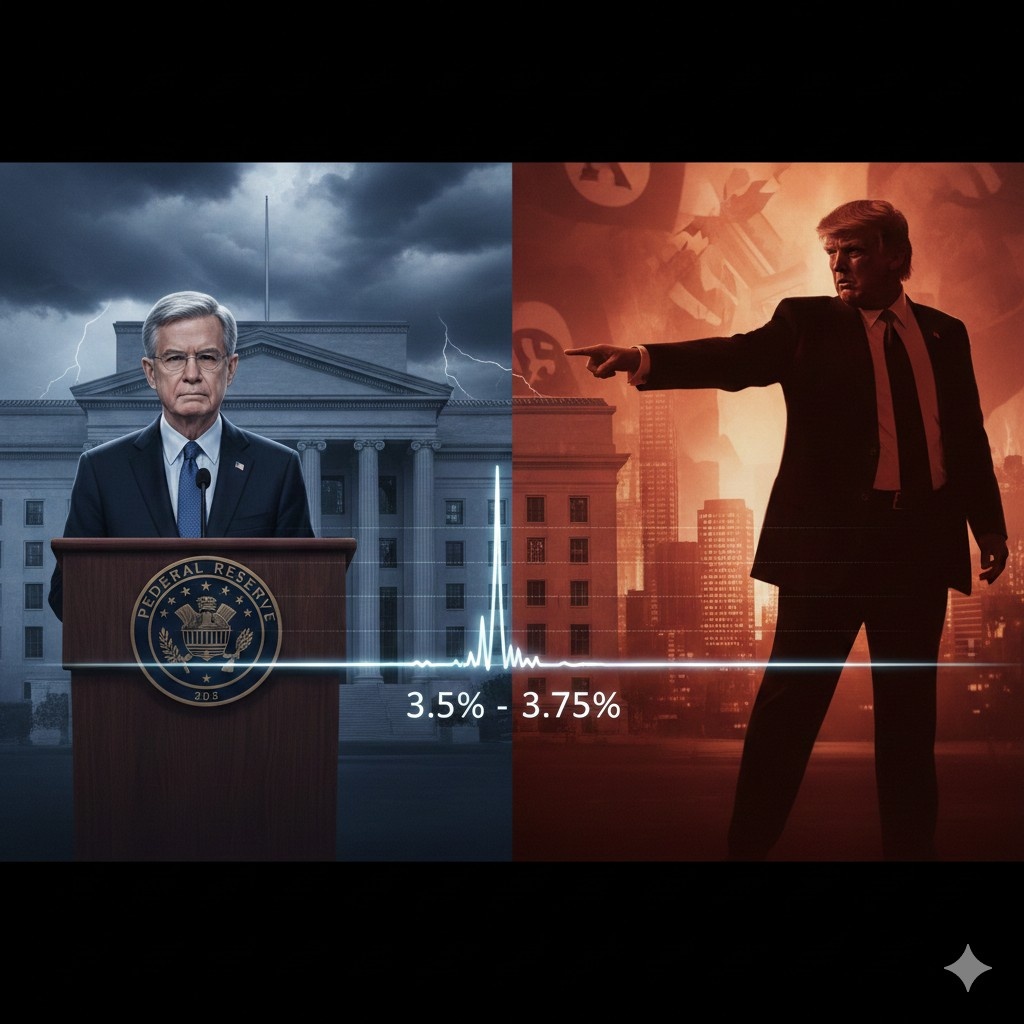

The Standoff: Fed Holds Rates Steady Amidst Political Firestorms and Economic Paradoxes
Date: 29 January 2026
Topic: Federal Reserve January FOMC Meeting Analysis
The first Federal Reserve meeting of 2026 has concluded, and while the decision to hold interest rates steady was widely anticipated by markets, the context surrounding the decision was anything but routine. On Wednesday, 28 January, the Federal Open Market Committee (FOMC) voted to maintain the federal funds rate at a target range of 3.5% to 3.75%.
However, the dry language of monetary policy barely conceals the high-stakes drama unfolding in Washington. From a rare double dissent within the committee to an unprecedented criminal investigation targeting the Fed Chair himself, this meeting marks a pivotal moment in the history of American central banking. As President Trump piles on pressure and the economy sends mixed signals regarding tariffs and employment, Jerome Powell finds himself navigating a treacherous path between economic stewardship and political survival.
In this deep dive, we will unpack the economic data driving the Fed’s "wait-and-see" approach, analyse the internal fractures appearing within the FOMC, and examine the intensifying battle over the institution's independence.
The Decision: A "Solid" Economy Pauses the Easing Cycle
Coming off a series of three rate cuts in the autumn of 2025, the Fed pressed the pause button this January. The official FOMC statement cited that economic activity has been expanding at a "solid pace," a notable upgrade from previous descriptions of "moderate" growth.
While the decision to hold rates was expected by a majority of analysts, it was not unanimous. In a 10-2 vote, Governors Stephen Miran and Christopher Waller broke ranks, voting instead for a 25-basis point cut. This dissent is significant. Governor Miran had been vocal about deeper cuts previously, but Governor Waller’s dissent came as a mild surprise to market watchers, as he had historically been viewed as more cautious regarding near-term cuts. Some observers speculate that Waller’s dovish pivot might be positioning him as a favourable candidate for the Fed Chair position, for which he is currently considered a contender.
The committee’s statement highlighted that while job gains remain low, the unemployment rate—currently at 4.4%—has shown signs of stabilisation. This nuanced view allowed the Fed to remove previous language stating that "downside risks to employment rose in recent months," signalling a slightly more hawkish or confident stance on the labour market than they held in December.
The Economic Logic: Tariffs, Inflation, and the Neutral Range
Why stop cutting rates now? The answer lies in a complex web of economic indicators that suggest the U.S. economy is neither overheating nor collapsing, but rather moving through a period of distortion caused by trade policy and labour supply shifts.
The Tariff Trouble
A central theme of Powell’s press conference was the impact of tariffs on inflation. The Fed acknowledged that inflation remains "somewhat elevated," with total PCE prices rising 2.9% and core PCE at 3.0% over the last year. Powell explicitly attributed much of this stickiness to the goods sector, which has been "boosted by the effects of tariffs" implemented by the Trump administration.
Powell’s economic argument is that this tariff-induced inflation is likely a "one-time price increase" rather than a persistent inflationary spiral. He noted that if one looks away from goods and focuses on services, there is "ongoing disinflation". The Fed’s working theory is that the tariff effects will peak and then wash out of the data by the middle of 2026, assuming no new major trade barriers are erected.
The Labour Market Puzzle
The labour market presents its own contradictions. The economy grew at a robust 4.4% annual rate in the third quarter of 2025. Despite this, job growth has slowed, with nonfarm payrolls declining at an average pace of 22,000 per month recently. Powell explained this divergence by pointing to supply-side constraints, specifically a decline in labour force growth due to lower immigration.
Market Reaction Summary
| Asset Class | Movement / Reaction | Key Note |
|---|---|---|
| Equities | S&P 500 dipped 0.01%; Nasdaq rose 0.17% | Mixed response to "wait-and-see" stance. |
| Treasury Yields | 10-year yield rose to 4.25% | Reflects slower anticipated rate cuts. |
| US Dollar | Remained largely steady | Supported by the refusal to cut rates immediately. |
The Political Firestorm: Subpoenas and Independence
While the economics of the meeting were complex, the political atmosphere was toxic. The January meeting took place under the shadow of an active criminal investigation into Chair Powell himself, initiated by the Department of Justice regarding testimony given concerning Fed headquarters renovations.
"Monetary policy can be used through an election cycle to affect the economy in a way that’s politically worthwhile... it would be hard to restore the credibility of the institution if that faith is lost." — Jerome Powell
Despite his reticence on legal details, Powell was vociferous in his defence of the Federal Reserve's institutional independence. In what observers called a remarkable defiance of presidential bullying, Powell warned that allowing monetary policy to be directed by political pressure would be disastrous for the British and American public alike.
Conclusion: The Eye of the Storm
The January 2026 FOMC meeting will be remembered less for the decision to hold rates and more for the extraordinary circumstances under which it took place. The Federal Reserve is currently operating under a siege mentality, defending its institutional prerogatives against an executive branch determined to bend monetary policy to its will.
- Rates are likely grounded: With growth solid and tariff-inflation sticky, the Fed is in no rush to cut.
- Independence is on the ballot: Legal cases will define the boundaries of central bank power.
- Regime change is imminent: Powell’s term ends in May, signalling a potential shift in policy direction.
As Powell noted, the economy is entering 2026 on "firm footing". Whether the governance of the Federal Reserve can say the same remains the year's biggest open question.



Community Insights