
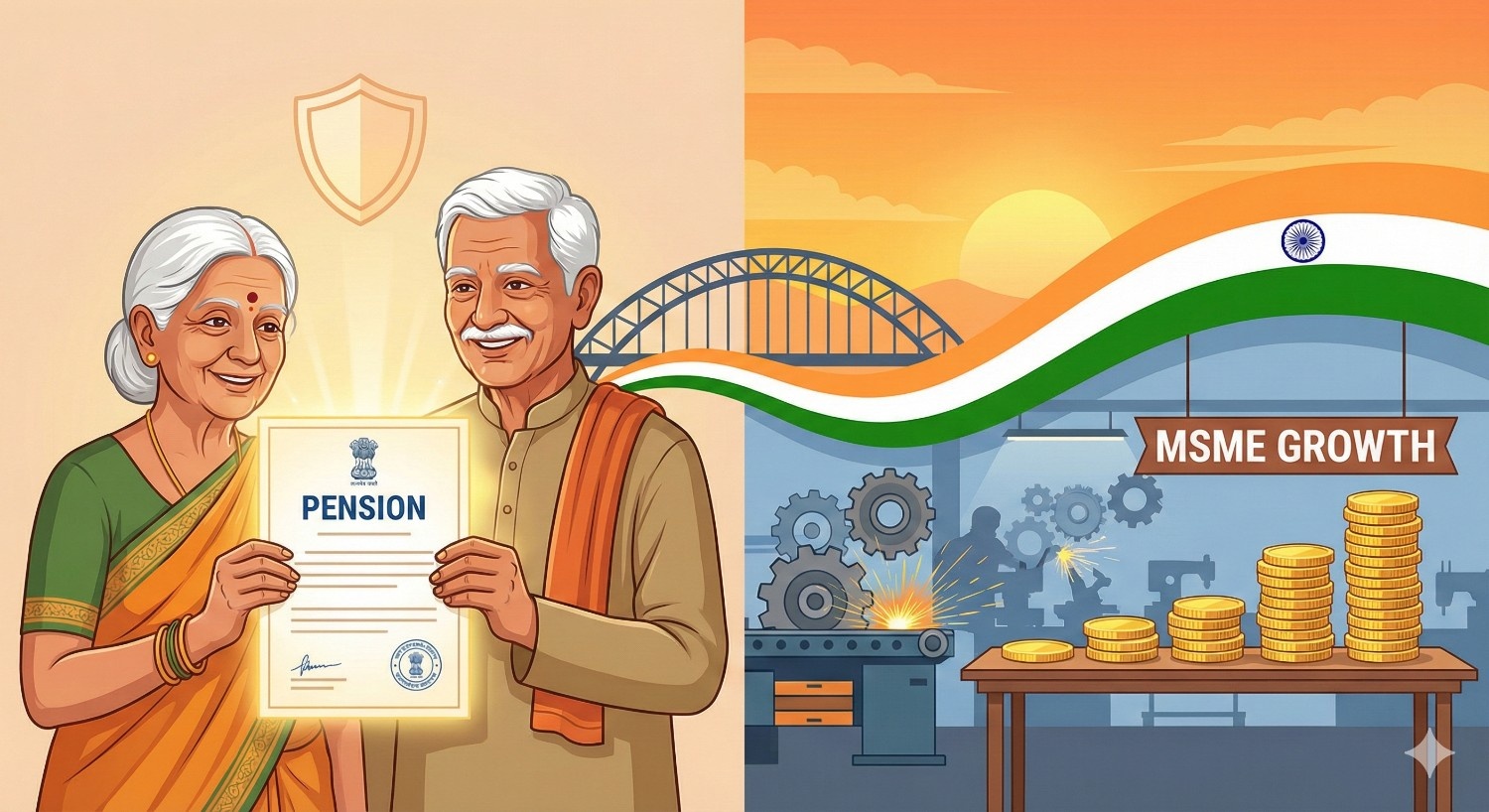

In a decisive move towards fortifying India’s social security framework and accelerating economic self-reliance, the Union Cabinet, chaired by Prime Minister Narendra Modi, has approved two landmark initiatives. On 21 January 2026, the Centre gave the green light for the continuation of the flagship Atal Pension Yojana (APY) until the financial year 2030–31 and approved a substantial equity infusion of ₹5,000 crore into the Small Industries Development Bank of India (SIDBI). These decisions mark a pivotal moment in the nation’s journey towards becoming Viksit Bharat (Developed India) by 2047, ensuring that growth remains inclusive for the unorganised workforce while providing the necessary capital fuel for the Micro, Small and Medium Enterprises (MSME) sector.
This detailed analysis explores the implications of these cabinet decisions, the mechanics of the scheme extensions, and the projected economic impact on the Indian landscape.
The Atal Pension Yojana: A Shield for the Unorganised Sector
India’s demographic trajectory suggests a significant rise in the elderly population in the coming decades. Addressing the longevity risks for the vast unorganised sector—which comprises the majority of the country's workforce—has been a priority for the government. The Cabinet’s approval to extend the Atal Pension Yojana beyond its initial timeline, now stretching to 2030–31, serves as a robust commitment to creating a 'pensioned society'.
Understanding the Extension and Government Support
The extension is not merely administrative; it comes with financial muscle. The Cabinet has cleared continued funding support for three critical areas:
- Gap Funding: This is perhaps the most critical component for the financial sustainability of the scheme. Gap funding ensures that if the actual returns on the pension corpus are lower than the assumed returns required to pay the guaranteed pension, the Union Government will bridge the deficit. This sovereign guarantee provides immense confidence to subscribers that their retirement benefits are secure, regardless of market volatility.
- Promotional and Developmental Activities: To ensure the scheme reaches the last mile, funds have been allocated for awareness campaigns and capacity building. This involves sensitising the target demographic through various media channels, training banking correspondents, and organising outreach programmes at the district and state levels.
- Incentive Structure: The funding supports the ecosystem of banks and post offices that act as the points of presence for enrolling subscribers.
The decision underscores the government's intent to keep the scheme financially viable while expanding its footprint. Since its launch on 9 May 2015, APY has successfully brought millions of informal workers into the fold of formal social security.
The Mechanics of Dignity: How APY Works
Targeted primarily at the poor, the underprivileged, and workers in the unorganised sector, the APY is a voluntary, periodic contribution-based pension system. It is administered by the Pension Fund Regulatory and Development Authority (PFRDA) under the architecture of the National Pension System (NPS).
The scheme offers a defined pension benefit. Subscribers are guaranteed a minimum monthly pension ranging from ₹1,000 to ₹5,000 after attaining the age of 60. The quantum of the pension depends on the contributions made, which in turn are determined by the age at which the subscriber joins the scheme. The minimum contribution period is 20 years. For instance, a subscriber joining at the age of 18 would pay a much lower monthly premium compared to someone joining at the age of 40 to secure the same pension amount.
Furthermore, the scheme provides a safety net for the family. In the unfortunate event of the subscriber’s death, the pension is payable to the spouse. Upon the death of both the subscriber and the spouse, the accumulated pension corpus is returned to the nominee. This triple-benefit structure—pension to self, pension to spouse, and corpus to nominee—has been instrumental in the scheme's widespread adoption.
A Surge in Adoption: The Numbers Speak
The extension comes against the backdrop of impressive enrolment figures, signalling a shift in the savings culture of rural and semi-urban India. As of 19 January 2026, the total number of subscribers under the Atal Pension Yojana has crossed the 8.66 crore mark. This represents a massive mobilisation of savings from a sector that was historically excluded from formal financial instruments.
Data indicates that Public Sector Banks (PSBs) have played a dominant role, accounting for approximately 70.44 per cent of total enrolments, followed by Regional Rural Banks (RRBs) at roughly 19.80 per cent. Private sector banks, small finance banks, and cooperative banks constitute the remainder.
A particularly encouraging trend is the increasing participation of women. Recent data highlights that women now comprise nearly 48 per cent of the total subscriber base, with a significant surge in enrolments in the current financial year. This reflects the success of targeted financial inclusion initiatives and the growing financial independence of women in rural households.
Empowering the Engine of Growth: Equity Infusion in SIDBI
While the APY extension secures the future of the workforce, the Cabinet’s second major decision aims to secure the present and future of the industries that employ them. The approval of a ₹5,000 crore equity infusion into the Small Industries Development Bank of India (SIDBI) is a strategic intervention designed to boost credit flow to the MSME sector.
Strategic Capital Injection
The infusion will be carried out in tranches over three financial years:
- ₹3,000 crore in FY 2025–26.
- ₹1,000 crore in FY 2026–27.
- ₹1,000 crore in FY 2027–28.
This capital support serves a technical but vital purpose. As SIDBI expands its lending portfolio, particularly through directed credit and new digital lending products, its risk-weighted assets increase. To maintain a healthy Capital to Risk-weighted Assets Ratio (CRAR)—a key indicator of a bank's financial stability and ability to absorb losses—additional equity capital is essential. Maintaining a high CRAR allows SIDBI to retain a favourable credit rating, which in turn enables it to raise funds from the market at competitive rates. These lower borrowing costs can then be passed on to MSMEs in the form of affordable loans.
Impact on MSMEs and Employment
Micro, Small and Medium Enterprises are often referred to as the backbone of the Indian economy, contributing significantly to GDP and exports. However, access to timely and affordable credit has remained a perennial challenge. The equity infusion aims to address this credit gap aggressively.
Following this capital boost, SIDBI is expected to significantly scale up its operations. The number of MSMEs receiving financial assistance from the bank is projected to rise from 7.62 million at the end of FY 2024–25 to approximately 10.2 million by FY 2027–28. This translates to roughly 2.57 million new beneficiaries gaining access to formal credit channels.
The ripple effect on employment is expected to be substantial. Using Ministry of MSME data which estimates an average of 4.37 employees per enterprise, the additional lending facilitated by this equity infusion is estimated to support employment for around 11.2 million people by the end of FY 2028. This aligns perfectly with the government's broader agenda of job creation and industrial growth.
Digitalisation and Direct Credit
The fresh capital will also support SIDBI’s pivot towards digital and direct lending. The institution has been developing digitally enabled, collateral-free credit products aimed at reducing the turnaround time for loan sanctions. By strengthening its balance sheet, SIDBI can accelerate the rollout of these products, ensuring that small businesses do not have to rely on informal money lenders or face hurdles in accessing working capital.
Moreover, the infusion supports SIDBI’s venture debt operations for startups, further catalysing the innovation ecosystem in the country. This holistic approach ensures that support is available across the spectrum—from traditional manufacturing units to new-age tech startups.
Synthesising Social Security and Economic Resilience
The simultaneous approval of the APY extension and the SIDBI equity infusion paints a picture of a government balancing welfare with development. On one hand, the state is acting as a guarantor of social security for the vulnerable; on the other, it is acting as an enabler for enterprise.
Towards a Pensioned Society
The concept of a "pensioned society" is central to the transition from a developing to a developed economy. In many developed nations, universal social security coverage ensures that the elderly do not fall into poverty. By extending APY, India is addressing the historical anomaly where only government employees and the organised corporate workforce had access to retirement benefits.
The APY complements other initiatives like the Pradhan Mantri Shram Yogi Maan-dhan (PM-SYM), creating a comprehensive safety net. However, challenges remain, particularly regarding the pension amount. While ₹5,000 is a significant sum for many rural households today, inflation may erode its value by the time a current 18-year-old retires. The government’s continued involvement suggests a flexibility to review and adapt the scheme dynamics as the economy evolves, but for now, the guarantee of a fixed income acts as a crucial financial anchor.
The MSME Multiplier Effect
Similarly, the strengthening of SIDBI is an acknowledgement that the banking sector alone cannot meet the nuanced needs of the MSME sector. Specialised development finance institutions like SIDBI are crucial for providing not just capital, but "patient capital" and developmental support.
By empowering SIDBI to lend more, the government is essentially stimulating the grassroots economy. MSMEs are labour-intensive; supporting them yields a higher employment multiplier than supporting capital-intensive large industries. Furthermore, as these enterprises grow, they integrate into global supply chains, boosting India’s export competitiveness—a key goal under the Make in India programme.
Conclusion
The Cabinet decisions of January 2026 are not isolated administrative approvals; they are strategic manoeuvres in the grand strategy of nation-building. The extension of the Atal Pension Yojana until 2031 ensures that the promise of a dignified old age is kept for millions of hard-working Indians in the unorganised sector. It reinforces trust in the social contract between the citizen and the state.
Simultaneously, the ₹5,000 crore infusion into SIDBI ensures that the wheels of industry keep turning, fuelled by adequate credit. By supporting the job creators (MSMEs) and protecting the workforce (through pensions), the Centre is fostering an economic environment that is both robust and humane. As India marches towards 2047, these twin pillars of social security and industrial credit will arguably form the foundation of a resilient, self-reliant, and developed nation.


Community Insights