
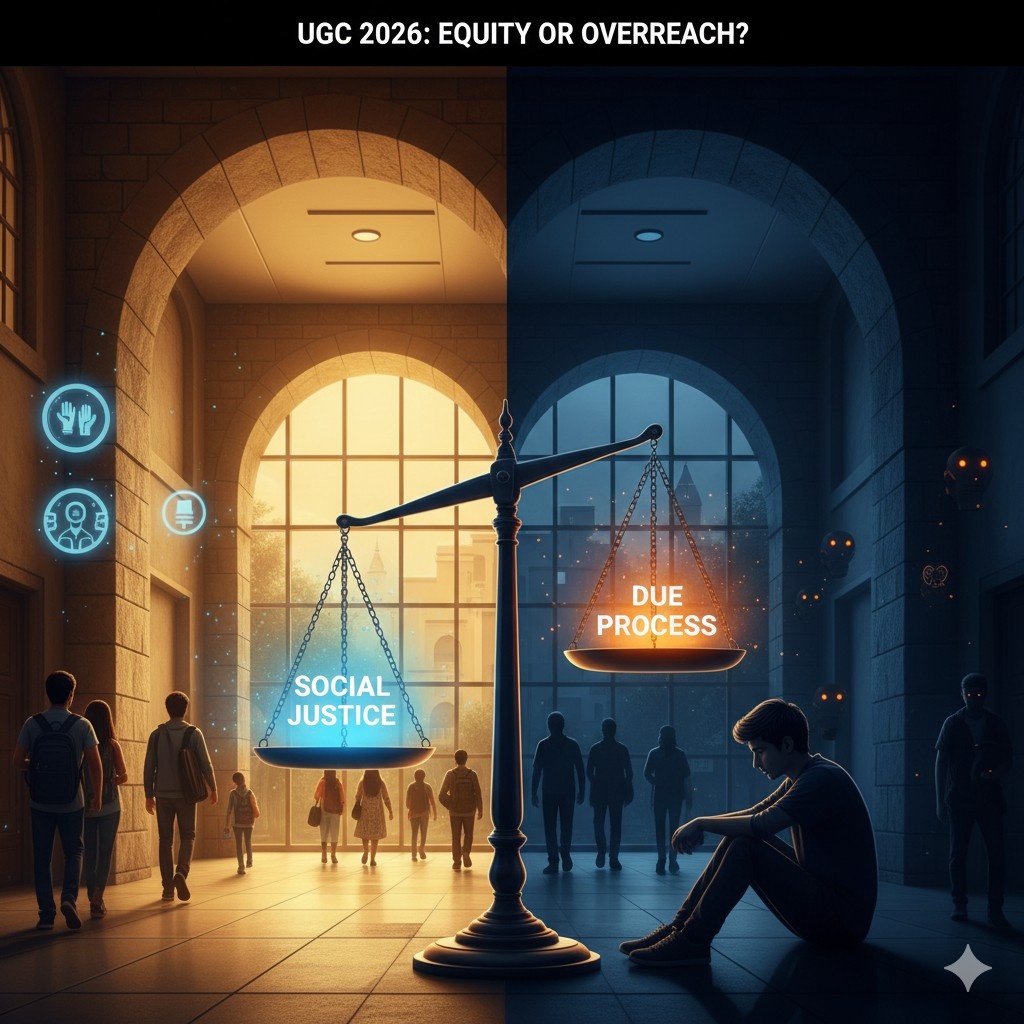

In the evolving landscape of Indian higher education, a significant debate has erupted regarding the balance between protecting marginalised students and ensuring a fair environment for all. The central question now facing the nation is whether admission and survival in the country's colleges and universities will be determined solely by hard work and capability, or if students must now live under the constant shadow of complaints and surveillance.
This question has become urgent following the introduction of new University Grants Commission (UGC) regulations, set to be implemented in January 2026. These rules have sparked a conversation that can no longer be ignored, presenting two contrasting visions of the future of Indian campuses. On one side, there is the vision of the Modi government and the UGC, which claims to be creating a discrimination-free and safe campus environment. Their logic is rooted in the belief that every student has the right to study with dignity. They argue that strict rules are necessary because, in the harsh reality of society, victims often fear complaining due to immense social pressure.
However, to alleviate this fear, the government has created a legal framework that has terrified another section of the student population. This group is now asking a poignant question: Has being ‘Savarna’ (General Category) become a crime for their very existence? They fear that the Prime Minister is constructing a legal enclosure against them where they may not even get the opportunity to prove their innocence.
The Context: Why New Rules Were Necessary
To understand the fear spreading across social media, one must first understand the regulations themselves. The UGC regulations were unveiled to come into effect on 13 January 2026. The government stated that these are being implemented under the New Education Policy to ensure equal opportunities for all in educational spaces.
Over the past few years, reports of discrimination within campuses have prompted the government to realise that the old regulations were insufficient. Consequently, the Modi government is making it mandatory for every college to establish specific centres and committees to address these issues. Under the new rules, if a student feels they have been subjected to inappropriate behaviour, they can lodge a complaint via an online portal or a helpline. The college is then mandated to conduct a full investigation within 15 to 30 days.
Broadly speaking, the government's intention appears clear: to create a system where students from backward classes do not feel insecure. However, it is under the guise of this intention that the general category is expressing deep anxiety.
The Removal of the 'Safety Shield'
The primary cause of the controversy lies in a specific change from the previous regulations. In the older rules from 2012, there was a provision stating that if an individual deliberately filed a false discrimination charge, the complainant would also face punishment. This acted as a safety shield to prevent the misuse of the law.
The profound fear among Savarna students stems from the fact that the 2026 regulations have removed this safety shield. Experts suggest the government likely did this to ensure that genuine victims are not afraid to report incidents, as the fear of counter-punishment often silences the truth. However, general category students fear that if a complainant knows they face no consequences even if their lie is caught, the law could be weaponised against them.
The concern is that without a check-and-balance mechanism in the law, the potential for misuse remains high. Savarna students are asking if their identity has become their greatest vulnerability, fearing that these laws will be used to intimidate or frame them without consequence.
The 'Equity Squads': Protection or Espionage?
Another startling aspect of the new regulations is the deployment of "Equity Squads". The government views these squads as security teams that will monitor sensitive areas of the campus to provide safety to weaker sections. However, amongst the student body, this is frequently perceived as a form of espionage.
According to the UGC, these squads will roam the campus, monitoring hostels, canteens, and common seating areas. The fear among general category students is that due to vague terms like "indirect discrimination," their normal behaviour could be reported incorrectly.
This creates a stifling atmosphere. One can imagine a classroom scenario where a teacher thinks ten times before scolding a student for a lack of academic effort, fearing it might be misconstrued as an insult based on caste. There is a genuine worry that this will destroy the academic freedom where students and teachers converse openly; even joking amongst students could be jeopardised.
Institutional Pressure and Due Process
The regulations also place immense pressure on college administrations. The UGC has clearly stated that if a college fails to resolve complaints correctly, its funding will be halted, and its recognition could be cancelled.
The consequence of this administrative pressure is predictable. To save their chairs and funds, principals or management committees are likely to take strict action. When the reputation of the college is at stake, the administration may prioritise suppressing the matter or appeasing the complainant rather than delivering justice.
General category students fear that the government has not provided them with a strong platform to present their side. While the rules specify where to complain, they do not clarify how a falsely accused student can prove their innocence. With the management under pressure to solve cases within a tight timeframe, there is a fear that innocent students will be sacrificed to protect the institution, potentially allowing the real culprits to weaponise the system against others.
The Comparison with the SC/ST Act
Opponents of the new regulations frequently cite conviction rates to justify their fears. Recent reports indicate that the conviction rate under the SC/ST Act is between 34% and 42%. Savarna students argue that a large number of cases fail in court due to a lack of evidence or end in compromise. While this does not imply all cases are fake, it highlights that many cases proceed in the wrong direction within the legal process.
High-profile cases, such as that of Rohith Vemula, are cited as examples where, by the time police reports cleared individuals of blame years later, the careers and reputations of the students or professors involved had already been destroyed.
The burning question remains: if a general category student faces a false complaint and is proven innocent years later, who will compensate them for the loss? Because the accused is given no opportunity to counter-file, students fear a flood of cases filed with the knowledge that there are no repercussions for falsehoods.
Political and Social Ramifications
There is also an undeniable political dimension to this controversy. The Savarna voter base has traditionally been a strong pillar of the current government, expecting the administration to respect merit. Following these regulations, questions are arising in the minds of these voters about whether the government is now operating solely under the pressure of electoral equations.
Despite the government's attempt to win trust through the 10% EWS (Economically Weaker Section) reservation, these new rules have sown seeds of doubt. Students feel that when committees are formed in colleges, there is no neutrality visible to hear the Savarna perspective. For a healthy society, every group must feel heard; when a student feels they have been labelled merely as an oppressor, they begin to break down mentally. This anxiety is reportedly driving meritorious students to consider leaving the country.
Suggestions for a Balanced Approach
Criticism alone is insufficient; to bridge the gap between equality and justice, concrete suggestions are required to protect the interests of both Savarna and marginalised groups.
| Proposal | Purpose | Benefit |
|---|---|---|
| Preliminary Inquiry | Conduct an initial check before major action is taken against the accused. | Ensures the complaint has merit before reputation damage occurs. |
| Independent Review Panels | Teams comprising retired judges or external experts. | Ensures decisions are made without internal college pressure or bias. |
| Neutral Committee Members | Inclusion of non-political, neutral members. | Guarantees decisions are based solely on truth rather than political affiliation. |
Conclusion: The Need for True Democracy
Ultimately, democracy is about the inclusion and development of all; creating fear in one group to alleviate the fear of another is not true democracy. Equality should not mean intimidating one section of society but taking everyone forward together.
While it is absolutely necessary to have strict rules to eradicate discrimination and ensure justice for genuine victims, justice must be equal for all. The UGC needs to introduce balance into these regulations so that no innocent person is framed without cause. The fear generated by these rules does not necessarily prove they are wrong, but it certainly indicates they need improvement.
If we speak of removing discrimination on one side while pushing another class into the shadows of fear, it is not justice, but injustice. The dream of a developed India will only be realised when every student, regardless of their background, can prove their mettle without discrimination and without fear.
Community Insights