

Introduction: A Republic Day Like No Other
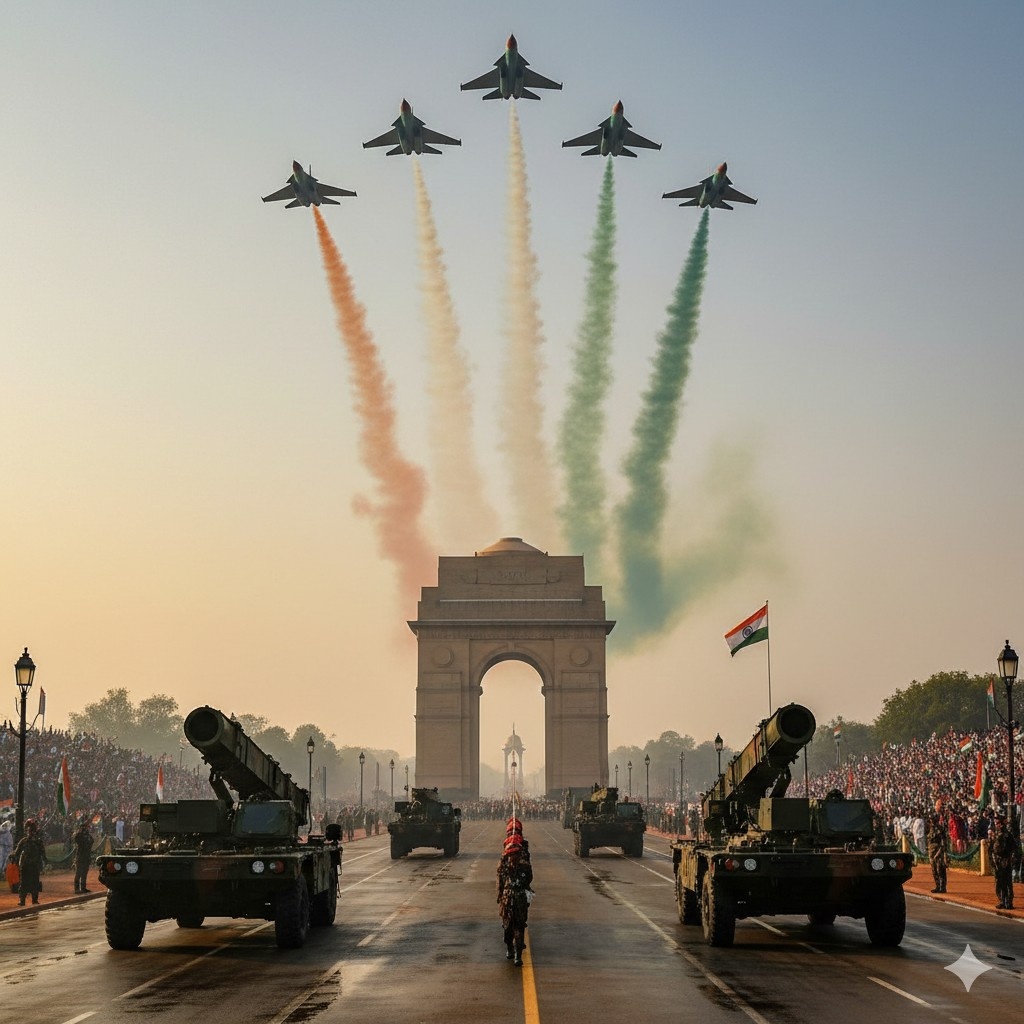
The morning of 26 January 2026 was not merely another date on the calendar for New Delhi. As the winter mist slowly receded from the Raisina Hills, revealing the grand expanse of the Kartavya Path, the atmosphere carried a weight and electricity distinct from previous years. The 77th Republic Day celebrations were poised to be a spectacle of tradition and pageantry, yet the undercurrent was undeniably martial. For the first time, the parade did not just display static assets; it told a cohesive story of a nation that had, only months prior, redrawn the red lines of South Asian geopolitics.
With the President of the European Council, António Costa, and the President of the European Commission, Ursula von der Leyen, seated alongside Prime Minister Narendra Modi and President Droupadi Murmu, the geopolitical signalling was potent. However, the true protagonist of the day was the narrative of "Operation Sindoor"—the decisive military campaign launched in May 2025 that had fundamentally altered the security calculus of the subcontinent. This year, the rhythmic crunch of boots and the roar of jet engines were not just ceremonial; they were the echoes of a victory that military historians are already calling a paradigm shift in modern aerial warfare.
The Catalyst: The Road to May 2025
To comprehend the magnitude of the displays at the 2026 parade, one must rewind to the volatile spring of 2025. In April of that year, a brutal terror attack in Pahalgam, Jammu and Kashmir, claimed the lives of 26 people. The incident, traced back to terror infrastructure across the border, sparked public outrage and demanded a response that went beyond diplomatic dossiers.
The Indian government’s answer was Operation Sindoor. Launched in the early hours of 7 May 2025, it was a tri-service campaign, though spearheaded by the Indian Air Force (IAF), designed to dismantle terror leadership and degrade the adversary’s ability to retaliate. Unlike the surgical strikes of the past, this was a sustained, four-day engagement that blurred the lines between sub-conventional retribution and conventional dominance. The operation targeted training camps in Bahawalpur, Muridke, and Muzaffarabad, but it quickly evolved into a high-stakes duel for air superiority.
The Sky as a Battlefield: Technology and Tactics
The most riveting chapter of Operation Sindoor, and consequently the highlight of the Republic Day flypast, was the technological duel that unfolded in the skies. A detailed assessment by a Switzerland-based military think tank, the Centre for Military History and Perspective Studies, later concluded that the IAF established "decisive air superiority" over large swathes of Pakistan, compelling Islamabad to seek a ceasefire within four days.
The conflict served as a real-world crucible for competing military technologies. It pitted Western and Russian systems operated by India against Chinese and American platforms used by Pakistan. The star of this aerial theatre was the Dassault Rafale. In the skies over the border, the Indian Rafales, armed with the Meteor Beyond Visual Range (BVR) missile, faced off against the Pakistan Air Force’s (PAF) J-10C fighters, equipped with the Chinese PL-15E missile.
For years, defence analysts had debated the paper statistics of these missiles. Operation Sindoor provided the kinetic evidence. The Meteor, with its ramjet propulsion, demonstrated a superior "no-escape zone," forcing Pakistani jets to remain on the defensive. Conversely, the conflict exposed critical limitations in the Chinese PL-15E. Post-conflict analysis of debris recovered in Hoshiarpur suggested that the seeker heads of the Chinese missiles were susceptible to the advanced electronic warfare suites of the Rafale, specifically the SPECTRA system. This revelation has reportedly sent shockwaves through the global arms market, casting doubt on the reliability of Chinese "anti-access/area denial" technologies when pitted against top-tier electronic countermeasures.
The Shield of Sudarshan
While the Rafales dominated the offensive, the defensive line was held by the S-400 Triumf system, operationally referred to as the "Sudarshan Chakra." Integrated with the indigenous Akash missile system through the Akashteer network, the S-400 effectively denied airspace to opposing forces. The Swiss study noted that Pakistan launched massive drone offensives, utilising over 600 units including Wing Loong and CH-4 UAVs, in an attempt to saturate Indian defences.
The result was a masterclass in layered air defence. The S-400 and Akash systems intercepted the vast majority of these threats. The integration was so effective that Indian forces could activate radars only briefly to engage targets, preventing the adversary from triangulating their positions. This failure to map India’s electronic order of battle was a critical factor in Pakistan's inability to mount effective counter-attacks.
The Parade: A Narrative of "Battle Array"
Reflecting these operational realities, the 77th Republic Day parade broke from the traditional format where contingents march in isolation. Instead, the 2026 parade featured a "Battle Array" format. This innovative approach simulated how military units move in actual combat scenarios, offering spectators a glimpse into the operational sequence of modern warfare: reconnaissance, followed by the strike element, and supported by logistics.
The "Sindoor Formation" was the pièce de résistance of the aerial display. As the roar of jet engines reverberated through the capital, a seven-aircraft formation pierced the sky. Comprising two Rafales, two MiG-29s, two Su-30 MKIs, and a Jaguar, the formation symbolised the "spearhead" of the IAF’s offensive capabilities. It was a visual representation of the strike packages that had breached enemy defences in May.
Adding to the realism, the parade showcased the very assets that had delivered victory. The "Prahar" formation featured the Advanced Light Helicopter (ALH) Rudra, which had provided close air support. The "Garud" formation followed, displaying the operational readiness of the special forces. For the first time, spectators saw the "Heron" and "Guardian" drones that had provided the persistent surveillance necessary for precision strikes.
Tableaux of Victory and Resilience
On the ground, the story was retold through vivid tableaux. The tri-services tableau, titled "Operation Sindoor: Victory Through Jointness," was a crowd favourite. It featured replicas of the major weapon systems that had defined the conflict, including the BrahMos supersonic cruise missiles—used for precision strikes against hardened command centres—and the S-400 launchers.
A particularly poignant display was the Veterans' Tableau, themed "Sangram se Rashtra Nirman Tak" (From Battle to Nation Building). The front of the tableau paid homage to past sacrifices, featuring models of the T-55 and Vijayant tanks, and aircraft such as the Hunter and MiG-21. This bridged the legacy of the 1965 and 1971 wars with the modern success of Operation Sindoor, reminding the nation that while technology evolves, the spirit of the soldier remains the bedrock of national security.
The Himachal Pradesh tableau also depicted scenes from Operation Sindoor, reflecting the state's pride in its brave hearts who serve in the armed forces. Furthermore, the Defence Research and Development Organisation (DRDO) showcased its latest innovations, including the Long Range Anti-Ship Hypersonic Missile (LR-AShM). This hypersonic glide missile, capable of engaging moving targets, signalled that India is not just mastering current technology but pioneering the next generation of warfare.
The War of Narratives: Fighting the "Deepfakes"
In the 21st century, warfare extends into the cognitive domain, and Operation Sindoor was no exception. The Republic Day celebrations also served as a subtle rebuttal to the information warfare unleashed against India. In the aftermath of the operation, a slew of disinformation campaigns had flooded social media platforms.
One prominent piece of disinformation involved a doctored, AI-generated video of former Army Chief General V.P. Malik. The deepfake falsely portrayed the General praising Pakistan’s military capabilities and admitting to Indian losses. The Press Information Bureau’s (PIB) Fact Check unit had to work overtime to debunk these claims, releasing the original footage where the General had, in fact, highlighted India’s technological superiority.
During the conflict, propaganda accounts had circulated images of downed aircraft, claiming they were Indian Rafales. Detailed open-source intelligence (OSINT) analysis later proved these to be recycled images from previous conflicts or totally unrelated incidents. The Swiss study corroborated India's position, noting that while Pakistan claimed to have shot down six Indian aircraft, visual evidence only supported the loss of one Rafale and one Mirage-2000, losses that the IAF absorbed while inflicting disproportionate damage on the enemy's infrastructure.
Strategic Implications: The View from the Dais
The presence of European leaders Antonio Costa and Ursula von der Leyen was strategic. The display of the Rafale (French) and the Meteor (European) dominating the skies was a testament to the success of the India-Europe defence partnership. It sent a message that European technology, when integrated with Indian professionalism and indigenous innovation, creates a formidable security architecture.
Moreover, the success of Operation Sindoor has likely influenced defence procurement decisions globally. The underperformance of the Chinese PL-15E missile and HQ-9 air defence system against Western and Russian equivalents used by India was noted by defence attachés worldwide. Reports suggest that nations like Indonesia, which were evaluating fighter jet options, pivoted firmly towards the Rafale after observing its performance in the South Asian theatre.
Vande Mataram: The Soul of the Republic
While military might was the centrepiece, the soul of the 77th Republic Day lay in its cultural theme: the 150th anniversary of "Vande Mataram." This national song, which fueled India’s freedom struggle, provided the overarching theme for the cultural performances.
Approximately 2,500 artists from across the country performed under the banner of "Vividata Mein Ekta" (Unity in Diversity). The fusion of classical, folk, and tribal dance forms, all set to the stirring notes of Vande Mataram, created a tapestry of Indian heritage. This cultural segment softened the hard edges of the military display, reminding the world that India’s strength lies not just in its missiles, but in its vibrant democracy and pluralistic society.
The "Nari Shakti" (Women's Power) theme was also prominent. For the first time, the IAF band included Agniveervayu women musicians, and women officers led several contingents. This inclusivity reflected the changing face of the Indian Armed Forces, where women are increasingly taking on combat and leadership roles—a transformation that was operationally visible during Operation Sindoor as well.
Honouring the Space Warrior
The ceremony also bridged the terrestrial and the extra-terrestrial. In a moment of immense pride, President Murmu conferred the Ashoka Chakra—India's highest peacetime gallantry award—upon Group Captain Shubhanshu Shukla. Group Captain Shukla had created history by becoming the first Indian to visit the International Space Station as part of the Axiom-4 mission. His 18-day odyssey, coming 41 years after Rakesh Sharma, symbolised India’s expanding horizons, from dominating the airspace during Operation Sindoor to exploring the final frontier.
Conclusion: A Developed India in the Making
The 77th Republic Day was more than a commemoration; it was a projection of India’s vision for 2047—a "Viksit Bharat" (Developed India). The parade showcased a nation that is self-reliant ("Aatmanirbhar") yet globally connected. The conclusion of negotiations for the India-EU Free Trade Agreement, announced around the time of the Republic Day, further cemented this partnership.
Prime Minister Modi, dressed in a multi-coloured Rajasthani-style turban, symbolised the vibrancy of the nation. His tribute at the National War Memorial before the parade was a sombre reminder of the cost of peace. As the Rafales vanished into the horizon at the end of the flypast, leaving a trail of thunder, the message was unambiguous.
India is no longer a passive observer in the global security dynamic. Through operations like Sindoor, it has demonstrated the political will and military capability to protect its sovereignty. The conflict proved that India has moved away from purely reactive measures to an assertive posture that blurs the lines between sub-conventional and conventional warfare.
In the annals of Indian military history, Operation Sindoor will likely be studied as a turning point where air power, jointmanship, and indigenous technology forced a swift cessation of hostilities. But in the collective memory of the public, it will be remembered through the lens of the 2026 Republic Day: the roar of the jets, the precision of the march, and the enduring melody of Vande Mataram echoing down the Kartavya Path. This was not just a parade; it was a statement of arrival.

Community Insights