
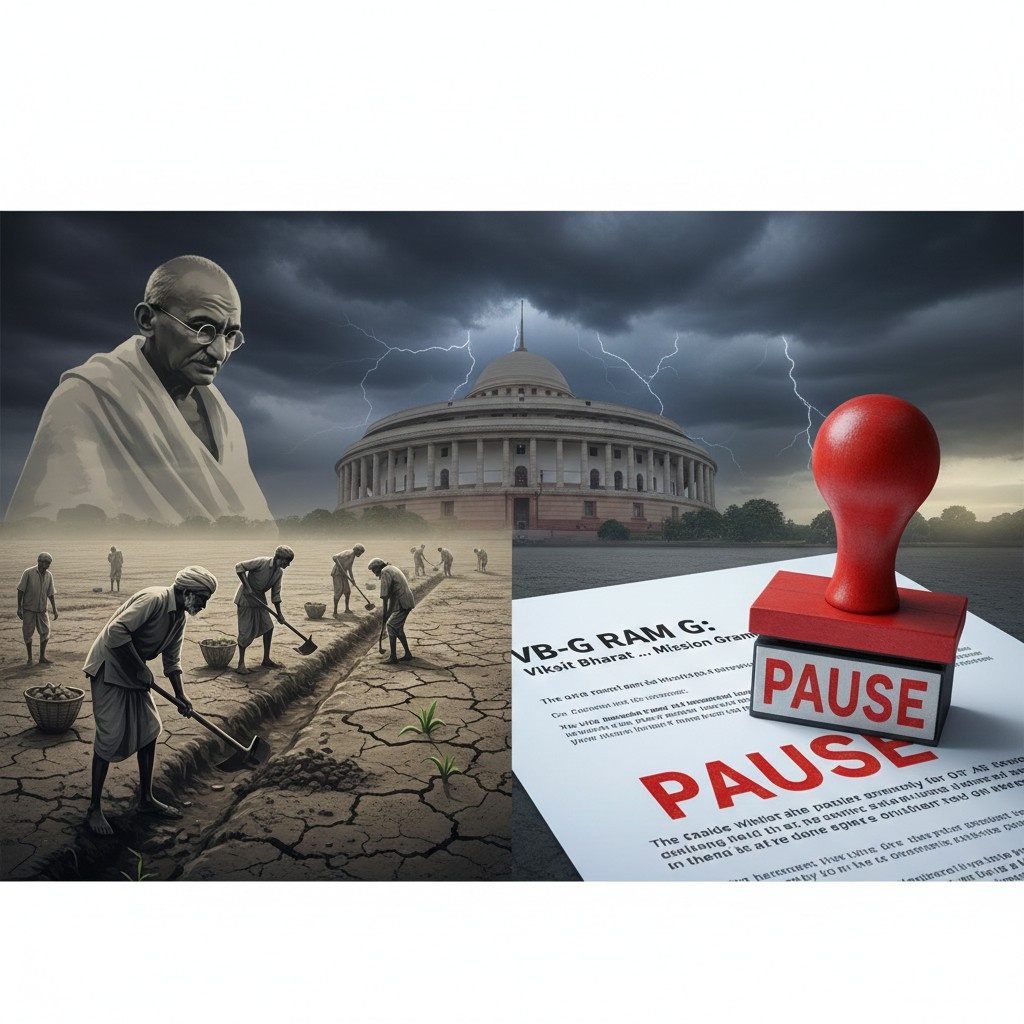

In a move that has sent shockwaves through the corridors of rural development and policy-making, the Indian Parliament recently gave its nod to a bill that fundamentally alters the landscape of social welfare in India. Without detailed discussion or noting objections, the government has replaced the UPA-era flagship program, the Mahatma Gandhi National Rural Employment Guarantee Act (MGNREGA), with a new entity: the Viksit Bharat Guarantee for Rozgar and Aajeevika Mission Gramin, or VB-G RAM G.
While the government touts this as a necessary modernisation aligned with its "Viksit Bharat" (Developed India) vision, critics and the opposition are calling it something far more sinister. Former Union Minister P. Chidambaram, who originally proposed the MGNREGA bill, has termed this move the "second assassination" of the Father of the Nation.
Part 1: The Legacy of a "Monument of Failure"
To understand the magnitude of this change, we must look back at why MGNREGA was created and how the current government’s relationship with it has evolved.
The Birth of a Right
In the early 2000s, India witnessed the fruits of privatisation and globalisation. However, this "Shining India" story had a dark underbelly. Rural India was not growing at the same pace. Agriculture suffered from "disguised unemployment"—where people were technically employed on paper but had zero productivity.
Against this backdrop, the Manmohan Singh government introduced the National Rural Employment Guarantee Act in 2005. It was a revolutionary shift. For the first time in the world, employment was treated not as charity, but as a legal right. The core premise was simple: if a rural household is willing to do manual labour, the government is legally bound to provide work within 15 days.
A Success Story Despite the Odds
The results of the original scheme were tangible across several sectors:
- Reduced Migration: Provided work where people lived, slowing the exodus to cities.
- Empowerment: Gave laborers bargaining power against private contractors.
- Inclusivity: Almost half of the workforce was comprised of women.
- Economic Shock Absorber: Acted as a safety net during the 2008 Global Financial Crisis and the 2020 COVID-19 pandemic.
Part 2: The Logic Behind VB-G RAM G
The new "Viksit Bharat Guarantee for Rozgar and Aajeevika Mission Gramin" (VB-G RAM G) is presented as a revamp. It promises to integrate rural employment with infrastructure creation, but the underlying changes tell a different story.
| Feature | Old (MGNREGA) | New (VB-G RAM G) |
|---|---|---|
| Guaranteed Days | 100 Days | 125 Days (Theoretical) |
| Implementation | Continuous / Demand-driven | "Seasonal Pause" possible for 60 days |
| Financial Model | Open-ended Central funding | Normative allocations / 60:40 ratio |
| Right to Work | Strict Legal Mandate | Central Discretion/Approval based |
Part 3: The "Seasonal Pause" – A Tool for Exploitation?
Perhaps the most controversial provision in the VB-G RAM G bill is the introduction of a "Seasonal Pause" button. The government can now legally pause the scheme for up to 60 days a year.
" By pausing the scheme during peak demand, the government effectively strips labourers of their leverage. Without the fallback option of government work, labourers will be forced to accept whatever rates contractors or landlords offer."
Part 4: Dismantling Federalism – Power to the Centre
The structural changes fundamentally alter the financial relationship between the Centre and the States:
- Centralised Power: The Central Government retains absolute discretion on where and when to implement the scheme.
- Shifted Liability: While the Centre holds the power, the bill mandates that if work is not provided, the State Government must pay the unemployment allowance.
- The 60:40 Trap: Once the allocated budget runs out, the entire excess burden falls on the State.
Part 5: Welfare vs. The "Freebie" Culture
This legislative overhaul brings us to a larger ideological question. The UPA approach was rights-based (The government owes you work). The current approach appears to favour populism over empowerment. By dismantling the right to work and replacing it with a scheme that can be paused at will, the narrative shifts from "Rights" to "Benevolence."
Conclusion
The renaming of the bill is symbolic of a larger agenda. By removing "Mahatma Gandhi" from the title, the government isn't just shortening an acronym; it is attempting to rebrand a legacy. The VB-G RAM G bill leaves rural India in a precarious position. The "Seasonal Pause" threatens to depress wages, while funding changes threaten to bankrupt States. MGNREGA was far from perfect, but the solution was to fix the implementation, not to dismantle the rights-based framework. As the "pause" button is hit on the survival of the poorest, the dream of a truly "Viksit Bharat" remains in question for those at the bottom of the pyramid.
Community Insights