
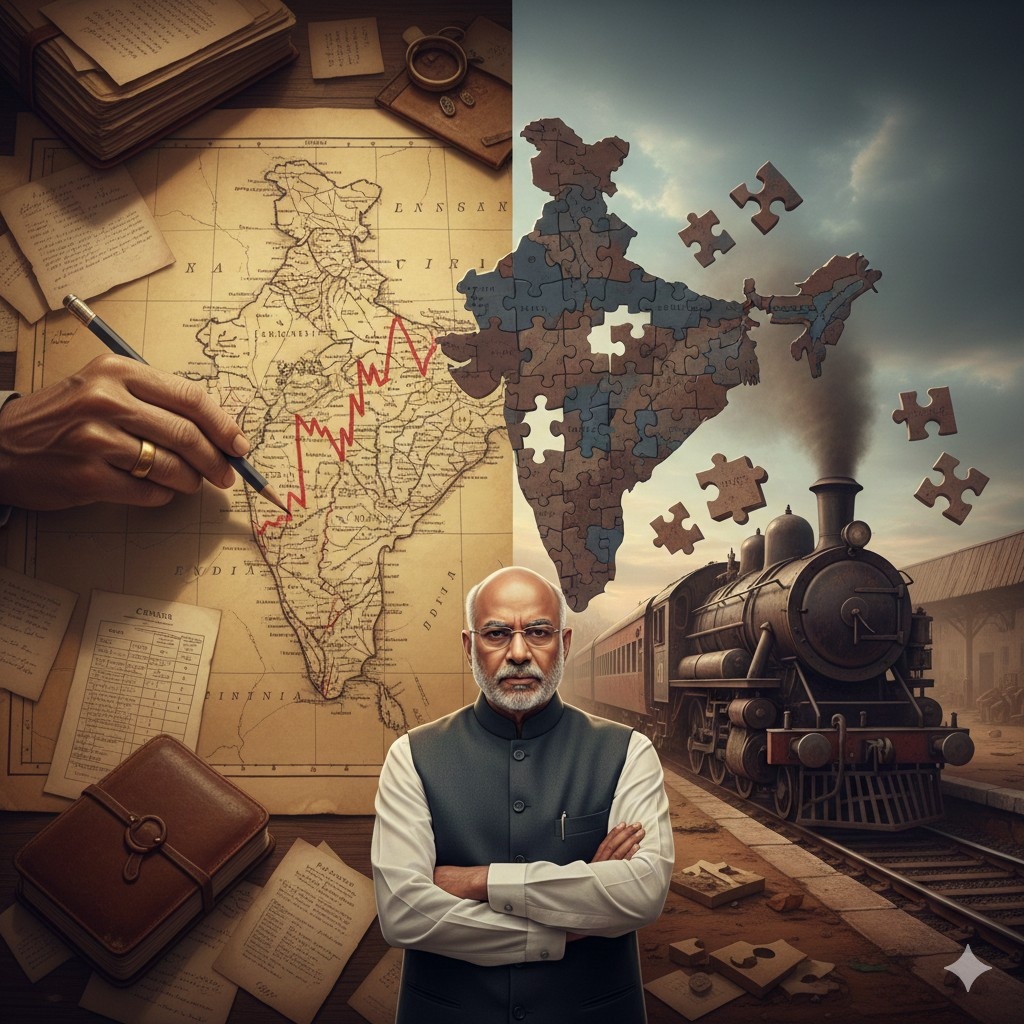
History is often remembered as a series of dates and treaties, but the reality of 1947 was far more chaotic, human, and tragic. In August of that fateful year, the destiny of millions was being decided not on a battlefield, but in a closed room in Delhi. There, a man sat with a pencil, drawing lines on a map. He had papers and population tables scattered before him, but what he lacked was perhaps the most crucial element: he had never seen the India he was about to divide.
This man was Sir Cyril Radcliffe. He did not know that the lines he was drawing would cause 20 million (2 crore) people to leave their homes. He did not know that hundreds of thousands would be killed because of the strokes of his pencil. In fact, until a few weeks prior, he had never even set foot in India.
In this deep dive into the history of 1947, we will explore the chaotic reality behind the border, the tragedy of the partition, the "ghost trains" of Punjab, the miracle of Calcutta, and the impossible feat of integrating 565 princely states into one nation.
Part I: The Man Who Drew the Line
The British government was in a hurry. By 1947, they realised they were sitting on a "ship filled with explosives, which was on fire". They wanted to exit India as quickly as possible. The task of drawing the border between the new nations of India and Pakistan required someone who was seen as completely neutral—someone who had no bias toward the Congress or the Muslim League.
They found Sir Cyril Radcliffe, a respected legal mind from London. He was chosen precisely because he had nothing to do with India. When Radcliffe arrived, he assumed he would have ample time to carefully adjudicate the division. Instead, Lord Louis Mountbatten, the last Viceroy, gave him a deadline that seems impossible in hindsight: August 15th.
"India is quite simple. All you've got to do is draw a line." — Lord Mountbatten to Radcliffe
Radcliffe was given four local advisors—two from Congress and two from the Muslim League—but they spent most of their time fighting with each other. The basis for the division was theoretically clear:
- Districts with a Muslim majority would go to Pakistan.
- Districts with a Hindu and Sikh majority would stay in India.
Part II: The Battle for Cities and Ducks
As the deadline approached, the logistical nightmare of partition extended far beyond land. Two major cities posed a significant problem: Calcutta and Lahore.
| City | Outcome | Reasoning |
|---|---|---|
| Calcutta | Awarded to India | High Hindu population and industrial importance. |
| Lahore | Awarded to Pakistan | To balance the loss of Calcutta, despite high Hindu/Sikh business ownership. |
The pettiness of the partition trickled down to the smallest assets. It wasn't just land; it was files, furniture, ceiling fans, and board pins. In one bizarre case, the government of Bengal had ordered 60 ducks from England. A dispute arose over whether they belonged to West or East Bengal, leading to the birds being left neglected in a warehouse.
Part III: The Sealed Envelope and the Ghost Trains
On August 13, 1947, Radcliffe submitted his report. Lord Mountbatten, fearing that the announcement would ruin the independence celebrations, took the report and locked it in a safe. He decided to keep the boundaries a secret until after August 15th.
This decision meant that on the morning of independence, millions of people did not know which country they were actually citizens of. When the boundaries were finally announced on August 17, chaos erupted. It triggered the largest migration in human history.
The violence was unspeakable. The most horrific symbol of this period was the "ghost trains." These were trains arriving at stations in Amritsar or Lahore filled with the corpses of refugees, often bearing taunting messages written on the carriages.
Part IV: The Miracle of Calcutta
While Punjab burned, the British feared Calcutta would be even worse. Mountbatten approached Mahatma Gandhi to be his "One-Man Boundary Force."
Gandhi arrived in Calcutta on August 13 and stayed in Hyderi House with Huseyn Shaheed Suhrawardy. When violence erupted in late August, Gandhi announced a fast unto death. The impact was immediate:
- His health deteriorated rapidly over 73 hours.
- The atmosphere of the city shifted from rage to concern.
- Riots stopped as former combatants surrendered their weapons at his feet.
Part V: The Swiss Cheese Map
While the partition was a tragedy, another crisis loomed: the 565 Princely States. Legally, these states could choose to join India, Pakistan, or remain independent. If they chose independence, India would have looked like "Swiss cheese," riddled with holes.
The task of unification fell to Sardar Vallabhbhai Patel and V.P. Menon. They used a "basket of apples" strategy to convince the princes to sign the Instrument of Accession.
Part VI: Pistols, Dogs, and Invaders
1. The Pistol at the Head (Jodhpur)
The Maharaja of Jodhpur nearly joined Pakistan. When confronted by V.P. Menon and Mountbatten, he signed the papers but then pulled a mini-pistol on Menon, threatening him before Mountbatten intervened.
2. The Dog-Lover of Junagadh
The Nawab of Junagadh, who famously owned 2,000 dogs, acceded to Pakistan despite his state being surrounded by India. When Indian forces surrounded the state, he fled to Karachi by plane—reportedly packing his favourite dogs instead of his wives.
3. The Tragedy of Kashmir
Maharaja Hari Singh wanted independence. However, after an invasion by Pakistani-backed tribal warriors in October 1947, he sought India's help. India required him to sign the Instrument of Accession on October 26 before sending troops to secure Srinagar.
Conclusion
The map of India as we know it was not inevitable. It was forged through blood, diplomacy, and the iron will of leaders like Sardar Patel, V.P. Menon, and Nehru. Looking back, the reality of 1947 is a duality: Partition was an undeniable human tragedy, marked by the haste of a pencil line, but the integration of India was a political miracle. In the face of 565 potential fractures, the country held together to form a unified nation.
Community Insights