
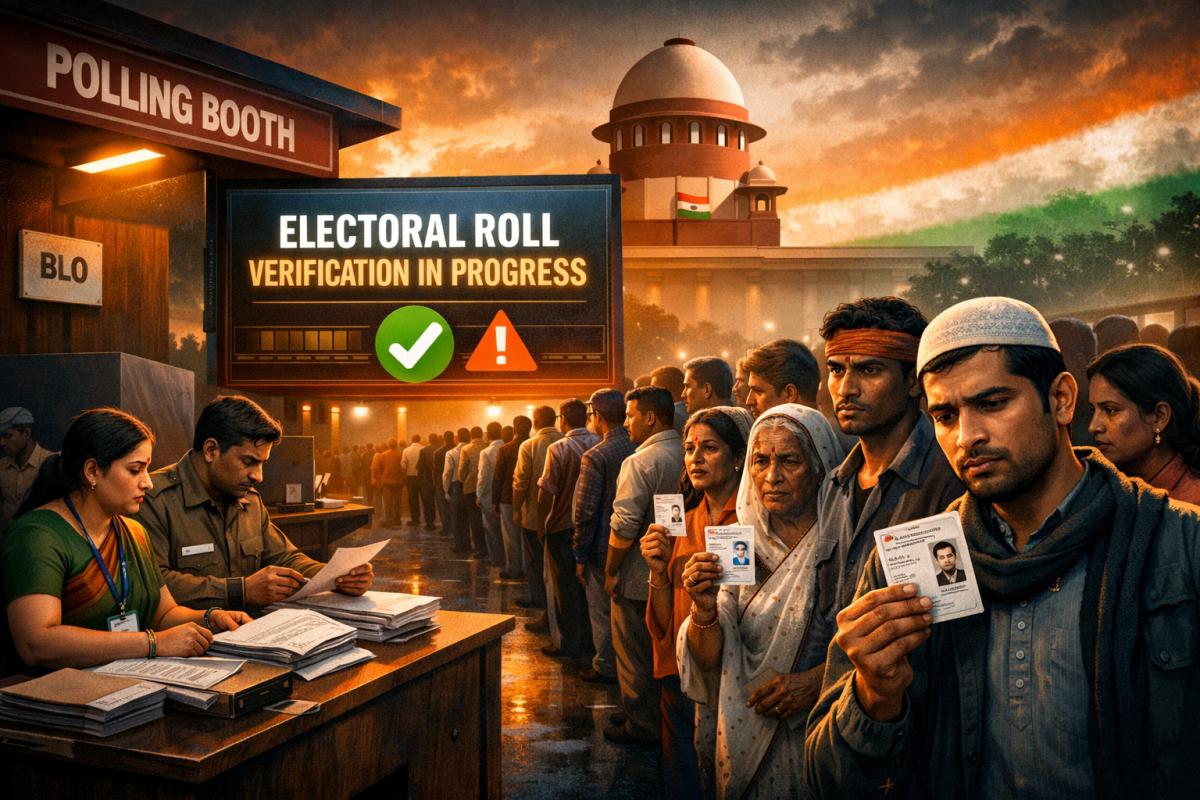

The Great Purge or Democratic Purification? Inside India’s Controversial Special Intensive Revision (SIR) of Electoral Rolls
As India approaches the crucial 2026 Assembly elections, the foundational infrastructure of democracy—the electoral roll—is undergoing one of the most contentious revisions in recent history. The Special Intensive Revision (SIR) conducted by the Election Commission of India (ECI) across multiple states has triggered constitutional debate, public anxiety, and judicial intervention at the highest level.
Officially framed as a necessary clean-up exercise to remove duplicate, deceased, and ineligible voters, the 2025–2026 SIR has evolved into a deeply polarising national event. Allegations of algorithmic failures, disproportionate targeting of marginalised communities, administrative breakdowns, and mass panic have transformed what should have been a routine bureaucratic update into a defining moment for India’s democratic framework.
Understanding the Legal Framework Behind the SIR
The authority for revising electoral rolls originates from:
- Article 324 of the Constitution of India – granting the Election Commission superintendence, direction, and control over elections.
- Section 21(3) of the Representation of the People Act, 1950 – allowing special revisions of electoral rolls.
Historically, intensive revisions were conducted periodically, with the last comprehensive exercise occurring between 2002 and 2004. The current SIR differs significantly due to its reliance on digital systems and legacy mapping requirements.
The Enumeration Phase
The SIR begins with Booth Level Officers (BLOs) distributing Enumeration Forms (EF) to households. A critical requirement in the 2025–2026 exercise is the establishment of legacy linkage—citizens must connect their current voter identity with the 2002 electoral rolls.
The workflow includes:
- Distribution of Enumeration Forms.
- Submission of legacy details linked to the 2002 rolls.
- Scanning via the ECI mobile application.
- Green confirmation if matched; discrepancy notice if not.
- Additional documentation via Form 6 (inclusion) or Form 8 (correction) if flagged.
This process, though procedurally sound on paper, has imposed a significant evidentiary burden on ordinary citizens.
The Algorithmic Crisis in West Bengal
West Bengal emerged as the epicentre of the SIR controversy. The digitisation of 2002 paper rolls—primarily in Bengali—required transliteration and automated comparison with current databases. The result was catastrophic.
| Category | Number of Voters Flagged |
|---|---|
| Logical Discrepancies | 1.36 Crore |
| Unmapped Voters | 31.38 Lakh |
Nearly 18% of the state's electorate was flagged for hearings.
Primary Causes of Algorithmic Failure
- Transliteration Errors: Minor phonetic differences (e.g., “Xalxo” vs “Khalkho”).
- Abbreviations: “Mohammed” shortened to “Md”.
- Cultural Naming Variations: Inclusion or omission of middle names.
- Progeny Age Linking Errors: Rigid age-gap logic ignores social realities.
Local Electoral Registration Officers (EROs), given 30-day deadlines, reportedly processed 4,000–5,000 notices daily—making meaningful review virtually impossible.
Impact on Marginalised Communities
Adivasi and Migrant Workers
In Madhya Pradesh and Chhattisgarh, the revision coincided with peak migration season. Thousands of Adivasi families working outside their home states were marked “absent” or “shifted.”
Challenges included:
- Lack of legacy documents.
- Displacement and land insecurity.
- Inability to attend hearings.
The Gendered Burden of Legacy Mapping
Married women were required to trace legacy links to their natal homes rather than marital residences. In cases of interstate marriages, access to 2002 data became nearly impossible.
Documentary perfection in a nation marked by migration and poverty is a privilege, not a universal reality.
Transgender Individuals and Sex Workers
Trans persons and sex workers, often estranged from natal families, lack access to legacy documentation. Name changes and identity transitions further complicate verification.
Accessibility and Administrative Breakdown
Gujarat
2002 rolls were uploaded as unsearchable PDFs within ZIP files, making public verification difficult.
Goa
Some citizens were reportedly asked to produce passports to rule out Portuguese citizenship, raising due process concerns.
The Human Toll
The psychological impact has been profound. Fear linked to the NRC and CAA intensified public anxiety.
Reported consequences include:
- Stress-induced heart attacks.
- Suicides linked to fear of deletion.
- Community-wide panic.
In West Bengal alone, reports indicated at least 28 deaths connected to SIR-related stress.
The Plight of Booth Level Officers (BLOs)
BLOs faced extreme workloads, technological glitches, and administrative pressure. Reports from multiple states indicated burnout and severe stress-related incidents.
Challenges faced by BLOs:
- Door-to-door enumeration under tight deadlines.
- Real-time digital scanning.
- Handling public anger and confusion.
- Administrative pressure to meet quotas.
The Constitutional Standoff
The West Bengal government accused the ECI of overreach and politically motivated targeting. The ECI countered that the state failed to provide qualified officers.
Points of contention included:
- Deployment of out-of-state micro-observers.
- Alleged refusal to register FIRs.
- Language and cultural unfamiliarity of observers.
Supreme Court Intervention Under Article 142
Faced with escalating tension, the Supreme Court intervened. Invoking Article 142, the Court directed the deployment of serving and former District Judges to oversee discrepancy adjudications.
Key Judicial Directions
- Judicial officers to pass binding orders.
- District Collectors and SPs placed on deemed deputation.
- Micro-observers are restricted to assistive roles.
- One-week extension granted.
- Primary and supplementary roll publication framework established.
“Genuine persons must remain on the electoral roll.”
Technology vs Democratic Safeguards
The SIR exposed risks of algorithmic governance without adequate human oversight.
Core Issues Identified
- Opaque software logic.
- Inadequate testing before statewide deployment.
- Over-reliance on automated transliteration.
- Rigid age-linking filters.
Democratic systems demand procedural fairness. Automation without contextual calibration risks systemic exclusion.
Is Electoral Purification Compatible with Social Reality?
India’s demographic complexity—internal migration, poverty, displacement, gendered documentation gaps—makes legacy-based validation structurally exclusionary.
The core philosophical dilemma:
Can mathematical precision justify the exclusion of legitimate citizens?
Comparative Risk Assessment
| Objective | Intended Outcome | Observed Risk |
|---|---|---|
| Remove duplicate voters | Electoral accuracy | Mass false positives |
| Identify illegal immigrants | Integrity of rolls | Community-wide panic |
| Digital modernization | Efficiency | Algorithmic bias |
The Broader Democratic Implications
The SIR controversy underscores a widening trust deficit between constitutional institutions and state governments. When electoral management becomes a litigated terrain, democratic legitimacy itself is strained.
The Supreme Court’s unprecedented intervention marks a significant doctrinal development:
- Affirmation of judicial supremacy in safeguarding voting rights.
- Limitations on executive discretion.
- Recognition of systemic algorithmic fallibility.
Looking Ahead to the 2026 Assembly Elections
The publication of supplementary rolls under judicial supervision will determine whether millions retain their franchise. The legitimacy of the 2026 elections will hinge on:
- Transparency of adjudication.
- Correction of algorithmic flaws.
- Accessibility for marginalised citizens.
- Institutional cooperation.
Conclusion
The Special Intensive Revision of 2025–2026 will be remembered as a watershed moment in India’s democratic history. What began as an administrative effort to purify electoral rolls has exposed deep structural vulnerabilities in the intersection of technology, governance, and human rights.
While electoral accuracy is undeniably essential, the methods employed revealed a dangerous assumption: that citizenship can be cleanly verified through rigid digital matching systems in a nation defined by migration, poverty, and complex social realities. The burden of documentary perfection fell disproportionately on women, migrants, tribal communities, transgender individuals, and the economically marginalised.
The Supreme Court’s intervention under Article 142 represents a historic assertion that the right to vote cannot be reduced to algorithmic output. Democracy is not merely about data integrity—it is about protecting the dignity and participation of every citizen.
As India moves toward the 2026 Assembly elections, the ultimate test will not be how many names were deleted or corrected, but whether the process strengthened public trust. A democracy that prioritises inclusion while ensuring integrity will endure. A democracy that sacrifices its vulnerable at the altar of procedural perfection risks eroding the very legitimacy it seeks to defend.
Community Insights