
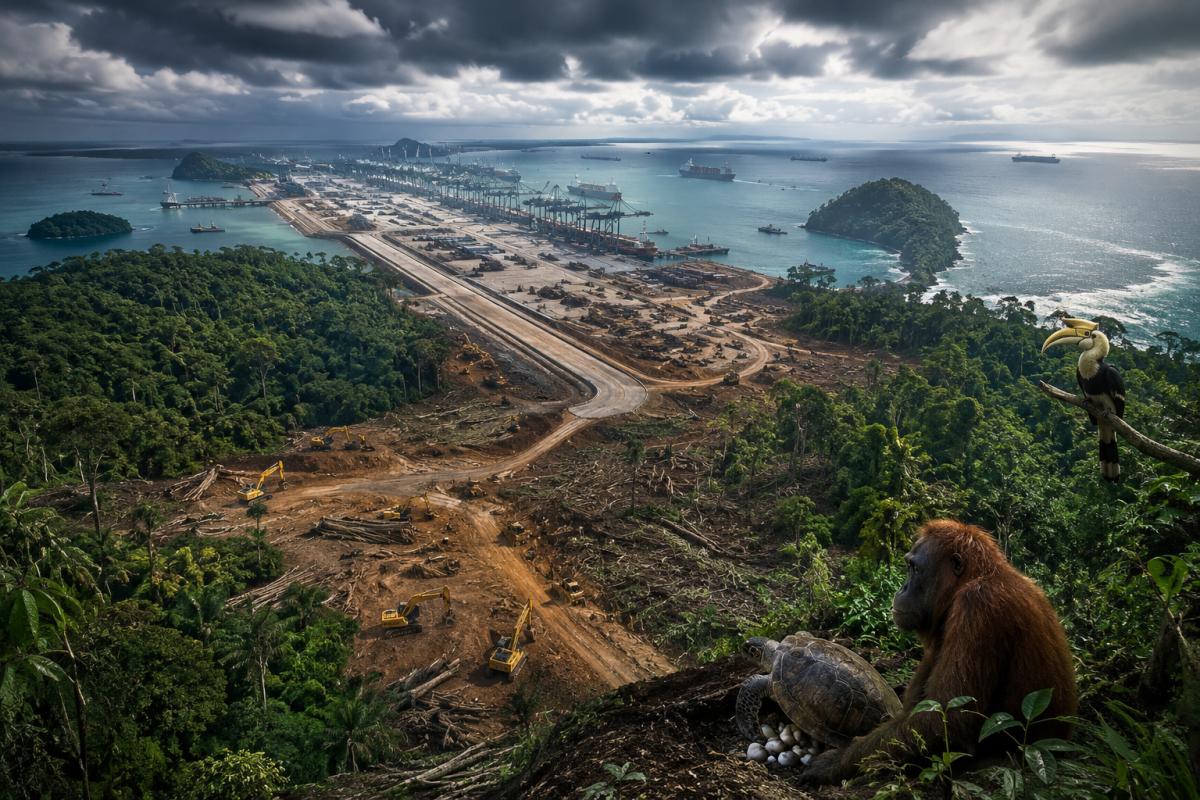

India has always balanced two competing dreams — rapid economic growth and environmental preservation. Over the last few decades, the country has launched massive infrastructure projects in the name of national development, connectivity, defense, and economic expansion. Some of these projects transformed regions positively, while others triggered debates about ecological destruction, displacement of indigenous communities, and irreversible environmental damage.
Among all these controversial initiatives, one project has emerged as perhaps the most debated mega-development plan in recent Indian history — the Great Nicobar Project. Touted as a strategic and economic masterstroke, the project promises to convert the remote Great Nicobar Island into a major global shipping and economic hub. However, critics, scientists, environmentalists, tribal rights activists, and even former government officials have raised alarming concerns regarding its ecological and humanitarian consequences.
The project has generated intense national debate because it touches multiple sensitive issues at once:
- Destruction of one of India’s richest biodiversity hotspots
- Threats to indigenous tribal communities
- Large-scale deforestation
- Ecological vulnerability in a seismic zone
- Potential militarization and strategic exploitation
- Climate change implications
- Long-term sustainability concerns
Supporters argue that the project is essential for India’s strategic dominance in the Indian Ocean Region and can turn the country into a global maritime power. Opponents, however, believe the environmental cost is simply too catastrophic to justify the economic gains.
This article explores the Great Nicobar Project in detail — its objectives, components, strategic significance, environmental impact, tribal concerns, ecological risks, and why many experts are calling it one of the biggest environmental disasters waiting to happen.
Understanding Great Nicobar Island
Great Nicobar Island is the southernmost island of the Andaman and Nicobar archipelago. It lies near the strategically important Malacca Strait, one of the busiest maritime trade routes in the world. The island is geographically isolated, densely forested, ecologically fragile, and home to rare wildlife and indigenous tribal communities.
The island covers approximately 910 square kilometers and contains tropical rainforests, mangroves, coral reefs, wetlands, and unique coastal ecosystems. It is also part of the Indo-Burma biodiversity hotspot, one of the richest ecological zones on Earth.
What makes Great Nicobar ecologically extraordinary is not merely its biodiversity but its relative isolation from large-scale human exploitation. Unlike many mainland forests that have suffered industrial expansion, mining, and urbanization, Great Nicobar remained comparatively untouched for decades.
The island is home to:
- Leatherback sea turtles
- Saltwater crocodiles
- Nicobar megapodes
- Rare endemic bird species
- Coral reef ecosystems
- Unique tropical rainforest flora
It is also inhabited by indigenous tribal communities such as the Shompen and Nicobarese, who have maintained traditional lifestyles for generations.
What Exactly Is the Great Nicobar Project?
The Great Nicobar Development Project is a mega infrastructure initiative proposed by the Government of India. The estimated cost of the project is over ₹72,000 crore, making it one of the most expensive island infrastructure projects in Indian history.
The project includes several major components:
- International Container Transshipment Terminal
- Greenfield International Airport
- Township Development
- Power Plant
- Road Infrastructure
- Defense and Strategic Installations
The government envisions Great Nicobar as a future economic powerhouse capable of competing with major international shipping hubs like Singapore and Colombo.
Major Components of the Project
| Component | Description | Purpose |
|---|---|---|
| Transshipment Port | Large international shipping terminal | Global maritime trade hub |
| International Airport | Greenfield airport capable of handling large aircraft | Civilian and military use |
| Township | Urban settlement for thousands of people | Support infrastructure and population growth |
| Power Plant | Energy generation facility | Industrial and residential electricity supply |
| Road Networks | Connectivity infrastructure across the island | Transportation and logistics |
| Defense Infrastructure | Strategic military facilities | Indian Ocean security operations |
Why Is the Project Strategically Important?
One of the strongest arguments in favor of the project is its geopolitical importance. Great Nicobar lies extremely close to the Malacca Strait, through which a significant percentage of global trade and energy shipments pass every year.
India sees the island as a critical strategic location for multiple reasons:
- Countering Chinese influence in the Indian Ocean
- Enhancing naval dominance
- Monitoring global shipping lanes
- Strengthening maritime security
- Improving regional logistics capabilities
Supporters claim that if India does not develop the region aggressively, other geopolitical powers may dominate the area economically and militarily.
The proposed transshipment terminal could potentially reduce India’s dependence on foreign ports for cargo handling. Currently, a large portion of Indian cargo is processed through ports outside India, particularly Singapore and Colombo. A domestic transshipment hub could theoretically boost India’s maritime economy significantly.
The Environmental Concerns
While the economic and strategic arguments sound powerful, environmental experts warn that the ecological consequences may be devastating and irreversible.
The biggest concern is the scale of deforestation involved in the project. Reports indicate that nearly one million trees may be cut down for the development process. This would fundamentally alter the island’s ecological balance.
Rainforests are not just collections of trees; they are highly interconnected ecosystems developed over thousands of years. Once destroyed, they cannot simply be recreated through plantation drives.
Major Environmental Threats
- Massive deforestation
- Loss of biodiversity
- Coral reef destruction
- Habitat fragmentation
- Increased carbon emissions
- Threats to endangered species
- Marine ecosystem disruption
Threat to Leatherback Sea Turtles
One of the most serious concerns involves the endangered Leatherback sea turtle, the world’s largest sea turtle species.
Great Nicobar contains some of the most important nesting sites for these turtles in the Indian Ocean region. The proposed port construction and coastal infrastructure threaten these nesting habitats directly.
Leatherback turtles are already endangered globally due to:
- Plastic pollution
- Climate change
- Fishing nets
- Habitat destruction
- Coastal development
Scientists fear that industrial development in Great Nicobar could severely damage one of their last safe nesting grounds in the region.
Seismic and Tsunami Risks
Another major concern is the island’s geological vulnerability.
Great Nicobar falls within a highly seismic zone. The region experienced catastrophic destruction during the 2004 Indian Ocean tsunami. The earthquake and tsunami significantly altered the island’s geography and caused extensive environmental and human damage.
Critics argue that constructing massive infrastructure projects in such a vulnerable area is inherently risky.
The dangers include:
- Tsunami exposure
- Earthquake damage
- Coastal erosion
- Rising sea levels
- Cyclonic vulnerability
Climate scientists warn that long-term climate change could further intensify these risks, making the sustainability of such a mega-project questionable.
The Indigenous Communities at Risk
Perhaps the most morally sensitive aspect of the project involves the indigenous tribal communities living on the island.
The Shompen tribe, in particular, remains one of the most isolated indigenous groups in India. Their population is extremely small, and they maintain limited contact with the outside world.
Large-scale infrastructure development could disrupt their:
- Traditional lifestyle
- Food systems
- Forest dependence
- Cultural identity
- Disease vulnerability
- Land rights
Historically, indigenous communities across the world have suffered heavily when exposed suddenly to industrial expansion and urban populations. Diseases, cultural erosion, land displacement, and economic exploitation often follow.
Activists argue that development cannot come at the cost of tribal extinction.
Questions About Environmental Clearance
The project also sparked controversy regarding the environmental approval process.
Critics claim that the environmental impact assessments were inadequate and failed to fully account for the ecological sensitivity of the island.
Several environmental groups alleged:
- Insufficient biodiversity studies
- Incomplete impact assessments
- Lack of transparency
- Inadequate public consultation
- Downplaying ecological risks
There are concerns that the urgency surrounding strategic and economic goals may have overshadowed scientific caution.
Can Economic Growth Justify Ecological Damage?
This question lies at the heart of the Great Nicobar debate.
Modern governments often justify large infrastructure projects in the name of national development. Economic growth generates jobs, improves connectivity, strengthens defense capabilities, and boosts geopolitical influence.
However, environmental destruction creates long-term costs that are often invisible initially.
These costs include:
- Climate instability
- Loss of ecosystem services
- Disaster vulnerability
- Biodiversity collapse
- Food chain disruption
- Irreversible habitat loss
Once ancient rainforests are destroyed and species disappear, they cannot simply be restored through compensation policies or plantation drives.
The debate therefore becomes philosophical as much as economic:
Should fragile ecological regions be sacrificed for rapid industrial development, even if the consequences are irreversible?
The Climate Change Contradiction
India frequently presents itself as a global leader in climate responsibility and sustainable development. The country has invested heavily in renewable energy, international climate diplomacy, and environmental commitments.
However, critics argue that projects like Great Nicobar contradict these commitments.
Cutting nearly a million trees while simultaneously discussing carbon neutrality creates an obvious contradiction.
Forests act as carbon sinks that absorb atmospheric carbon dioxide. Destroying them accelerates climate change instead of combating it.
Environmentalists therefore argue that the project undermines India’s broader sustainability narrative.
Supporters’ Perspective
Despite the criticism, supporters strongly defend the project.
According to proponents, India cannot afford to ignore strategic infrastructure in a rapidly changing geopolitical environment.
Supporters believe the project will:
- Create employment opportunities
- Boost regional development
- Strengthen national security
- Reduce shipping dependence on foreign ports
- Increase trade competitiveness
- Enhance maritime infrastructure
They also argue that modern engineering and environmental mitigation measures can reduce ecological damage.
Some policymakers believe that complete environmental preservation without development is unrealistic for an emerging global power like India.
The Global Pattern of Ecological Sacrifice
The Great Nicobar debate reflects a larger global trend.
Across the world, governments frequently prioritize mega-projects over fragile ecosystems:
- Amazon rainforest deforestation in Brazil
- Industrial expansion in Southeast Asia
- Arctic resource extraction
- Large dam projects in Africa and Asia
- Coastal urbanization worldwide
In many cases, economic gains were immediate while environmental consequences became visible only decades later.
Scientists warn that humanity is entering an era where ecological collapse may become one of the biggest threats to civilization itself.
What Makes Great Nicobar Different?
Several factors make this project uniquely controversial:
- Ecological Sensitivity
The island contains rare biodiversity and fragile ecosystems. - Tribal Presence
The existence of vulnerable indigenous communities raises humanitarian concerns. - Disaster Vulnerability
The island lies in a highly seismic and tsunami-prone zone. - Scale of Development
The proposed infrastructure transformation is extremely large relative to the island’s size. - Climate Impact
Massive deforestation directly conflicts with climate sustainability goals.
The Future of Great Nicobar
The future of the project remains uncertain in terms of public acceptance, environmental consequences, and long-term sustainability.
While government approvals have progressed, legal challenges and environmental activism continue.
The final outcome may shape India’s future approach toward balancing:
- Development and conservation
- Economic growth and ecological responsibility
- Strategic ambition and sustainability
- National security and indigenous rights
The decisions made today may affect not only Great Nicobar Island but also India’s environmental legacy for generations.
Could There Have Been an Alternative Approach?
Many experts argue that development and conservation do not necessarily have to be enemies. The real issue may not be development itself, but the scale and design of the project.
Alternative approaches could potentially include:
- Smaller-scale sustainable infrastructure
- Limited ecological footprint construction
- Strict conservation zones
- Tribal consultation mechanisms
- Phased development plans
- Independent ecological monitoring
Critics believe that instead of transforming the island into a massive industrial and urban hub, India could have pursued a more balanced model emphasizing sustainability and ecological preservation.
Media, Public Awareness, and Debate
The Great Nicobar Project gained wider public attention largely because of independent journalists, environmental activists, researchers, and digital creators who simplified the issue for ordinary citizens.
Public debate plays an essential role in democratic decision-making, especially for projects with irreversible consequences.
Environmental debates are often dismissed as “anti-development,” but many scientists argue that questioning ecological destruction is not opposition to progress — it is a demand for responsible progress.
The Great Nicobar discussion therefore represents something much larger than one island. It symbolizes the broader struggle between industrial expansion and environmental survival in the 21st century.
Conclusion
The Great Nicobar Project stands at the intersection of ambition, geopolitics, economics, ecology, and ethics. On one side lies the vision of transforming India into a dominant maritime and strategic power with world-class infrastructure and global trade capabilities. On the other side lies the fear of irreversible ecological destruction in one of the most fragile and biodiverse regions on Earth.
The project is not merely about ports, airports, or economic growth. It is about defining what kind of development model modern India wants to pursue. If economic expansion comes at the cost of ancient rainforests, endangered wildlife, indigenous communities, and ecological stability, then the long-term consequences may far outweigh the immediate benefits.
History has repeatedly shown that environmental damage often appears manageable in the beginning but becomes catastrophic over time. Forests disappear permanently, species vanish forever, coastlines erode, and fragile ecosystems collapse silently. Once these losses occur, no amount of economic investment can fully restore them.
The Great Nicobar debate ultimately raises a difficult but necessary question for India and the entire world:
Can humanity continue pursuing aggressive development without destroying the very ecosystems that sustain life itself?
The answer to that question may determine not only the future of Great Nicobar Island but also the environmental future of generations to come.

Community Insights