
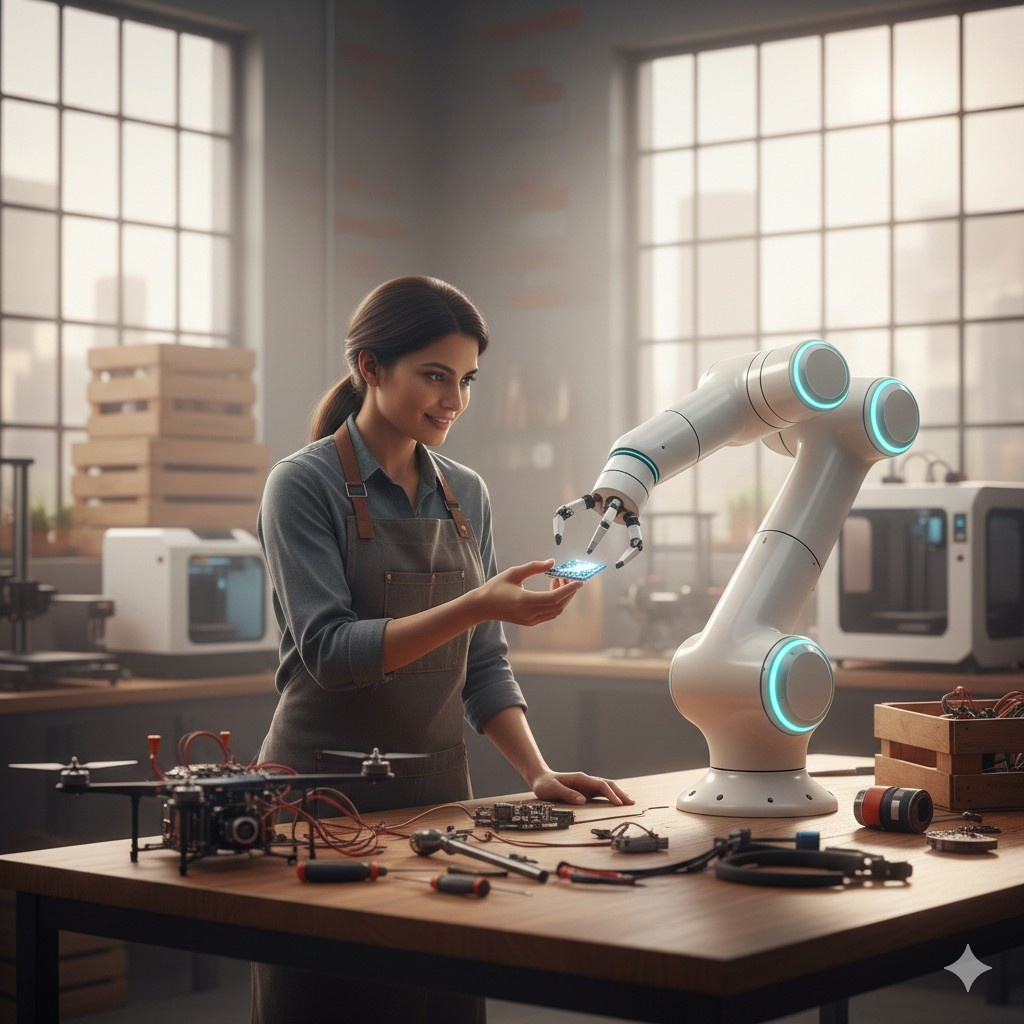

But in 2026, a different kind of mechanical evolution has reached its tipping point. Enter the Cobot, or "collaborative robot."
Unlike their predecessors, cobots are designed to work alongside humans, sharing the same workbench, breathing the same air, and—metaphorically speaking—shaking hands with their human counterparts. This shift is not just a technological curiosity; it is a full-scale revolution for Small and Medium Enterprises (SMEs). For the first time, a local machine shop, a boutique bakery, or a specialised electronics lab can afford the same level of precision and consistency that was once reserved for the world’s largest factories.
Defining the Revolution: What Makes a Cobot "Collaborative"?
The term "cobot" is more than a marketing buzzword. It represents a fundamental shift in how we engineer machines. To understand why they are revolutionising small businesses, we have to look at the three pillars of their design: Safety, Simplicity, and Versatility.
Built-in Safety (The End of the Cage)
Traditional robots are dangerous. They move with such speed and force that any contact with a human could be fatal. Cobots solve this through "baked-in" safety. They are equipped with force-torque sensors and vision systems that monitor their environment in real-time. If a human arm moves into the cobot’s path, or if the robot detects even a slight resistance (the "contact stop" feature), it pauses instantly. This removes the need for expensive, space-consuming safety fences, allowing them to sit right next to a worker on a crowded production floor.
Intuitive Programming (The Democratisation of Coding)
In the past, programming a robot required a degree in robotics engineering and knowledge of proprietary code. Today’s cobots are designed with a Human-Machine Interface (HMI) that feels as intuitive as a smartphone.
- Hand-guiding: Many cobots can be "taught" by physically moving the arm through the desired motions. The robot records the path and repeats it.
- Visual Programming: Drag-and-drop software allows shop floor managers to build complex workflows without writing a single line of code.
Versatile Footprint
Small businesses rarely have the luxury of dedicating hundreds of square feet to a single machine. Cobots are lightweight and portable. A cobot can spend the morning tending a CNC machine and be wheeled over to the packaging station in the afternoon. They typically run on standard 230V power (or regional equivalents), making them as easy to "plug and play" as a kitchen appliance.
Why SMEs are Leading the Charge in 2026
For years, small businesses stayed away from automation due to two hurdles: High Initial Cost and Low Flexibility. The cobot revolution has dismantled both.
The Maths of Accessibility
In 2026, the price of entry-level cobots has stabilised at around £20,000 to £30,000. While that is still a significant investment for a small shop, the Return on Investment (ROI) timeline has shrunk dramatically. Most SMEs find that a cobot pays for itself in 12 to 18 months.
When you factor in that these machines don't require specialised safety infrastructure or a full-time robotics engineer on staff, the "Total Cost of Ownership" (TCO) becomes significantly lower than traditional automation.
High-Mix, Low-Volume (HMLV) Manufacturing
Small businesses often survive by being agile—producing a wide variety of parts in small batches. Traditional robots are terrible at this because they take weeks to reprogram. Cobots, however, excel in HMLV environments. A business owner can switch a cobot from assembling circuit boards to labelling bottles in under an hour.
Real-World Applications: From the Shop Floor to the Lab
The "Cobot Revolution" isn't happening in a vacuum; it’s happening in local businesses you likely interact with every day.
Machine Tending
This is perhaps the most common application. In small machine shops, loading and unloading a CNC machine or a plastic injection molder is a "dull, dirty, and dangerous" job. A cobot can handle the repetitive lifting and placing with micron-level precision, while the human machinist focuses on quality control, tool offsets, and complex problem-solving.
Quality Inspection
Small electronics manufacturers are now using cobots equipped with AI-powered vision systems. These robots can pick up a component, rotate it under a high-definition camera, and detect a solder defect that the human eye might miss after eight hours of work.
Packaging and Palletising
For a small warehouse or a local food producer, stacking heavy boxes on pallets is a recipe for back injuries. Cobots can now handle payloads of up to 20kg, performing the heavy lifting while a human worker manages the logistics and shipping software.
The "Third Hand" in Assembly
In intricate assembly—like building medical devices or custom drones—cobots act as a "third hand." They can hold a heavy part in a precise orientation while the human worker performs the delicate task of threading wires or applying adhesive.
The Human Impact: Collaboration, Not Replacement
The most persistent fear regarding robots is the loss of jobs. However, in the small business sector, the story is proving to be quite different. Instead of replacing workers, cobots are multiplying them.
Upskilling the Workforce
When a small business introduces a cobot, the role of the worker changes. A manual labourer becomes a "robot supervisor." Employees are learning to manage, program, and maintain these systems, which increases their value in the labour market and often leads to higher wages.
Tackling the Labour Shortage
Small businesses across the globe are facing a massive shortage of skilled labour. In 2026, the problem hasn't vanished. Cobots allow businesses to stay open and meet demand even when they can't find enough human staff for repetitive roles. By automating the "boring" parts of the job, businesses can offer more engaging, creative roles that are easier to fill.
Health and Longevity
By taking over tasks that cause Repetitive Strain Injuries (RSI) or require heavy lifting, cobots are extending the careers of skilled veteran workers. A 55-year-old master welder can work alongside a cobot that handles the heavy positioning, allowing them to use their expertise without the physical toll on their body.
Challenges and Considerations for Small Business Owners
While the revolution is here, it isn't without its hurdles. Small business owners looking to adopt cobot technology in 2026 should keep three things in mind:
| Challenge | Mitigation Strategy |
|---|---|
| Tooling Costs | The "arm" is just the start. End-of-arm tooling (grippers, welders, etc.) can add significant cost. Budget for the entire solution, not just the robot. |
| Integration Complexity | Even "easy" robots need to talk to your existing machines. Start with a simple, standalone task before attempting a fully integrated production line. |
| Cultural Acceptance | If employees feel threatened, the project will fail. Involve your team in the selection process early. Show them how the cobot will make their day easier. |
The Future: AI-Powered Cobots
As we look toward the end of 2026 and beyond, the next phase of the revolution is Physical AI. We are already seeing cobots that can learn through trial and error or respond to natural language commands. Imagine a world where a small business owner can say, "Hey, can you help me move these battery packs to the shipping dock?" and the cobot understands the context and executes the task.
Conclusion
The "Cobot Revolution" is doing something remarkable: it is levelling the playing field. It is giving the "little guy" the tools to compete with global conglomerates without losing the human touch that makes small businesses special.
As cobots become smarter, cheaper, and more collaborative, the divide between human creativity and mechanical precision is disappearing. We aren't entering a future where robots take over; we are entering an era where humans and robots build the future, side-by-side.


Community Insights