
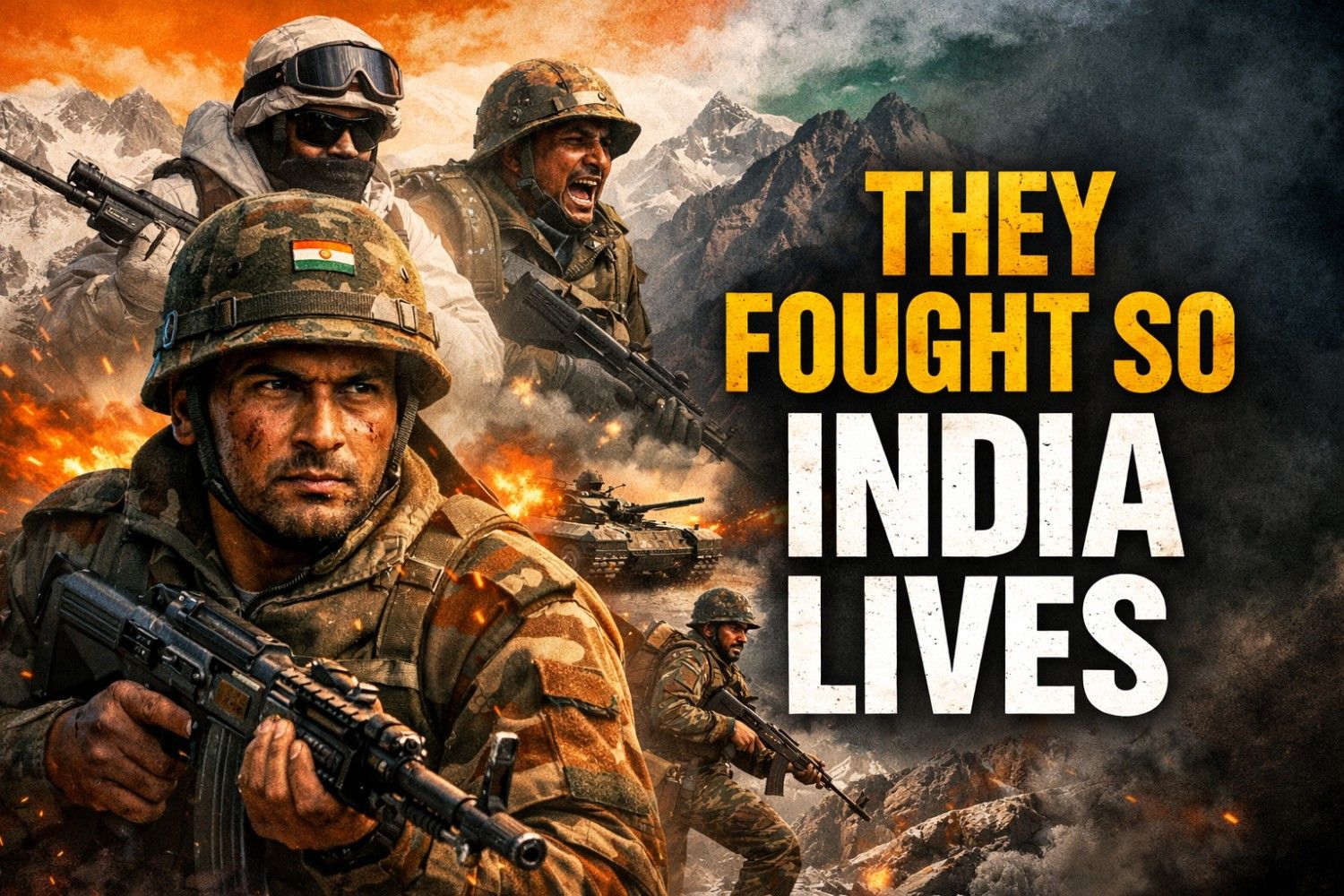
In the annals of a nation’s history, there are stories that transcend the boundaries of time and memory. They are tales not just of war, but of the human spirit pushed to its absolute limit—where the instinct for self-preservation is overpowered by a colossal sense of duty. These are the stories of the Param Vir Chakra (PVC) awardees, the men who wore the country’s highest gallantry award, many of whom did not return to tell their own tales.
Recent initiatives by the Ministries of Defence and Education have sought to bring these legends closer to the younger generation. As of 2024, school textbooks in India will include material on the National War Memorial and a specific chapter dedicated to Veer Abdul Hamid, to instill patriotism and a spirit of sacrifice in students. This initiative, part of the National Education Policy 2020, ensures that the legacy of soldiers like Abdul Hamid—who destroyed Pakistani tanks with a jeep-mounted gun—remains etched in the collective consciousness.
But who were these men? What drove them to charge into enemy fire, scale frozen walls, and stand their ground against overwhelming odds? Drawing from military archives and historical accounts, here is the saga of India’s bravest.
The First War: 1947–48
The ink on India’s independence was barely dry when the nation faced its first major military challenge in Jammu and Kashmir.
Major Somnath Sharma: The First Recipient
In November 1947, despite having a plastered arm from a previous injury, Major Somnath Sharma of 4 Kumaon insisted on leading his company to Badgam. Outnumbered seven to one, he understood that the fall of the Srinagar airfield would sever India’s lifeline to the valley.
“I shall not withdraw an inch but will fight to the last man and the last round.”
Moments later, a mortar shell killed him, but his company held off the raiders for six crucial hours, saving Srinagar.
Naik Jadunath Singh: The Ghost of Tain Dhar
On February 6, 1948, Naik Jadunath Singh of 1 Rajput commanded a picket of just nine men against thousands of raiders at Tain Dhar. Wounded and alone, he charged out of his trench firing his gun until he was fatally shot, forcing the enemy to retreat.
The Saviours of the North
- Second Lieutenant Rama Raghoba Rane crawled under enemy fire to clear mines and roadblocks, saving civilians in Rajouri.
- Company Havildar Major Piru Singh destroyed multiple enemy bunkers despite grievous wounds.
- Lance Naik Karam Singh repelled eight attacks and fought hand-to-hand when ammunition ran out.
The Congo Mission: 1961
During a UN peacekeeping mission in Congo, Captain Gurbachan Singh Salaria led a small platoon against heavily armed gendarmerie. Charging with a khukri, he neutralized enemy positions before succumbing to his wounds, leaving behind a legacy of courage on foreign soil.
The 1962 Sino-Indian War: Courage in Defeat
Major Dhan Singh Thapa
At Sirijap in Ladakh, Major Dhan Singh Thapa fought until his ammunition was exhausted and then engaged in hand-to-hand combat. Presumed dead, he later returned from Chinese captivity, a living testament to resilience.
Subedar Joginder Singh
Despite being wounded, Subedar Joginder Singh manned a machine gun at Bum La and later charged the enemy with fixed bayonets, dying in captivity after refusing to yield.
Major Shaitan Singh
At Rezang La, Major Shaitan Singh led Charlie Company of 13 Kumaon at 16,000 feet. Of 124 men, 113 were killed fighting, leaving behind a battlefield that testified to unmatched sacrifice.
The 1965 War: The Graveyard of Pattons
Havildar Abdul Hamid
In the Khem Karan sector, Abdul Hamid used a jeep-mounted recoilless gun to destroy multiple Patton tanks, earning immortality as the hero of Asal Uttar.
Lieutenant Colonel Ardeshir Burzorji Tarapore
Commanding the Poona Horse, Lt Col Tarapore led relentless tank assaults during the Battle of Chawinda, destroying nearly 60 enemy tanks before being killed in action.
The 1971 Liberation War
- Lance Naik Albert Ekka silenced enemy machine-gun nests despite fatal injuries.
- Flying Officer Nirmal Jit Singh Sekhon defended Srinagar airfield in a lone dogfight.
- Second Lieutenant Arun Khetarpal refused to abandon his burning tank at Basantar.
- Major Hoshiar Singh held captured positions despite repeated counter-attacks.
The High Altitudes: Siachen and Sri Lanka
Major Ramaswamy Parameswaran displayed extraordinary presence of mind in Sri Lanka, continuing to command even after being mortally wounded.
At 21,000 feet in Siachen, Subedar Major Bana Singh led an assault up an ice wall to recapture Quaid Post, later renamed Bana Top.
The Kargil War: 1999
- Captain Manoj Kumar Pandey led assaults despite multiple wounds.
- Grenadier Yogender Singh Yadav survived 15 bullet injuries and turned the tide at Tiger Hill.
- Rifleman Sanjay Kumar neutralized enemy bunkers under heavy fire.
- Captain Vikram Batra, “Sher Shah,” laid down his life rescuing a wounded comrade.
References
| Source | Topic |
|---|---|
| Clarion India | National War Memorial and Veer Abdul Hamid in curriculum |
| Rachna Bisht Rawat | The Brave: Param Vir Chakra Stories |
| Awaz The Voice | Abdul Hamid and the 1965 War |
| The Tribune | Centurion tanks in the 1965 war |
| IAS Gyan | Battle of Asal Uttar |
Conclusion
These stories are not merely accounts of military maneuvers; they are chronicles of the human capacity for courage. From the frozen heights of Siachen to the tank graveyards of Punjab, these men lived and died by a simple creed: for your tomorrow, we gave our today. They are the bravest of the brave, and they must never be forgotten.
Community Insights