
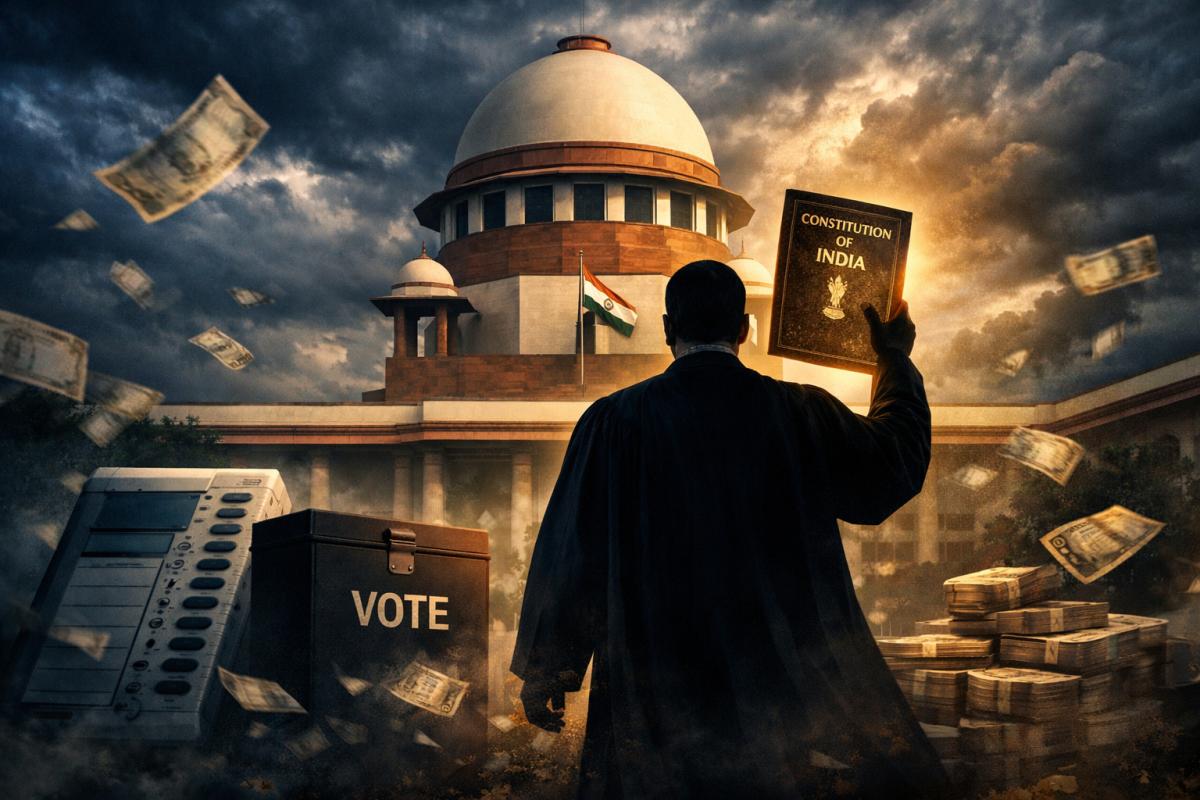

The foundation of any vibrant democracy is trust — trust that elections are conducted fairly, trust that every vote counts equally, and trust that the mechanisms of governance treat all participants without undue influence or advantage. In recent developments, the Supreme Court of India has raised urgent questions about the integrity of election financing and called on the Election Commission of India (ECI) to take meaningful action. This shift reflects a deeper democratic concern: when money plays an outsized role in elections, the very legitimacy of the mandate — and the voice of the people — is undermined.
This blog explores the legal, constitutional, and political implications of that judicial intervention and why it resonates far beyond the corridors of law courts.
The Core Issue: Election Spending and Fair Play
At the heart of recent judicial scrutiny is the question of excessive election expenditure — how much money is being deployed in political campaigns, who controls it, and whether existing safeguards are adequate to ensure equality of opportunity among candidates and parties. India’s democratic credentials rest significantly on the idea that elections must be free and fair, and that includes financial fairness. Yet there are indications that the scale and opacity of election spending may tilt the playing field, favouring well-resourced entities and eroding grassroots voices.
A petitioner — an individual concerned about how unchecked spending influences electoral outcomes — approached the Supreme Court seeking a structured plan to curb excessive campaign expenditures. While the court did not directly order a new policy or mandate immediate reform, it strongly urged the Election Commission to consider the petitioner’s suggestions and to integrate them into its internal policies if they are found meaningful.
This judicial nudge signifies a broader recognition: unchecked financial influence in elections is no longer a theoretical worry; it’s a practical threat to democratic equality.
Who Oversees Election Spending in India?
Before understanding the Supreme Court’s intervention, it’s important to appreciate the role of the Election Commission of India (ECI) — an autonomous constitutional authority established under Article 324 of the Constitution. This article empowers the ECI to supervise, direct, and control the preparation of electoral rolls, conduct elections for Parliament, state legislatures, and the offices of President and Vice-President, and ensure that elections are conducted impartially.
Traditionally, the ECI devises guidelines, caps spending limits for candidates, and deploys expenditure observers to track and monitor financial disclosures and campaign expenses. Observers, often drawn from prestigious service cadres, are expected to operate independently and provide real-time audits of campaign finances. These mechanisms are designed to promote transparency and to regulate how campaign funds are used.
Yet critics argue that structural reforms are necessary. Monitoring alone cannot be the cure if the spending itself spirals beyond reasonable caps or if enforcement mechanisms lack teeth.
Why Curbing Election Spending Is So Crucial
1. Equality of Opportunity Among Candidates
One of the founding principles of democratic elections is that all candidates should have a fair shot at reaching voters — regardless of personal wealth or access to financial backers. When some candidates can deploy vastly more resources for advertising, ground campaigns, rallies, and media presence, this layered advantage jeopardises democratic equality. It distorts competition and shifts the focus from ideas and policies to sheer financial might.
2. Reducing the Influence of Money Power
Money power in elections doesn’t just finance ads — it buys influence. Heavy spending can, and often does, translate into deeper corporate ties, favourable policy favour, and implicit quid pro quo arrangements. When political actors become beholden to deep pockets, the public interest can be sidelined in favour of private gains.
3. Enhancing Public Trust in the System
Public scepticism about elections is amplified when citizens believe that financial muscle, not merit or public service, determines outcomes. When average voters feel their voice is drowned out by big money, trust in democratic institutions — including the courts and the electoral body — erodes.
What the Supreme Court Highlighted
When the Supreme Court engaged with this issue, its bench — led by Chief Justice of India Surya Kant alongside Justices Joymalya Bagchi and N.V. Anjaria — recognised the legitimacy of concerns raised about excessive election spending, but also underscored the necessity for grounded evidence. It refused to base its judgment on third-party reports that were contested by the Election Commission itself.
Yet, the court did something more strategic than immediate adjudication: it directed the Election Commission to take seriously the suggestions put forward by the petitioner. That means the petitioner’s ideas should now become part of the ECI’s internal deliberations. If found suitable, they may influence future standard operating procedures for regulating campaign finance.
By doing this, the court avoided judicial overreach while still emphasising that institutional self-reflection and reform are urgent and necessary.
Possible Reform Measures Under Consideration
Though the court did not spell out specific reforms, public discourse and election law experts have propounded several potential improvements that the Election Commission might examine:
1. Recalibrating Spending Limits
Current caps on election expenditure may be outdated, considering inflation, media costs, and new forms of campaign spending such as influencer partnerships and digital ads. A recalibration — ideally indexed and regularly updated — could bring caps in line with contemporary realities.
2. Real-Time Digital Disclosure Platforms
Imagine if all candidates and parties were required to upload digital disclosures of spending, updated in near real time. Such transparency would allow civil society, watchdogs, and the media to scrutinise fund flows, enhancing accountability.
3. Broader Definitions of 'Expenditure’
Campaign spending often extends beyond direct expenses paid by candidates — for instance, when third-party groups run ads or social media messaging. Redefining what counts as spending could close loopholes where significant resources evade regulation.
4. Strengthening Penalties and Enforcement
Capping expenses is only effective if violations have deterrent consequences. This might include disqualification clauses, financial penalties, or independent audits that trigger sanctions for breaches.
5. Public Funding Models
Some democracies deploy partial public funding to balance the influence of private money. While not without challenges, a calibrated public funding mechanism could reduce the dependency on private donors.
Broader Legal Context: ECI and Transparency
This push for election finance reform is not isolated. In recent years, India’s highest court has tackled other controversial electoral funding issues. For example, it struck down the Electoral Bonds Scheme as unconstitutional, citing that it violated voters’ right to information under Article 19(1)(a) of the Constitution. That scheme had allowed anonymous corporate and individual political donations, which critics argued obscured financial transparency.
Other debates — such as whether political parties should be subject to the Right to Information Act — also reflect ongoing tension between freedom of political activity and democratic accountability. The Supreme Court’s suggestive stance on election spending now fits into this broader jurisprudential arc of demanding transparency and fairness in electoral processes.
Democratic Implications Beyond Legal Technicalities
While the legal mechanics of campaign finance reform are intricate, the stakes are deeply democratic. Excessive spending skews the electoral competition in several ways:
Impact on Citizens’ Participation
When elections feel like contests between financial giants rather than debates of ideas, ordinary citizens may withdraw from active political engagement. This can reduce voter turnout, limit grassroots candidacy, and concentrate political power within elite networks.
Media and Narrative Capture
Large spending capacities enable some campaigns to dominate media narratives — both traditional and social. That gives an advantage not rooted in policy but in messaging saturation.
Policy Priorities Influenced by Donor Interests
Once elected, representatives may feel beholden to those who financed their campaigns. If major funding sources dictate policy priorities or expect favourable regulations in return, public policymaking can drift away from the general electorate’s interests.
Why the Court’s Approach Is Strategic
The Supreme Court’s decision to prompt the Election Commission to deliberate on reform — without issuing immediate directives — reflects a respect for institutional competence and separation of powers. It strikes a balance between judicial oversight and respect for an independent body tasked with election management. This approach also places accountability squarely on the ECI to act, rather than outsourcing responsibility to the judiciary.
From a democratic perspective, this is significant: it acknowledges that systemic issues require systemic solutions, not merely judicial pronouncements.
Challenges Ahead
While the court’s call for reform is bold, implementing meaningful change will face challenges:
-
Political Resistance: Politicians or parties benefiting from the existing financial landscape may resist tightened caps or enhanced transparency.
-
Technical and Administrative Logistics: Establishing real-time disclosures, auditing systems, and enforcement protocols requires technical preparedness and bureaucratic capacity.
-
Public Awareness and Civil Society Engagement: For reforms to have teeth, citizens and watchdogs need access to data and tools to hold actors accountable.
-
Digital Campaign Oversight: With digital advertising and social media campaigns becoming dominant, regulating spending in virtual spaces is complex and constantly evolving.
The Broader Lesson for Democracy
What stands out in this entire debate is not just a legal push on spending limits, but a profound democratic assertion: elections must reflect equitable competition, not asymmetrical advantage. Democracy thrives not when money dictates outcomes, but when ideas, public service records, and policy visions take centre stage.
The Supreme Court’s intervention underscores that money shouldn’t buy outcomes — it must only enable civic participation. When financial practices overshadow democratic essence, institutions — whether courts, electoral bodies, or civil society — must act to safeguard public confidence.
Conclusion: A Moment of Democratic Reckoning
In urging the Election Commission to consider structural reforms regarding election expenditure, the Supreme Court of India has shone a spotlight on one of the most fundamental aspects of democratic integrity. The call is not merely legalistic; it is a reminder of democratic ethos — that elections must be free, fair, transparent, and accessible to all voices, regardless of financial backing.
Citizens, media, civil organisations, and policymakers must watch how the Election Commission responds. The momentum generated by this judicial push could become a watershed in how India conducts and perceives its democratic contests — provided reforms translate into real, enforceable change.
For a democracy of India’s scale, such introspection is not optional; it is imperative.
Community Insights