

By Legal Insights Blog
In a landmark development that promises to reshape the landscape of voter verification and electoral transparency in India, the Honourable Supreme Court has issued a fresh set of directives regarding the Special Intense Revision (SIR) hearings. For millions of citizens, particularly those facing scrutiny over "logical discrepancies" in voter lists, this verdict acts as a crucial shield and a procedural overhaul.
The Supreme Court’s intervention comes at a critical time, effectively rewriting the rules and regulations that govern how the Election Commission of India (ECI) conducts these sensitive hearings. If you or anyone you know has been anxious about the SIR process, this comprehensive guide breaks down the 10 major guidelines issued by the apex court, ensuring you are fully informed of your rights and the new procedures.
The Context: A Historic Hearing
The directives were born out of a significant hearing in the Supreme Court concerning the SIR process. A three-judge bench delivered this verdict in the case titled Mustari Banu vs. ECI (Writ Petition No. 1089 of 2025), which was decided on 19 January 2026.
Before these guidelines were issued, there was considerable confusion and concern regarding the rules of engagement for voters flagged for verification. The Supreme Court has now stepped in to clarify the process, ensuring it is conducted in a "simple, ordinary, and beautiful manner". The court noted that these guidelines constitute one of the biggest updates regarding SIR to date, effectively changing the entire regulatory framework of the hearings.
Here is a detailed breakdown of the 10 Guidelines that the Election Commission of India is now mandated to follow.
Summary of Key Directives
| Guideline No. | Subject | Key Directive |
|---|---|---|
| 1 | Transparency | ECI must publish the list of 1.33 crore voters flagged for discrepancies. |
| 2 | Representation | Voters can be accompanied by a BLA or a lawyer, or send an authorised representative. |
| 3 | Accessibility | Lists must be displayed at BDO, Panchayat, or Ward offices. |
| 4 | Documentation | Class 10 Admit Cards must be accepted as valid proof of Date of Birth. |
| 5 | Accountability | Officials must issue receipts acknowledging a voter's attendance. |
Detailed Analysis of the 10 Guidelines
1. Transparency First: Publishing the Voter List
The first and perhaps most foundational guideline addresses the scale of the issue. It has been reported that approximately 1.33 crore voters have been identified as having "logical discrepancies". Guideline No. 1 mandates that the Election Commission of India must publish a specific list of these 1.33 crore voters. This move ensures that the process is not opaque. By forcing the publication of this list, the Supreme Court ensures that citizens are aware of the magnitude of the revision and can check if they fall within this specific category of voters requiring verification.
2. Your Right to Representation
One of the most intimidating aspects of legal or quasi-legal hearings for the average citizen is the prospect of facing officials alone. The Supreme Court has addressed this directly. Guideline No. 2 states that if a voter receives a notice from the Election Commission of India to appear for a hearing, they are not required to go alone. If a voter feels the need, they are entitled to take a Booth Level Agent (BLA) or a lawyer with them to the hearing centre.
Furthermore, the court has expanded the scope of representation. If a voter cannot appear personally, they can submit their documents, evidence, or objections through an Authorised Representative. This is a massive relief for the elderly, the sick, or those who may be working in different locations, as it ensures their voice is heard even if they cannot be physically present.
3. Accessibility of Information: Displaying the Lists
Publication of lists online or in obscure offices is often not enough for grassroots accessibility. Guideline No. 3 directs that the list of voters identified with logical discrepancies must be physically displayed. These lists are to be hung or posted at accessible local administrative hubs, specifically the BDO (Block Development Officer) office, the Panchayat office, or the Ward office. This guideline ensures that residents in rural and semi-urban areas, who interact most frequently with Panchayat and Ward offices, have direct access to this vital information without needing to travel to district headquarters.
4. The Admit Card Victory: Proof of Date of Birth
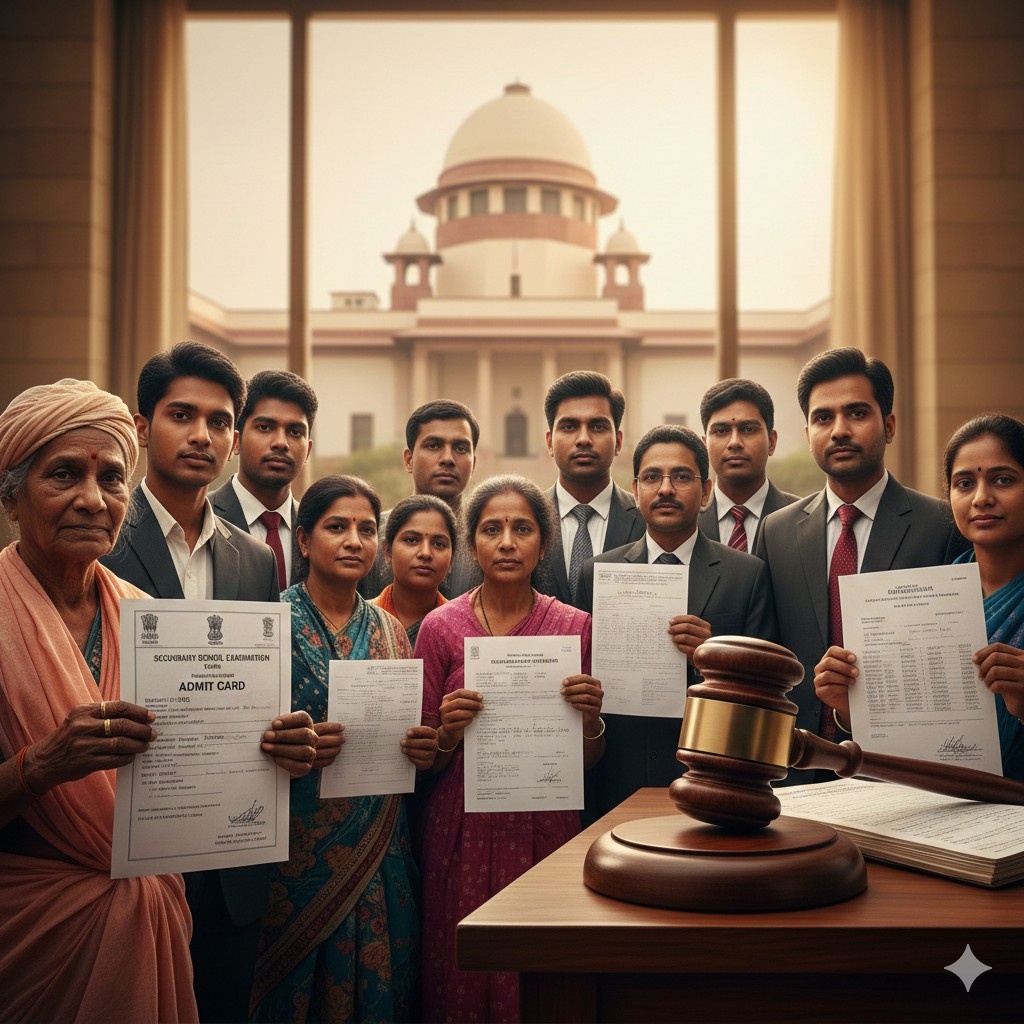
Perhaps the most significant procedural relief for millions of young and middle-aged voters concerns the admissibility of documents. Previously, the Election Commission of India had issued a notification stating that the Class 10 (Matriculation) Examination Admit Card would not be considered admissible in hearings. This was a major hurdle because, for a vast number of citizens, the admit card is a primary document that explicitly mentions their Date of Birth.
Guideline No. 4 reverses the ECI’s stance. The Supreme Court has directed that the Class 10 Admit Card must be admitted and accepted by the Election Commission of India. The Court reasoned that since this particular document discloses the Date of Birth, it holds the same significance as a birth certificate in this context. The directive clarifies that the previous system, which rejected this document, has been changed, and officials must now accept the Class 10 Admit Card as valid proof during SIR hearings.
5. Accountability: The Right to a Receipt
A common grievance in administrative processes is the lack of proof that a person actually attended a hearing or submitted their papers. Documents can go missing, and attendance records can be disputed. Guideline No. 5 introduces a mandatory receipt system. The Supreme Court has ordered that officials conducting the hearings must provide a receipt or acknowledgement to the people appearing before them. When a voter goes to submit documents or attend the hearing, the officials are required to issue a receipt certifying that this particular voter was present at the hearing.
6. The Opportunity to Be Heard
Natural justice demands that no action be taken against a person without hearing their side of the story. Guideline No. 6 reinforces the principle of Audi Alteram Partem (listen to the other side). The Supreme Court has stated that every voter called for a hearing must be given a genuine opportunity to present their side.
This guideline ensures that:
- All affected parties have the chance to place their arguments and views on record during the hearing.
- Voters can utilise an authorised person, such as a BLA or another trusted individual, to represent them.
- To authorise a representative, the voter must provide an Authority Letter containing their thumb impression or signature, explicitly assigning that person as their representative.
7. Decentralising the Hearings: Convenience for Voters
Until now, a significant bottleneck has been that hearings were largely conducted only at BDO offices. For many villagers or residents of large blocks, travelling to the BDO office can be time-consuming and expensive. Guideline No. 7 mandates a decentralisation of the hearing centres. The Supreme Court has stated that hearings must now also be conducted at Panchayat offices or Ward offices. This change is explicitly aimed at voter convenience. It allows voters to submit their documents and raise their objections at their local Panchayat Bhavan or Block Officer level, drastically reducing the logistical burden on the common citizen.
8. The 10-Day Timeline
Time is of the essence in these proceedings. The Supreme Court has set a clear timeline for the process to avoid indefinite delays. Guideline No. 8 stipulates that once a voter receives a notice, they have a window of 10 days to act. Within these 10 days, the voter must:
- Submit their documents.
- Appear at the hearing centre.
- Present any documents they possess.
- Raise any objections they may have regarding the discrepancy.
It is during this specific time period that voters must use documentary evidence to resolve the "logical discrepancy" flagged against their name. This deadline is crucial; voters must be vigilant and act immediately upon receiving a notice to avoid defaulting on the process.
9. State Responsibility for Law and Order
The SIR process involves millions of people and can be a source of tension. Recognising this, the Supreme Court has placed the burden of maintaining peace squarely on the state executive. Guideline No. 9 declares that the responsibility to maintain law and order within the state lies with the State Government. The Court emphasised that during the SIR procedure and the ongoing hearings, the State Government must ensure that law and order is not disrupted.
10. Directives to Police and Administration
Finally, to operationalise the security mandate, the Court issued specific instructions to law enforcement agencies. Guideline No. 10 directs the Director General of Police (DGP), the Superintendent of Police (SP) of all districts, and administrative representatives like Collectors to personally ensure law and order in their respective areas. Their objective is to guarantee that the SIR hearing process runs smoothly. By explicitly naming these high-ranking officials, the Supreme Court has made them personally accountable for any security lapses that might hinder the electoral revision process.
Conclusion
The verdict in Mustari Banu vs. ECI is a watershed moment for electoral administration in India. By mandating transparency through the publication of lists, ensuring accessibility by moving hearings to Panchayats, and protecting voter rights through legal representation and mandatory receipts, the Supreme Court has significantly empowered the citizen. These 10 guidelines are not just procedural tweaks; they are binding orders that the Election Commission of India must follow. For the 1.33 crore voters facing scrutiny, these rules provide a clear, fair, and accessible path to proving their eligibility and retaining their democratic rights.

Community Insights