
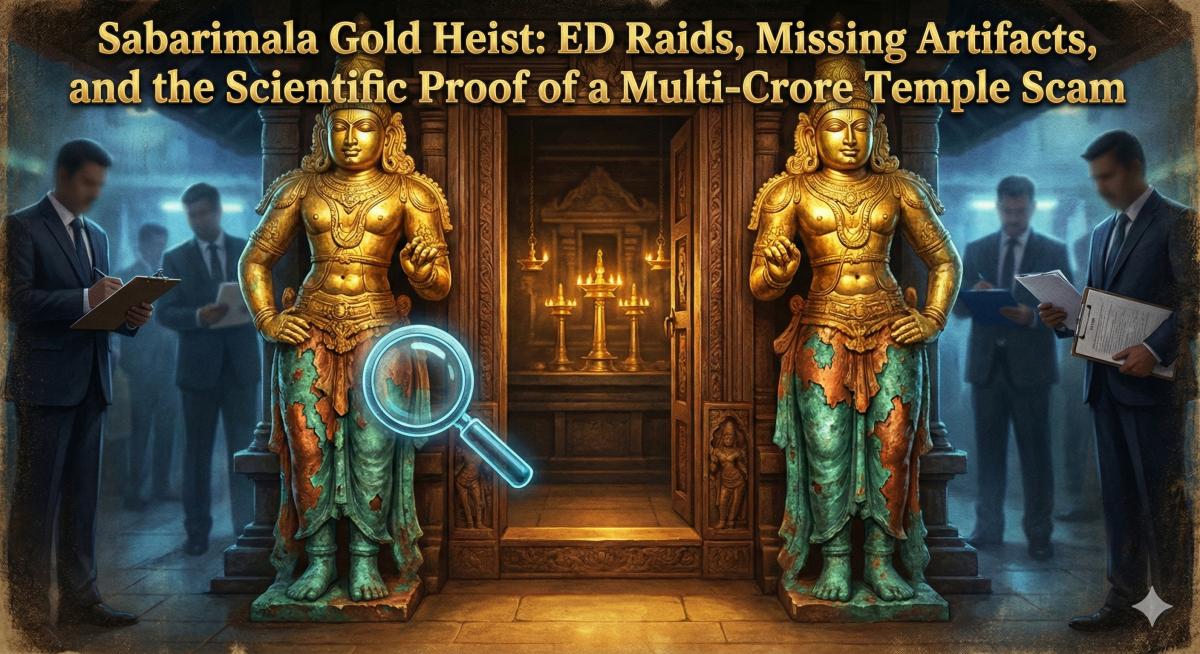

In a development that has sent shockwaves through the spiritual and political landscape of Kerala, the sacred hill shrine of Sabarimala is currently at the center of a massive financial and criminal investigation. On Tuesday, January 20, 2026, the Enforcement Directorate (ED) launched extensive raids across 21 locations in Kerala, Tamil Nadu, and Karnataka [1, 2]. These actions mark a critical turning point in the probe into the alleged multi-crore misappropriation of gold and other assets belonging to Lord Ayyappa.
What began as suspicions regarding the renovation of temple structures has snowballed into a confirmed case of "organized and systematic" pilferage, backed by forensic reports from the Vikram Sarabhai Space Centre (VSSC) and damning observations from the Kerala High Court [3, 4]. This report details the timeline, the methods of the theft, the accused, and the explosive findings that suggest a deep-rooted conspiracy within the temple's administration.
The ED Crackdown: Jan 2026
The Enforcement Directorate’s intervention signals that the case has moved beyond local theft to a suspected money laundering operation under the Prevention of Money Laundering Act (PMLA). Following the registration of an Enforcement Case Information Report (ECIR) on January 9, 2026, the agency mobilized teams to search the premises of officials from the Travancore Devaswom Board (TDB), private individuals, intermediaries, and jewellers [1, 5].
The raids targeted high-profile figures including:
- Unnikrishnan Potty: The prime accused and former priest-turned-businessman, whose residence in Pulimath and his sister's home in Venganoor were searched [6].
- A. Padmakumar: A senior CPI(M) leader and former Travancore Devaswom Board President [7].
- N. Vasu & Murari Babu: Former TDB officials allegedly linked to the administrative lapses [7].
- Smart Creations: The Chennai-based firm where the temple artifacts were taken for "renovation" [6].
- Gold Traders: Premises of jewellers in Bengaluru and Chennai, including a trader named Govardhan, were raided to trace the proceeds of the stolen gold [7].
The objective of these raids is to trace the illicit funds generated from melting down sacred gold artifacts, identify the beneficiaries, and seize digital evidence to map the full scale of the money laundering operation [8].
The Anatomy of the Theft: From Gold to Copper
At the heart of this scandal lies the theft of gold from the Dwarapalaka (door guardian) sculptures and the door frames of the sanctum sanctorum (Sreekovil). The origins of these assets date back to 1998, when Vijay Mallya, the then-chairman of the UB Group, donated over 30 kilograms of pure gold to the temple. Specifically, more than 5 kilograms of this donation were used to create gold-clad sheets for the Dwarapalaka sculptures [9].
The "Renovation" Conspiracy
According to investigations, a criminal conspiracy was hatched between 2019 and 2025 to strip these artifacts of their gold. The modus operandi involved falsifying official records. The gold-clad sacred artifacts were deliberately misrecorded as "copper plates" in official documents to facilitate their illicit removal from the temple [8, 10].
In 2019, under the guise of renovation and repair, these plates were dismantled. The records were falsified to show that copper sheets were being used, and the original gold-clad panels were transported to Chennai [10]. Investigations revealed that the gold was then allegedly melted using chemical processes at private facilities in Chennai and Karnataka [8].
The sheer brazenness of the theft is highlighted by the Devaswom manual violations. According to the rules, valuable items should not be taken outside temple premises without court approval and the deity's permission, and work must be done at the Sannidhanam (temple complex) itself [11, 12]. Instead, the revered gold-clad plates were handed over directly to the accused, Unnikrishnan Potty, who transported them across state lines [13].
Scientific Evidence: The VSSC Report
Any lingering doubts about the theft were dispelled by a crucial forensic report from the Vikram Sarabhai Space Centre (VSSC). The Special Investigation Team (SIT) submitted samples of the current artifacts for chemical analysis to determine if they were the original 1998 donations or cheap replacements.
The VSSC report confirmed "tampering and substitution" [5]. Key findings included:
- Weight Discrepancy: There was a massive difference between the weight of the gold plating on the sculptures in 1998 and the current weight [4]. A High Court order noted a glaring reduction of 4.541 kilograms from the weight recorded when the items were handed over for work versus when they were returned [14].
- Material Substitution: The high-quality original gold cladding was replaced with low-quality plating containing nickel and acrylic polymers [15].
- Absence of Mercury: The original gold cladding would have shown traces of mercury due to traditional application methods. The VSSC analysis showed an absence of mercury in the current plates, proving they were not the original artifacts but electroplated replacements [3].
"These analysis reports not only disclose the manner and modus operandi of the alleged tampering and substitution, but also provide critical evidentiary pointers for correlating past transactions with subsequent activities." — Kerala High Court Division Bench [16]
The Key Accused and Arrests
The investigation has led to the arrest of several influential figures, exposing a nexus between priests, administrators, and businessmen.
1. Unnikrishnan Potty (The Mastermind)
Described as a Bengaluru-based priest-turned-businessman, Potty is the prime accused. He acted as the "sponsor" for the renovation work. He was arrested by the SIT and charged under sections 403 (dishonest misappropriation) and 406 (criminal breach of trust) of the IPC [17]. The remand report states that Potty, in collusion with officials, transported the gold-clad copper sheets to Chennai. There, he allegedly extracted the gold, using only 394 grams for replating while keeping the rest of the metal [18].
2. Kandararu Rajeevaru (The Chief Priest)
In a move that stunned devotees, the SIT arrested Kandararu Rajeevaru, the Tantri (chief priest) of the Sabarimala temple. He is the 12th person arrested in the case [19]. The investigation found that Rajeevaru had close links with Potty and gave "silent permission" for the replating work to be done outside the temple premises, violating ritual norms [19]. The police claim the Tantri was aware of the dealings and did not report the violations due to his proximity to Potty.
3. TDB Officials and Political Appointees
The probe has widened to include members of the 2019 Travancore Devaswom Board governing committee. The Crime Branch named the 2019 TDB members as accused, stating the removal of plates happened "with the knowledge of the then board members" [20]. This includes A. Padmakumar, the former TDB president and CPI(M) leader, who has been questioned by agencies [20, 21].
The High Court's Scathing Observations
The Kerala High Court has been monitoring the situation through suo motu proceedings and has been heavily critical of the temple administration. In an order dated September 29, 2025, the Division Bench comprising Justice Raja Vijayaraghavan V. and Justice K.V. Jayakumar recorded findings of "systemic flaws and administrative lapses" [22].
The Court noted that:
- Missing Records: No registers existed detailing the quantity of gold used for the Dwajasthambham, Dwarapalakas, or Peedams [23].
- Casual Handling: The Board dealt with priceless gold-cladded items in a "casual and negligent manner" [24].
- Secretive Acts: The discovery of gold-plated Peedams concealed in the house of Unnikrishnan Potty's sister highlighted the "secretive and irregular manner" in which temple property was handled [25].
Consequently, the Court appointed retired Justice K.T. Sankaran to conduct a comprehensive inventory and appraisal of all valuables in the temple's strong room to prevent further pilferage [26].
Political Fallout and Future Probes
The scandal has ignited a political firestorm in Kerala. The Opposition Congress and BJP have launched protests demanding the resignation of Devaswom Minister V.N. Vasavan and TDB President P.S. Prasanth [27]. The BJP has called for a central agency probe, a demand partially met by the ED's entry into the case [28].
Meanwhile, the Akhila Tanthri Pracharak Sabha moved the High Court seeking a CBI investigation, alleging that the SIT is shielding real political culprits and making scapegoats out of priests [29]. They argue that the SIT is delaying the chargesheet to expand the probe into other areas, such as the gold plating of the flag post, to implicate opposition leaders [30, 31]. However, the High Court questioned the motive behind this plea, noting that the scientific evidence against the accused is strong [32].
The TDB and the Kerala government maintain that the culprits will be punished. Minister V.N. Vasavan stated, "If any particle of gold is lost from Sabarimala, it would be brought back... Those who stole the gold should be put behind bars" [20].
Conclusion
The Sabarimala gold theft case is not merely a financial crime; it is a breach of the trust of millions of devotees. The investigations have revealed a coordinated effort to loot the deity's wealth by replacing solid gold and gold-clad artifacts with inferior materials. With the Enforcement Directorate now tracking the money trail and the High Court supervising the inventory, the net is closing in on the perpetrators. As the probe widens to include politicians, high-ranking priests, and board members, the coming months will be crucial in determining the full extent of this sacrilege.
For more insights, visit themedium.blog.


Community Insights