
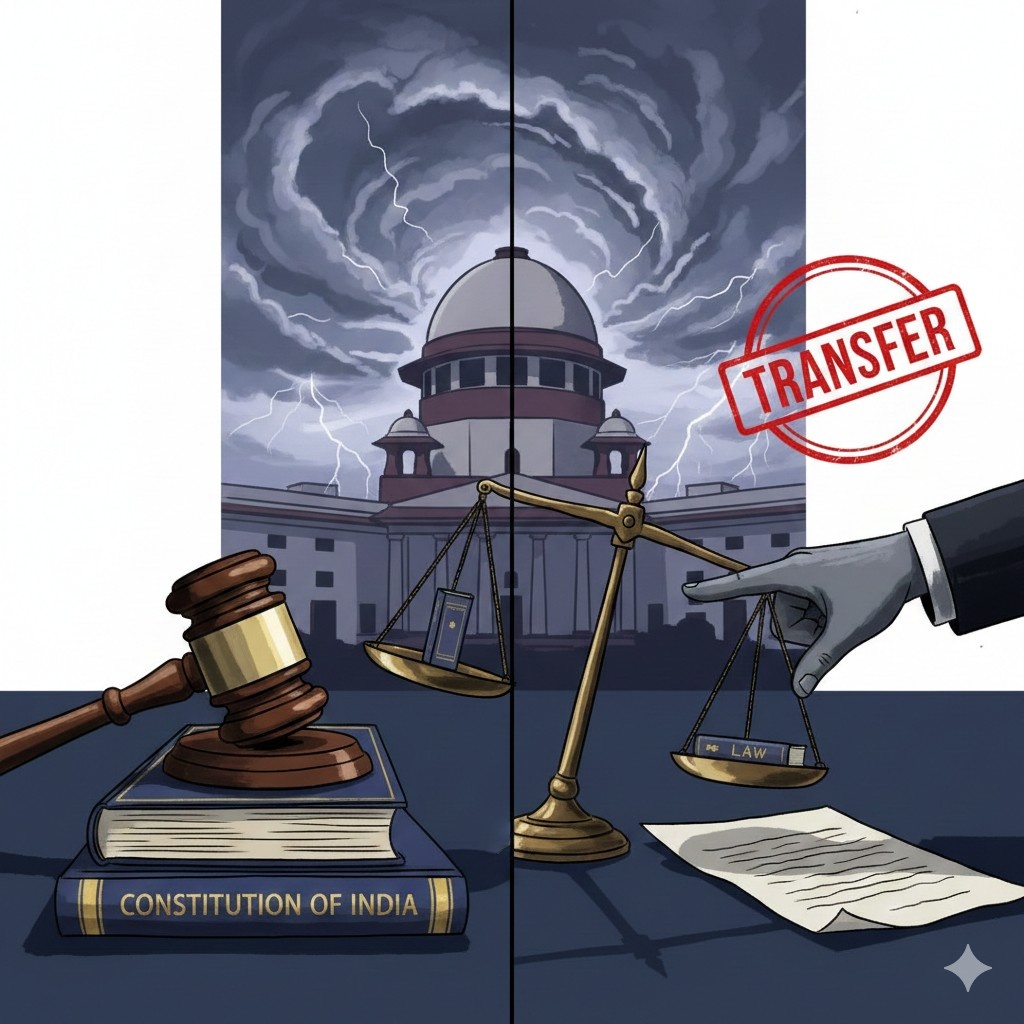

In the grand theatre of any democracy, the judiciary is often cast as the silent guardian—the stoic institution that speaks only through written orders and judgments. We operate under the comfortable assumption that the scales of justice are balanced by hands that fear no political power and favour no ideology. But what happens when that silence is broken, not by a political observer or a media pundit, but by a sitting judge of the Supreme Court of India?
Recently, a significant tremor ran through the legal corridors of the country. It was not caused by a scandalous verdict or a legislative amendment, but by a lecture delivered at the ILS Law College in Pune. The speaker was Justice Ujjal Bhuyan, a sitting judge of the apex court, and his topic was 'Constitutional Morality and Democratic Governance'. While the title sounded academic, the content was anything but. Justice Bhuyan raised uncomfortable, piercing questions that strike at the very heart of judicial independence. He asked a question that few in his position would dare to voice: Is the Supreme Court divided? And more alarmingly, is this division and the recent administrative decisions of the Collegium a result of Executive pressure?
When a voice from within the system asks if the judiciary is compromising its own integrity, it is no longer a matter of mere debate; it becomes a crisis that demands the attention of every citizen. This post delves into the specifics of Justice Bhuyan’s critique, the controversial transfer that sparked it, and the broader implications for Indian democracy.
The Spark: The Transfer of Justice Atul Sreedharan
To understand the gravity of Justice Bhuyan’s concerns, we must look beyond abstract legal theories and examine the specific incident that triggered his critique. The controversy centres on the transfer of Justice Atul Sreedharan.
The facts, as highlighted by various legal analyses, are telling:
- Initially, the Supreme Court Collegium proposed transferring Justice Sreedharan from the Madhya Pradesh High Court to the Chhattisgarh High Court.
- In October, the Collegium modified its decision, recommending his transfer to the Allahabad High Court instead.
- Crucially, the Collegium resolution explicitly recorded that the decision was modified based on "reconsideration sought by the Government".
Justice Bhuyan did not mince words, stating that for the Collegium to record that a transfer proposal was modified at the behest of the Centre reveals a "striking intrusion of executive influence into what is constitutionally supposed to be an independent process."
"Inconvenient Orders": Punishment Disguised as Administration?
Why would the government seek a reconsideration of Justice Sreedharan’s transfer? Justice Bhuyan raised a rhetorical yet warning question: "Why should a judge be transferred from one High Court to another High Court just because he had passed certain inconvenient orders against the Government?"
The implication is that the transfer system is seemingly being weaponised to punish judges who do not toe the government line. Justice Sreedharan is known for his independent stance. Specifically, his bench took cognisance of remarks made by a BJP Minister, Kunwar Vijay Shah, who allegedly made derogatory comments about an Army official. Justice Sreedharan’s bench ordered the registration of an FIR on the very same day—a move that was undeniably "inconvenient" for the Executive.
The Arithmetic of Influence: Why Allahabad Matters
The legal community understands the profound impact of where a judge sits. The transfer of Justice Sreedharan to Allahabad was not just a relocation; it was, effectively, a reduction in his institutional influence.
The judicial arithmetic is clear:
- In Chhattisgarh: Justice Sreedharan would have been senior enough to be part of the High Court Collegium, giving him a decisive role in recommending future judges.
- In Allahabad: Due to the massive size of the court, he ranks seventh. Given his retirement date in 2028, he is unlikely to ever reach the Collegium there.
By moving an independent judge to a position where his administrative influence is neutralised, the system appears to be managing "problematic" jurists rather than supporting them.
The Threat from Within
Perhaps the most chilling aspect of Justice Bhuyan’s lecture was his warning that the "greatest threat to judicial independence may come from within." He highlighted several internal risks:
"It would be a sad day for democracy if the outcome of a case becomes predictable merely by knowing which judge or bench is hearing it."
- Loss of Neutrality: The danger of judges harbouring their own ideological or political leanings.
- Yielding to Pressure: The Collegium system was devised specifically to rescue appointments from the Executive. If it buckles now, it fails its primary objective.
- Internal Dissent: References were made to Justice B.V. Nagarathna, who penned a formal dissent regarding the elevation of certain judges, signalling that the "division" within the court is real and documented.
A Pattern of "Managing" the Judiciary?
Justice Bhuyan’s concerns echo a growing sentiment among legal scholars. Critics point to a systematic pattern of weakening judicial resolve through administrative means, citing previous cases:
- Justice S. Muralidhar: Transferred from the Delhi High Court on the same day he pulled up the police regarding hate speeches during the 2020 Delhi Riots.
- The "Midnight Bench": Former Justice Abhay S. Oka warned that judges making bold humanitarian decisions often face professional consequences.
Legal academic G. Mohan Gopal describes this as a deliberate strategy to fill High Courts with judges who are "comfortable" with the worldview of those in power, potentially turning the judiciary into a "theoretical institution" that poses no real check on executive power.
Conclusion
When a sitting Supreme Court judge feels compelled to ask if the Collegium’s integrity is compromised, it is a signal that the internal checks and balances are straining. The case of Justice Atul Sreedharan is more than a human resources dispute; it is a test case for the resilience of the Indian Constitution. Justice Bhuyan warned that when judges cease to "stand erect," democracy begins to bow. His lecture serves as a reminder that the independence of the judiciary is not a privilege for the judges, but a right of the citizens, ensuring that when an individual stands against the might of the State, they have a fighting chance.



Community Insights