
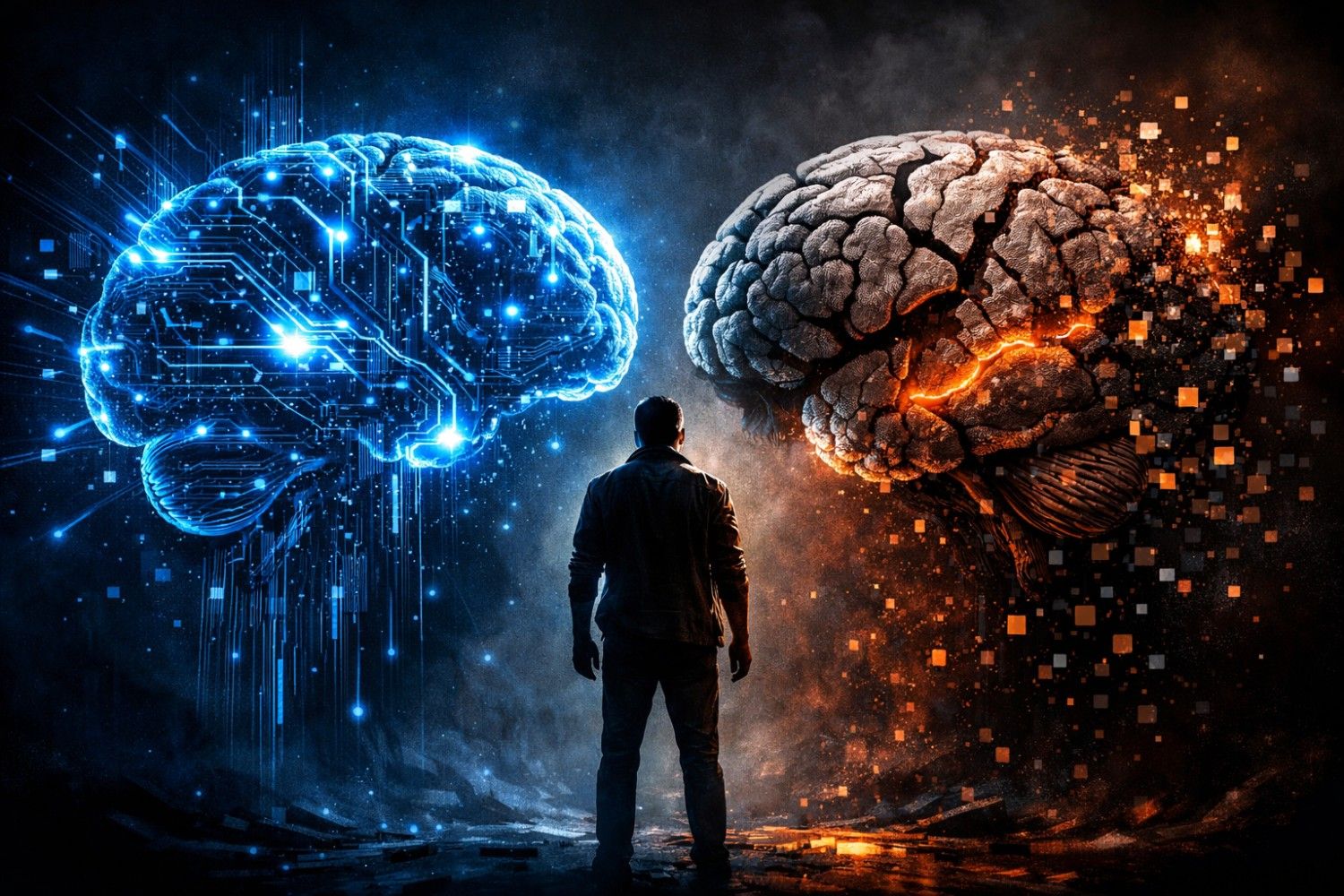

We are living through one of the most transformative periods in human history. Every day, it seems a new AI tool is released that promises to make us faster, more efficient, and ultimately, smarter. I have felt this shift myself. Over the last few years, I’ve used AI extensively, promoting its benefits and marvelling at its capabilities. But recently, a darker, more inconvenient question has started to haunt me, and perhaps it has crossed your mind too: Is artificial intelligence actually making us stupid?
It is an uncomfortable question to answer. We all assumed that by using tools that grant us access to the sum of human knowledge, we would evolve into super-intelligent beings. However, emerging scientific research suggests the opposite might be happening. The more we lean on artificial intelligence, the more our own natural intelligence risks being "hollowed out".
In this post, I want to dive deep into the science behind this phenomenon, explore the evolutionary traps we are falling into, and discuss how we can continue to use these incredible tools without sacrificing our cognitive sharpness.
The Symptoms of Digital Atrophy
To understand the scale of the problem, we don't need to look at complex neuroscience just yet; we can simply look at our own daily habits.
Think back about ten years. How many phone numbers did you have memorised? Likely at least four or five—your parents, your best friend, your home landline. Today, in 2025, try to recall how many you know by heart. It is difficult to remember even one or two, isn't it?. Because our phones store them for us, our brains have deemed that information unnecessary.
Similarly, consider navigation. A decade ago, we navigated by remembering landmarks, road names, and mental maps of our cities. Today, we simply open Google Maps or Waze and blindly follow the blue line. We have outsourced the cognitive task of orientation to a satellite.
These might seem like small conveniences, but they are symptoms of a profound shift. We are witnessing the "Google Effect" or "digital amnesia," a phenomenon identified by researcher Betsy Sparrow in 2011.
We don't remember what the information is; we only remember where to find it.
While this frees up space in our minds, it comes at a cost.
The Neuroscience of "Switching Off"
The most alarming evidence comes from recent studies analysing brain activity while interacting with AI.
In one study, participants were divided into three groups to write an essay: one group used ChatGPT, one used Google Search, and one wrote manually. An EEG machine recorded their brain activity during the task.
The group using ChatGPT showed the least amount of brain engagement. Effectively, their brains were "switched off".
Even more concerning was the long-term impact observed in the study. Over time, the ChatGPT users became lazier.
The Hippocampus and the Taxi Driver
To understand the physical impact of this reliance, we can look at the famous studies done on London taxi drivers.
When scientists analysed the brains of these drivers, they found that the hippocampus was significantly larger than that of the average person.
Today, the reverse is happening. Heavy users of GPS are showing signs of weaker navigation skills.
The Trap of the "Cognitive Miser"
The answer lies in our evolution. The human brain represents only about 2% of our body weight, yet it consumes a staggering 20% of our energy.
Our brains need friction to learn.
The Death of "Grunt Work" and Mastery
One of the most overlooked dangers of AI is the automation of "grunt work".
- Writing basic code
- Summarizing documents
- Drafting routine emails
If we bypass this stage using AI, we rob ourselves of the fundamentals.
Historical Panic vs. Modern Reality
Socrates famously opposed the invention of writing.
The AI revolution feels different because of the scope of the outsourcing.
The Solution: Don't Boycott, Train.
Absolutely not. That would be unrealistic and foolish.
We need Brain Training.
A Practical Regimen for the AI Age
| Mental Math | Short-Term Memory | Attention and Focus | Vocabulary and Reasoning |
|---|---|---|---|
| The Calculator Antidote | The Amnesia Antidote | The Distraction Antidote | The Writing Antidote |
1. Mental Math
We need to practice rapid mental math.
2. Short-Term Memory
We need exercises that force us to retain information.
3. Attention and Focus
Complex tasks require sustained focus.
4. Vocabulary and Reasoning
Arranging words by nuance keeps our linguistic processing sharp.
Conclusion: The Best of Both Worlds
The goal is not to choose between the convenience of AI and our own intelligence. We can have both.
- Take the "Navigation Challenge"
- Write the First Draft
- Hit the Mental Gym
AI is a tool to make us productive. It is up to us to ensure it doesn't also make us obsolete.

Community Insights