


The TCP/IP model is the foundation of modern networking and the Internet itself. Every email sent, every website loaded, and every video streamed relies on TCP/IP to ensure reliable communication between devices. Understanding this model is essential for network engineers, cybersecurity professionals, developers, and anyone preparing for certifications like CCNA. The TCP/IP suite provides a structured approach that defines how data moves from one device to another across networks using standardized protocols.
This article explains the TCP/IP model in depth, including its history, layers, encapsulation process, protocol data units, interaction between layers, and comparison with the OSI model. By the end, you will have a complete understanding of how real-world networking actually works.
What Is the TCP/IP Model?
The TCP/IP model is a layered networking framework that defines how data is transmitted across networks. It organizes networking functions into separate layers, each responsible for specific tasks. This layered approach allows devices from different manufacturers to communicate seamlessly because they follow the same standardized protocols.
TCP/IP stands for:
- Transmission Control Protocol (TCP) – Provides reliable communication and ensures data arrives correctly.
- Internet Protocol (IP) – Provides logical addressing and routing so data can reach the correct destination.
This model was originally developed by the United States Department of Defense through DARPA to create a resilient and interoperable communication system. Today, it forms the backbone of the global Internet.
Why Networking Models Exist
Without networking models, communication between devices would be chaotic. Each device manufacturer might use its own communication method, making interoperability impossible.
Networking models solve this problem by providing:
- Standardized communication rules
- Clear separation of responsibilities
- Easier troubleshooting
- Interoperability between different hardware and software
- Scalable and modular network design
Networking models provide structure for protocols and ensure devices can communicate reliably across diverse networks.
This layered design also allows engineers to troubleshoot problems more efficiently because each layer has clearly defined functions.
Layered Architecture Concept
The TCP/IP model uses a layered architecture. Each layer communicates only with the layers directly above and below it. This separation ensures that changes in one layer do not affect others.
For example:
- The application layer does not need to know how cables work.
- The physical layer does not need to know about web browsers.
- Each layer performs its specific role.
This modular approach makes networking flexible and efficient.
The Five Layers of the TCP/IP Model
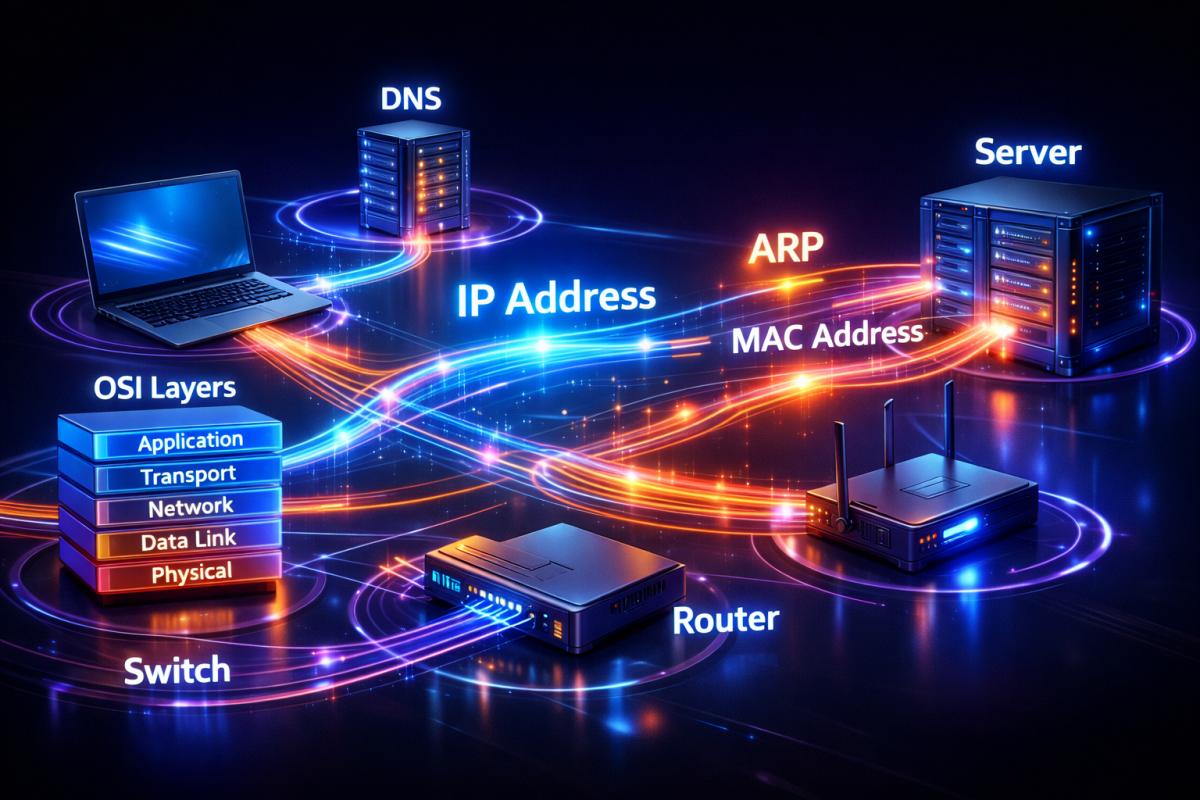
The TCP/IP model is commonly explained using five layers:
- Physical Layer
- Data Link Layer (Local Network Layer)
- Internet Layer
- Transport Layer
- Application Layer
Some versions combine the first two layers, resulting in a four-layer model. However, the five-layer model provides clearer understanding and aligns closely with real network operations.
Layer 1: Physical Layer
The Physical Layer is responsible for transmitting raw bits over a physical medium. This includes electrical signals, cables, connectors, wireless signals, and hardware components.
Key Responsibilities
- Transmission of binary data (0s and 1s)
- Electrical voltage levels
- Physical connectors
- Cabling standards
- Wireless signal transmission
Examples of Physical Components
- Ethernet cables
- Fiber optic cables
- Wireless radio transmitters
- Network interface cards
- Switch ports
This layer does not interpret data. It only transmits signals.
Layer 2: Data Link Layer (Local Network Layer)
The Data Link Layer ensures communication between devices on the same local network. It packages data into frames and handles physical addressing using MAC addresses.
Main Functions
- Frame creation
- Error detection
- MAC addressing
- Local network communication
- Switching
Examples of Protocols
- Ethernet
- Wi-Fi
- ARP (Address Resolution Protocol)
This layer ensures data reaches the correct device within the same network.
Layer 3: Internet Layer
The Internet Layer is responsible for logical addressing and routing. It determines the best path for data to travel between networks.
This layer uses IP addresses to identify devices globally. Routers operate primarily at this layer and forward packets between networks.
Key Responsibilities
- Logical addressing (IP addresses)
- Routing
- Packet forwarding
- Path selection
Common Protocols
- IPv4
- IPv6
- ICMP
Without this layer, devices could not communicate outside their local network.
Layer 4: Transport Layer
The Transport Layer ensures reliable communication between devices. It divides data into smaller pieces called segments and ensures they arrive correctly.
This process improves reliability because smaller segments can be retransmitted if errors occur.
Main Functions
- Segmentation
- Error correction
- Flow control
- End-to-end communication
- Port addressing
Main Protocols
- TCP – Reliable and connection-oriented
- UDP – Faster but connectionless
TCP vs UDP Comparison
| Feature | TCP | UDP |
|---|---|---|
| Reliability | High | Low |
| Speed | Slower | Faster |
| Connection | Connection-oriented | Connectionless |
| Use cases | Web browsing, email | Streaming, gaming |
Layer 5: Application Layer
The Application Layer provides network services directly to users and applications.
This layer combines the functions of the OSI model’s application, presentation, and session layers.
Common Protocols
- HTTP / HTTPS
- FTP
- SMTP
- DNS
- SSH
Whenever you open a website or send an email, the application layer is involved.
Encapsulation Process
Encapsulation is the process of adding headers as data moves down the layers.
Step-by-Step Encapsulation
- Application creates data
- Transport layer adds TCP/UDP header (Segment)
- Internet layer adds IP header (Packet)
- Data link layer adds frame header and trailer
- Physical layer transmits bits
Each layer adds its own information to ensure correct delivery.
Encapsulation allows multiple layers to work together while maintaining separation of responsibilities.
Decapsulation Process
Decapsulation is the reverse process. As data reaches the destination:
- Physical layer receives bits
- Data link layer removes frame header
- Internet layer removes IP header
- Transport layer removes TCP header
- Application layer receives data
This ensures the receiving application gets the original message.
Protocol Data Units (PDUs)
Each layer uses different names for data:
| Layer | PDU Name |
|---|---|
| Application | Data |
| Transport | Segment |
| Internet | Packet |
| Data Link | Frame |
| Physical | Bits |
This terminology helps engineers identify where data is in the transmission process.
Layer Interaction
Adjacent Layer Interaction
Each layer communicates only with the layer above and below it.
Example:
- Transport layer communicates with Internet layer
- Internet layer communicates with Data Link layer
Same Layer Interaction
Devices communicate logically with the same layer on another device.
Example:
- Transport layer communicates with transport layer on destination device
- Application layer communicates with application layer
Real-World Example: Loading a Website
When you visit a website:
- You enter a URL in your browser.
- Application layer sends HTTP request.
- Transport layer uses TCP.
- Internet layer adds IP address.
- Data link layer sends frame.
- Physical layer transmits bits.
- Destination responds using reverse process.
This entire process happens in milliseconds.
Importance of Protocol Standards
Networking standards ensure devices from different vendors work together.
Organizations responsible include:
- IETF
- IEEE
- ISO
- ICANN
These organizations define protocols used globally.
TCP/IP vs OSI Model
| OSI Model | TCP/IP Model |
|---|---|
| Application | Application |
| Presentation | |
| Session | |
| Transport | Transport |
| Network | Internet |
| Data Link | Network Access |
| Physical |
The OSI model has seven layers, while TCP/IP has fewer layers and is actually used in real networks.
Advantages of the TCP/IP Model
- Universal standard
- Highly scalable
- Reliable communication
- Supports modern Internet
- Modular design
- Flexible implementation
Common Protocol Examples by Layer
| Layer | Protocol Examples |
|---|---|
| Application | HTTP, HTTPS, FTP, DNS |
| Transport | TCP, UDP |
| Internet | IP, ICMP |
| Data Link | Ethernet, Wi-Fi |
| Physical | Cables, Signals |
Why TCP/IP Is Still Used Today
The TCP/IP model remains dominant because it is:
- Proven reliable
- Flexible
- Vendor-neutral
- Scalable
- Compatible with modern networks
Every modern network uses TCP/IP.
Troubleshooting Using TCP/IP Layers
Network engineers use layers to identify problems.
- No signal → Physical layer issue
- MAC issue → Data link layer
- IP issue → Internet layer
- Port issue → Transport layer
- Application error → Application layer
This structured approach makes troubleshooting efficient.
Real-World Devices and Their Layers
| Device | Layer |
|---|---|
| Hub | Physical |
| Switch | Data Link |
| Router | Internet |
| Firewall | Transport/Application |
| Browser | Application |
Key Concepts to Remember
- TCP/IP is the foundation of the Internet
- It uses layered architecture
- Each layer has specific responsibilities
- Encapsulation ensures reliable delivery
- Routers operate at Internet layer
- Applications operate at application layer
Conclusion
The TCP/IP model is the backbone of modern digital communication. It provides a structured and standardised method for transmitting data across networks, ensuring interoperability between devices worldwide. By dividing networking tasks into layers such as physical, data link, internet, transport, and application, the model simplifies network design, troubleshooting, and scalability. Concepts like encapsulation, protocol data units, and logical addressing enable reliable and efficient communication across complex global networks. Understanding how TCP/IP actually works is essential for anyone pursuing a career in networking, cybersecurity, or IT infrastructure, as it forms the foundation upon which the entire Internet operates.

Community Insights