
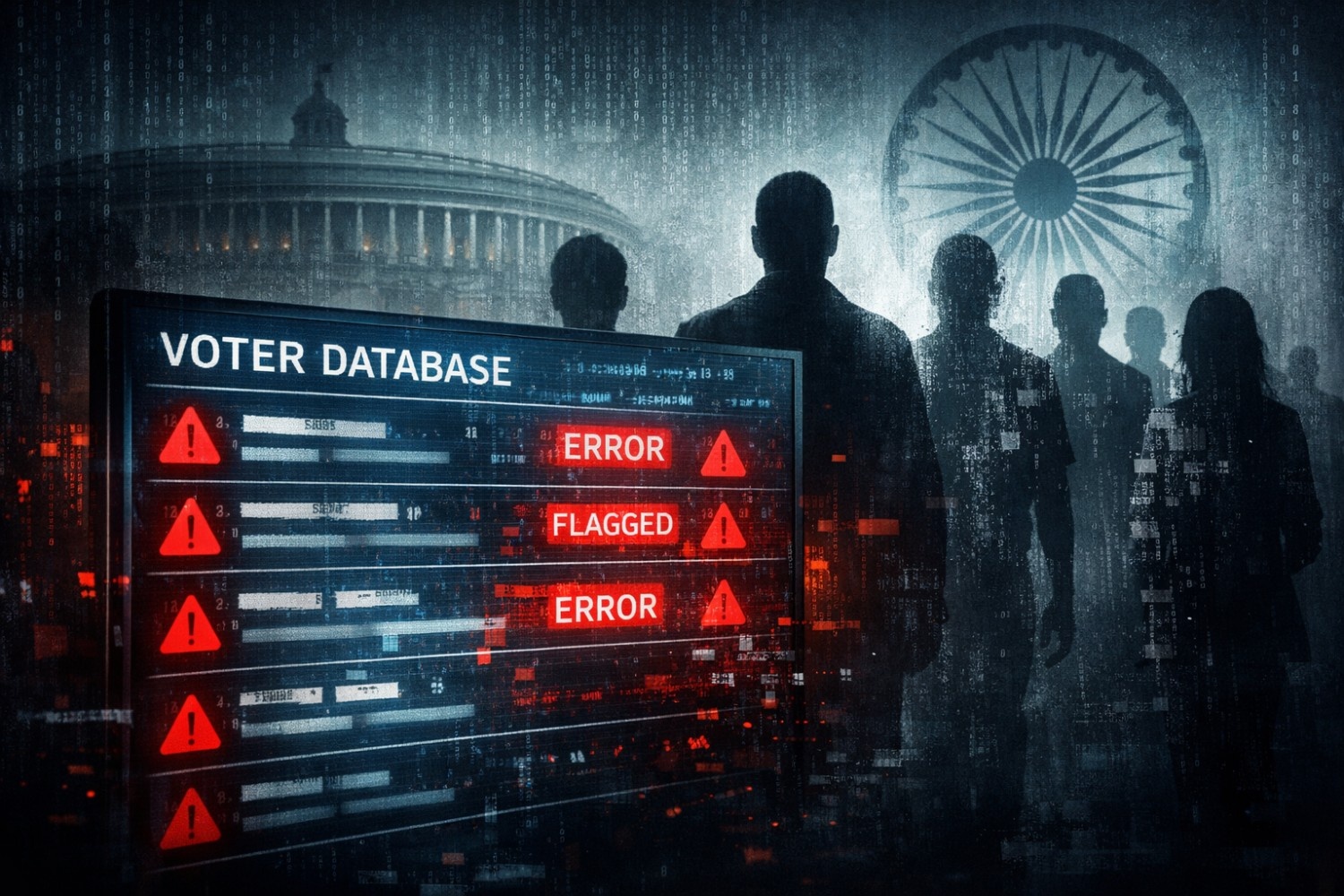

In the grand theatre of Indian democracy, we often view the Election Commission of India (ECI) as the infallible conductor of the orchestra. They set the tempo, they ensure the instruments are tuned, and they call out anyone playing out of key. Recently, the ECI pointed a sharp finger at the West Bengal state government, blaming "non-cooperation" and a lack of coordination within the state machinery for delays and discrepancies in the electoral roll revision. It seemed like a standard administrative standoff: a central body accusing a state body of inefficiency.
However, a massive twist has emerged in this narrative. While the ECI was busy casting blame on the state, reports and insiders have revealed that the problem might not be with the people running the state, but with the very digital system the ECI is using to manage us. We are now facing a terrifying question: Is the backbone of Indian democracy running on faulty software?
The Context: What is the Special Intensive Revision?
To understand the gravity of this situation, we first need to look at the process known as the Special Intensive Revision (SIR). This isn't just paperwork; it is a critical democratic exercise designed to thoroughly revise electoral rolls. The goal is simple and noble: ensure that only eligible voters are on the list, and remove any duplicate, deceased, or ineligible entries.
The voter list is the holy grail of our democracy. It decides who gets to speak and who is silenced. However, the Chief Minister of West Bengal, Mamata Banerjee, raised serious alarms about this specific exercise in the Supreme Court. She alleged that during the SIR, a large number of genuine voters were being flagged by the software under the guise of "logical discrepancies".
"In simple words, genuine voters suddenly became suspects just because their names didn't perfectly match the software's rigid logic."
The situation became so critical that the Chief Justice of India, Surya Kant, had to intervene. Recognizing the seriousness of excluding eligible citizens, the Supreme Court asked the ECI to explain the basis for flagging these voters, explicitly stating that eligible voters must not be excluded.
ERONET: The Flawed Backbone
The software at the heart of this controversy is the Electoral Registration Officer Network (ERONET). Developed by the National Informatics Centre (NIC) and rolled out nationwide around 2013-14, its purpose was to digitize voter registration, correction, and deletion to improve transparency and efficiency.
However, insiders and senior officials from the ECI’s IT division have now admitted that the software, combined with the reliance on old records, created a perfect storm of errors. The system essentially broke down because it could not handle the reality of Indian records.
1. The "Faded Ink" Glitch
One of the most baffling admissions is how the system handles physical records. The system depends heavily on the clarity of old records. If scanned copies of voter documents are unclear, faded, or have illegible handwriting, the software increases the chances of mistakes.
Consider a voter record from 20 years ago. The paper is likely yellowed, the ink faded. A human eye might squint and decipher it, but the software? It misreads the data. Once the software misreads the text, it automatically flags the entry as a discrepancy. Consequently, a perfectly eligible voter falls into a "doubtful" category simply because a piece of paper from two decades ago has degraded.
2. Lost in Translation: The Language Barrier
Perhaps the most culturally damaging flaw in the system is its inability to handle linguistic nuance. The old voter records in West Bengal, specifically those from 2002 and 2004, were recorded in Bengali. The software’s job was to translate or transliterate these records into English and match them against the current voter list.
But language is not a mathematical equation. It is fluid. Officials admitted that the software failed to account for natural variations in spelling and pronunciation. It treated common variations as errors.
The Discrepancy Table
To illustrate how absurd these "logical discrepancies" are, look at how the software misinterpreted standard name variations:
| Name Variation A | Name Variation B | Human Interpretation | ERONET Software Interpretation |
|---|---|---|---|
| Mohammed | Mohammad | Same Person | Discrepancy / Error |
| Sk | Sheikh | Same Person | Discrepancy / Error |
| Mondal | Mandal | Same Person | Discrepancy / Error |
As cyber security expert Srinivas Kodali noted, when a system compares text without understanding context or language, it treats small differences as serious issues. This turns a technical flaw into a systemic violation of rights. The software simply does not understand local language habits.
The Removal of the Human Touch
This brings us to a frightening realization about modern governance: the erasure of human judgment. In the past, Booth Level Officers (BLOs) and Electoral Registration Officers operated on the ground. If there was a small spelling mistake—a "Mandal" written as "Mondal"—the officer would verify the person, use their judgment, and correct it immediately.
However, the heavy dependence on this flawed software has reduced the role of these human officers. Now, once the system "flags" a voter, the correction process becomes long, arduous, and complicated. Instead of technology making the process easier, it has made it harder. Officials have admitted that errors that could previously be fixed instantly now trap the voter in a bureaucratic loop.
Changing the Rules Mid-Game
If the structural flaws weren't enough, the timing of the software's implementation raises even more questions regarding administrative accountability. While ERONET has been around for a decade, the ECI introduced new checks and scrutiny mechanisms specifically for this SIR exercise only last year. This led to a sharp rise in entries being marked with "logical discrepancies."
Worse still, officials revealed that the software was being updated while the work was ongoing. Imagine taking an exam where the format of the question paper is changed halfway through the test. Confusion is inevitable. By updating the software during a live electoral revision process, the ECI essentially guaranteed that errors would multiply.
Political Questions and Accountability
The ramifications of this are not just technical; they are deeply political. Member of Parliament Saket Gokhale has rightly pointed out the silence of Chief Election Commissioner Gyanesh Kumar on this issue. Gokhale raised two pertinent questions that deserve answers:
- Who made this "mysterious faulty software" that deletes legitimate voters?
- Why has the ECI not stopped using it despite knowing it is faulty?
The West Bengal government has argued in the Supreme Court that these software flaws are leading to the mass exclusion of genuine voters. This is not a trivial administrative error. Voting is a constitutional right. If a software glitch prevents a citizen from voting, it is a direct attack on democratic integrity.
Conclusion
While the current spotlight is on West Bengal, the implications are national. If ERONET is being used nationwide, and if it lacks the capability to understand linguistic nuances or read faded records, are voters in other states also at risk?. We often talk about the "Digital India" dream, but digitalization without empathy, context, or robust testing can become a nightmare. We cannot allow the backbone of our democracy to be broken by lines of code that can't tell the difference between "Sheikh" and "Sk." The Supreme Court’s intervention is a ray of hope, but this incident serves as a stark warning. We need to demand accountability, not just from the political parties, but from the technical systems that manage our lives. When the algorithm becomes the arbiter of citizenship, we must ensure the algorithm is flawless. Right now, it seems, it is anything but.

Community Insights