
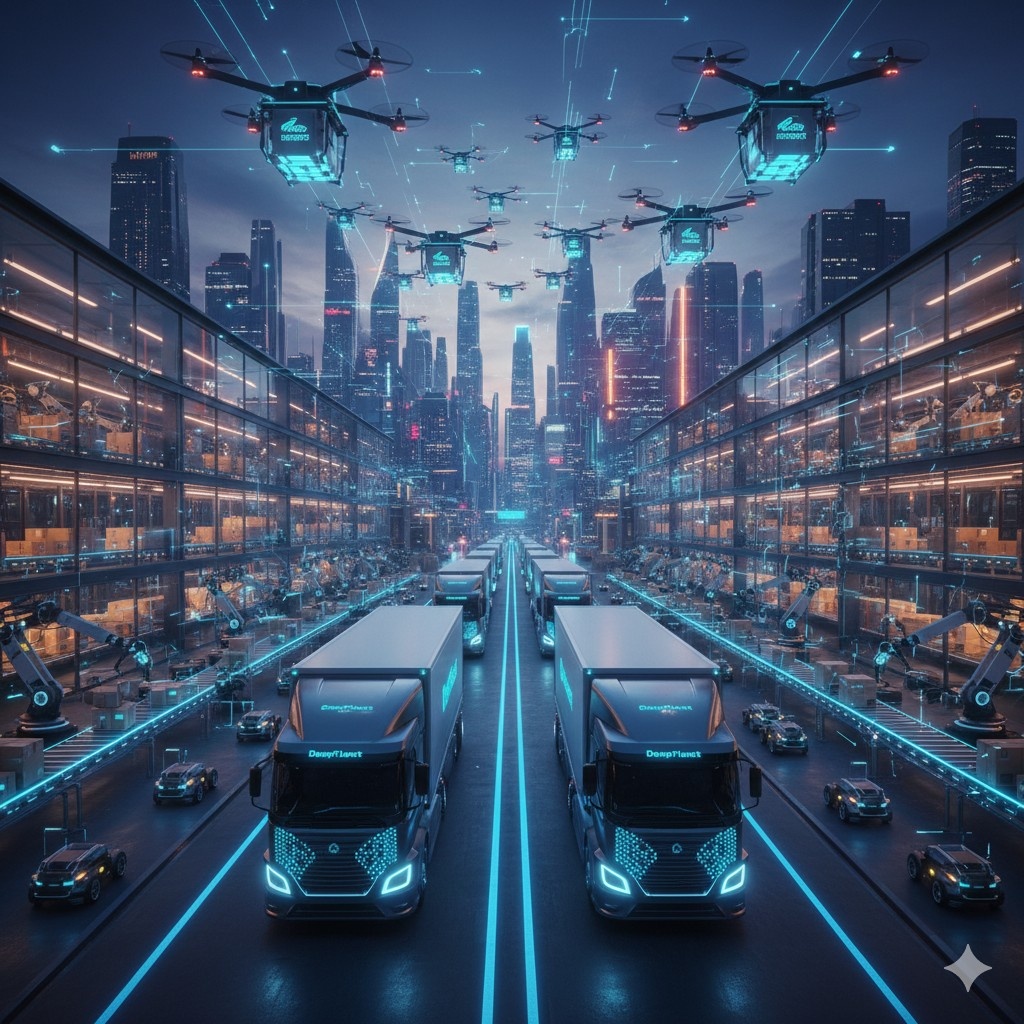

The gentle hum of an electric delivery van, the whir of a drone, and the almost imperceptible movement of automated forklifts in a vast warehouse – these are the new sounds of global logistics. For decades, the movement of goods, from factory floors to front doors, has been a complex ballet choreographed by humans. Drivers navigated congested streets, warehouse workers meticulously picked and packed, and dispatchers played a never-ending game of Tetris with schedules and routes. It was a system built on human intuition, resilience, and often, sheer brute force.
But by 2026, a silent revolution has taken hold, reshaping the very fabric of how products flow through the economy. This isn't just about a self-driving truck or a single automated warehouse. This is about Autonomous Logistics – an AI-driven, end-to-end ecosystem where "DeepFleets" of intelligent vehicles, robots, and sophisticated software coordinate to move packages with unprecedented efficiency, speed, and precision.
The term "DeepFleet" perfectly encapsulates this paradigm shift. It refers not merely to a collection of autonomous vehicles but to an interconnected, self-optimising network powered by deep learning AI. These fleets aren't just following pre-programmed routes; they are constantly analysing real-time data, predicting demand, avoiding bottlenecks, and even performing maintenance diagnostics autonomously. For consumers, this means faster deliveries, fewer errors, and a more seamless experience. For businesses, especially small and medium-sized enterprises (SMEs), it promises a level playing field, reducing operational costs and enabling them to compete with logistical giants.
1. What Exactly is Autonomous Logistics?
Autonomous Logistics is the overarching framework for supply chain operations where artificial intelligence, robotics, and advanced automation execute tasks with minimal human intervention. It spans the entire journey of a package:
A. Automated Warehousing and Fulfilment
The heart of autonomous logistics often begins in the warehouse. Here, robots no longer just move items; they orchestrate entire fulfilment processes:
- Automated Storage and Retrieval Systems (AS/RS): Tall, narrow aisles where robotic cranes or shuttles retrieve items with pinpoint accuracy.
- Autonomous Mobile Robots (AMRs): These intelligent robots navigate dynamically, moving goods between picking stations, packing zones, and loading docks without fixed paths. Unlike older Automated Guided Vehicles (AGVs), AMRs can react to obstacles and find alternative routes in real-time.
- Robotic Picking and Packing: Advanced robotic arms equipped with AI-powered vision systems identify, pick, and pack a vast array of items, often working collaboratively with human counterparts for complex tasks.
B. Autonomous Transportation
This is arguably the most visible aspect of autonomous logistics and where "DeepFleets" truly shine:
- Self-Driving Trucks (SDTs): Heavy Goods Vehicles (HGVs) equipped with Level 4 or Level 5 autonomy, capable of long-haul journeys on motorways and dedicated logistics lanes without a human driver.
- Last-Mile Delivery Bots: Smaller, ground-based robots and aerial drones that handle the final leg of delivery, navigating urban environments and reaching customer doorsteps.
- Automated Rail and Sea Freight: While less publicly visible, AI is optimising scheduling, routing, and even the loading/unloading of cargo on trains and ships.
C. AI-Powered Orchestration and Optimisation
The glue that holds this autonomous ecosystem together is sophisticated AI. This layer provides:
- Predictive Analytics: Forecasting demand, identifying potential supply chain disruptions, and optimising inventory levels before issues arise.
- Dynamic Routing: Real-time adjustments to delivery routes based on traffic, weather, road closures, and even customer availability.
- Fleet Management: Monitoring the health and performance of every autonomous vehicle, scheduling preventative maintenance, and dynamically reassigning tasks.
- Simulations and Digital Twins: Creating virtual models of the entire logistics network to test new strategies, predict outcomes, and refine operations in a risk-free environment.
2. The Technological Bedrock: What Makes DeepFleets Possible?
The rapid evolution of autonomous logistics is a testament to breakthroughs across several critical technology domains.
A. Advanced Artificial Intelligence and Machine Learning
Deep learning algorithms are the brain of every DeepFleet. They enable:
- Perception: Interpreting sensor data (cameras, LiDAR, radar) to understand the environment, identify objects (vehicles, pedestrians, signs), and predict their behaviour with human-like accuracy.
- Decision Making: Making split-second choices in complex, dynamic situations, such as navigating an unexpected road obstruction or optimising a delivery sequence.
- Optimisation: Continuously refining routes, schedules, and resource allocation to minimise costs, fuel consumption, and delivery times.
- Predictive Maintenance: Analysing sensor data from vehicles to anticipate mechanical failures before they occur, scheduling maintenance proactively, and reducing costly downtime.
B. Sensor Fusion and High-Precision Mapping
Autonomous vehicles rely on a rich tapestry of sensor data to "see" their world:
- LiDAR (Light Detection and Ranging): Creating highly detailed 3D maps of the environment, crucial for precise navigation and obstacle detection.
- Radar: Excelling in adverse weather conditions (fog, heavy rain) where cameras and LiDAR may struggle, detecting distances and speeds.
- Cameras: Providing visual context, reading traffic signs, identifying traffic lights, and classifying objects.
- Ultrasonic Sensors: Used for short-range detection, especially during parking and low-speed manoeuvres.
- GPS and Inertial Measurement Units (IMUs): For precise localisation and understanding the vehicle's movement and orientation.
This sensor data is fused together, creating a comprehensive and redundant understanding of the vehicle's surroundings, allowing for robust operation even if one sensor is temporarily obscured.
C. 5G Connectivity and Edge Computing
The sheer volume of data generated by DeepFleets demands robust communication infrastructure:
- 5G Networks: Providing ultra-low latency and high bandwidth, critical for real-time communication between vehicles, central command centres, and cloud-based AI. This enables vehicles to share information about traffic or hazards almost instantly.
- Edge Computing: Performing critical, time-sensitive processing (e.g., immediate obstacle avoidance) directly on the vehicle ("at the edge") to ensure rapid response times, while more complex data analysis and long-term learning are offloaded to the cloud.
D. Robotic Hardware Advances
The physical robots themselves have become more capable and cost-effective:
- Improved Dexterity: Robotic arms in warehouses can handle a wider variety of items with greater precision.
- Energy Efficiency: Electric drivetrains for autonomous trucks and delivery bots are becoming more efficient, extending operational ranges.
- Modular Design: Allowing for easier maintenance and upgrades, reducing the total cost of ownership.
3. The Economic Impact: Redefining Global Commerce
The transition to DeepFleets is not merely a logistical upgrade; it is a fundamental shift in the economics of trade. By removing the constraints of human driving hours and manual sorting errors, the cost of moving a parcel from point A to point B has begun to plummet.
The Death of the "Delivery Surcharge"
For decades, small businesses struggled with the "last-mile" problem—the most expensive part of the journey. In 2026, autonomous delivery bots have reduced last-mile costs by nearly 40%. This allows boutique retailers to offer free or low-cost shipping that was previously only sustainable for multinational corporations. This democratisation of delivery is allowing local high streets to compete on a global scale.
The 24/7 Supply Chain
Unlike human workers who require rest, DeepFleets operate on a "perpetual motion" model. Warehouses now hum with activity throughout the night, and long-haul autonomous trucks move across motorways during off-peak hours to avoid congestion. This has effectively compressed the traditional three-day delivery window into a standard 24-hour cycle for most national shipments.
4. DeepFleets vs. Traditional Logistics
To understand the magnitude of this revolution, we must compare the operational metrics of 2026 DeepFleets against the traditional human-centric models of the past decade.
| Metric | Traditional Logistics | AI-Driven DeepFleets |
|---|---|---|
| Operational Hours | 8–12 hours (Shift dependent) | 24/7 (Minus charging/service) |
| Route Planning | Static / Semi-dynamic | Real-time Predictive AI |
| Error Rate (Sorting) | Approx. 1-2% | Less than 0.01% |
| Carbon Footprint | High (Diesel/Inefficient routes) | Low (Electric/Optimised paths) |
| Last-Mile Cost | High (Driver + Fuel) | Low (Autonomous Bot) |
5. Environmental Stewardship: Green Logistics
Sustainability is perhaps the most significant "quiet" victory of the DeepFleet revolution. Because AI can calculate the most fuel-efficient acceleration, braking, and routing, the energy consumption per package has dropped significantly.
The Electric Integration
DeepFleets are almost exclusively electric. AI manages the charging cycles of the fleet to ensure they pull power from the grid during periods of high renewable energy production. This "smart charging" makes the logistics network a stabilising force for the national grid, rather than just a consumer of energy.
Dead-Heading Elimination
In the past, one in four trucks on the road was empty, returning from a delivery—a phenomenon known as "dead-heading." DeepFleets use advanced predictive algorithms to ensure that every vehicle is utilised at maximum capacity, matching return trips with new pickups in real-time, virtually eliminating wasted journeys.
6. Challenges: Navigating the Road Ahead
Despite the rapid progress, the road to total autonomy is not without its hurdles. Public perception and regulatory frameworks remain the primary bottlenecks in 2026.
The Regulatory Patchwork
While the UK has pioneered "Logistics Lanes" on major motorways for autonomous HGVs, international transit remains complex. Different countries have varying levels of acceptance for driverless technology, creating "hand-over" points at borders that temporarily slow down the seamless flow of goods.
Cyber Security: The New Frontier
When an entire fleet is connected to the cloud, the risk of a "network-wide" disruption becomes a serious concern. Logistics companies are now investing more in cyber-defence than in mechanical maintenance. Protecting the AI "brain" of the DeepFleet from interference is now a matter of national economic security.
7. The Human Element: From Drivers to Supervisors
The most common question regarding autonomous logistics is: "What happens to the drivers?" In 2026, we are seeing a significant transition rather than a simple displacement. Former drivers are being retrained as Fleet Supervisors.
A single human supervisor now monitors a "cell" of twenty autonomous vehicles from a remote command centre. When a robot encounters a situation it cannot solve—such as a complex police diversion or a damaged delivery terminal—the human supervisor "tele-operates" the vehicle or provides the necessary decision-making. This shift has moved the workforce from physically exhausting labour to highly skilled technical oversight.
Conclusion
Autonomous logistics is no longer a futuristic concept; it is the engine of the 2026 economy. Through the implementation of DeepFleets, we have created a supply chain that is faster, greener, and more resilient than anything the world has seen before. By combining the raw processing power of deep learning with the physical agility of autonomous robotics, we have effectively "solved" the friction of distance.
As we look forward, the continued integration of 5G-Advanced and even more sophisticated Physical AI will only refine this system. We are moving toward a world where the physical movement of goods is as invisible and reliable as the flow of water or electricity. The DeepFleet revolution is a testament to the fact that when we automate the mundane, we unlock the potential for a more connected and efficient global society. The package at your doorstep is no longer just a delivery; it is a data-driven miracle of modern engineering.

Community Insights