
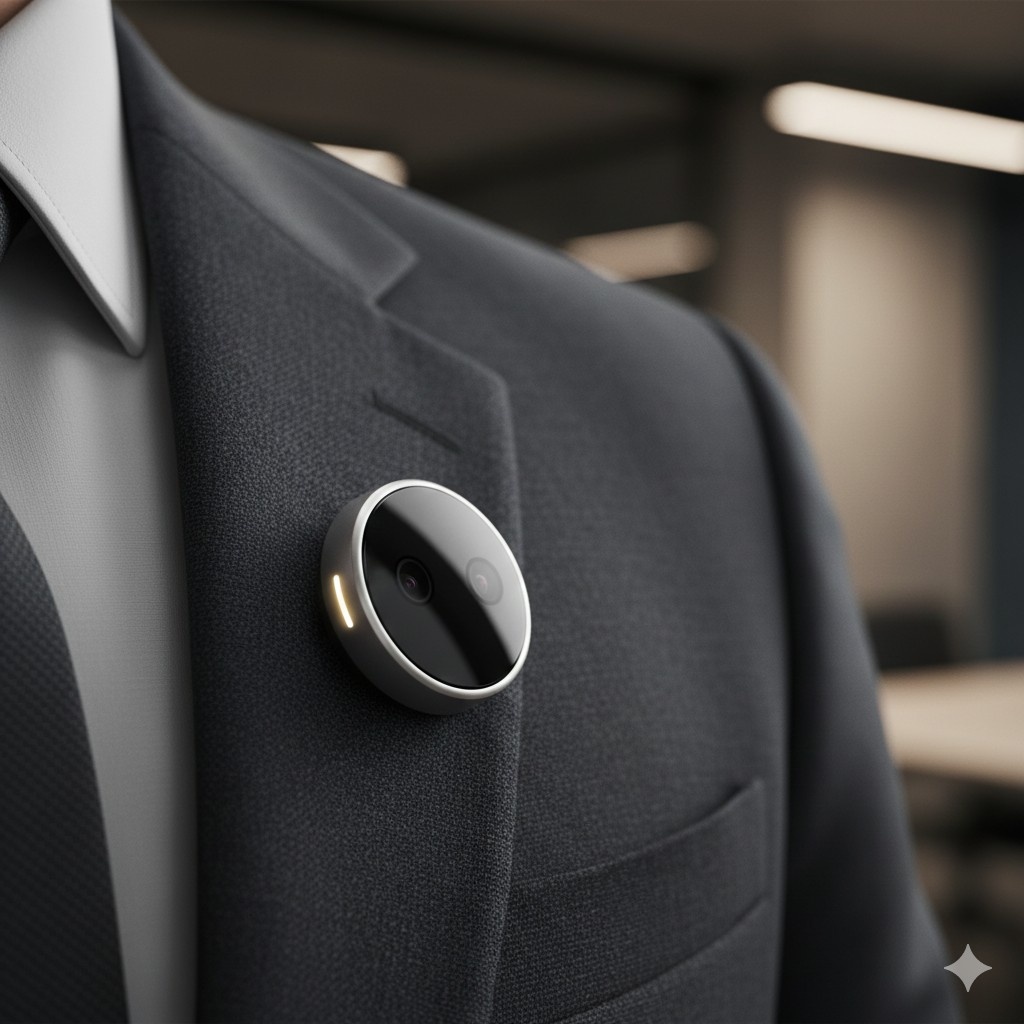

In the quiet corridors of Cupertino, a project is reportedly underway that could redefine how we interact with the digital world—or perhaps, how we detach from it. Recent leaks from reputable industry insiders suggest that Apple is deep into the development of a wearable AI device. Described as an "AirTag-sized pin," this hardware is not designed to track your keys, but to see the world as you see it and hear it as you hear it.
Following the spectacular public struggles of first-movers like the Humane AI Pin and the Rabbit R1, the tech community is rightfully sceptical of screenless gadgets. However, Apple’s approach appears to be fundamentally different, leveraged by a vertical integration of silicon, software, and a massive existing ecosystem. Drawing on detailed supply chain reports and Apple’s own recent technical disclosures regarding their Foundation Language Models, we can piece together a comprehensive picture of what might be the next "One More Thing" moment—or a high-stakes experiment that never leaves the lab.
The Form Factor: More Than Just a Tracker
According to reports from The Information and supply chain analysis, the device currently in the prototyping phase is a circular, disc-shaped unit. While it shares the footprint of an AirTag, it is reportedly thicker to accommodate the complex sensor array packed inside. The chassis is constructed from Apple’s signature aluminium and glass, maintaining the premium aesthetic users expect.
Unlike a passive tracker, this device is an active observer. The prototype features a dual-camera system embedded in the front face: a standard wide lens and an ultra-wide lens. This configuration is designed for multimodal scene understanding—allowing the AI to "see" the user’s environment, read text from physical documents, and recognise objects in real-time. Complementing the vision system is an array of three microphones designed to capture spatial audio, ensuring that voice commands are isolated from ambient noise, a critical feature for a device likely to be worn on a lapel or shirt.
Interaction seems to be primarily voice-driven, though a physical button on the edge of the device allows for tactile input—likely a privacy-focused "push-to-talk" or activation mechanism. Output is handled via a built-in speaker, although one assumes seamless integration with AirPods would be the preferred method for discreet communication. Charging duties are reportedly handled by a magnetic inductive interface on the back, mirroring the puck-style charger of the Apple Watch.
The Brains: Inside Apple’s Foundation Models
The hardware is merely a vessel; the true viability of an AI pin relies on the intelligence driving it. This is where Apple holds a significant strategic advantage over startups. Recent technical reports on Apple Intelligence Foundation Language Models reveal an architecture perfectly suited for a low-power, screenless wearable.
Apple has developed a dual-model approach that balances privacy, latency, and capability:
1. The On-Device Powerhouse
For a wearable to be responsive, it cannot rely entirely on the cloud. Latency kills the conversational experience. Apple’s technical documentation describes a proprietary on-device model with approximately 3 billion parameters. This model is optimised specifically for Apple Silicon through architectural innovations that are critical for a battery-constrained device.
Engineers have implemented "KV-cache sharing," a technique that reduces memory usage by over 30 per cent and significantly speeds up the "time-to-first-token"—essentially, how fast the AI starts speaking back to you. Furthermore, they employ aggressive "2-bit quantization," compressing the model’s weight to run efficiently without destroying its intelligence. This means the wearable could handle summarisation, basic questions, and tool usage locally, without draining the battery by constantly pinging a server.
2. The Server-Side Heavy Lifter
For complex queries requiring deep reasoning or vast world knowledge, the device would hand off tasks to Apple’s Private Cloud Compute (PCC). The server model utilises a "Parallel-Track Mixture-of-Experts" architecture. In plain English, this allows the AI to activate only the specific "experts" (sub-sections of the neural network) needed for a specific query, rather than lighting up the whole brain. This efficiency is vital for maintaining speed while accessing a model with capabilities rivalling GPT-4.
Furthermore, reports indicate Apple is negotiating access to Google’s Gemini models to handle heavy server inference. This hybrid approach—Apple’s efficient on-device model for immediate context and privacy, backed by Gemini’s trillion-parameter scale for broad queries—could solve the "stupid assistant" problem that plagued early AI wearables.
The "Killer" Use Case: Contextual Intelligence
The fundamental question haunting this form factor is: "What is it for?" Since the iPhone already exists, why wear a pin? The answer lies in "contextual computing."
Current rumours suggest the device is being timed to coincide with a massive overhaul of Siri, potentially arriving with iOS 27 (internally codenamed "Campos"). This new Siri is not just a voice command system but a conversational agent with semantic understanding. By wearing the device, the AI has the same vantage point as the user.
Imagine looking at a concert flyer on a coffee shop wall. With a tap of the pin, you could ask, "Check if I’m free that night and buy two tickets." The device uses its camera to read the date and pricing, checks your iCloud calendar via the on-device model, and executes the transaction using a web tool—all without you unlocking a phone. The technical papers mention extensive training on "text-rich image data," specifically charts, menus, and flyers, which aligns perfectly with this functionality.
In the enterprise sector, the implications are equally profound. For logistics managers, healthcare professionals, or field technicians, a hands-free device that can record, transcribe, and visually analyse workflows could act as a powerful second brain. Executives are reportedly already asking how such devices might shift mobile workflows, with projections of up to 20 million units in the initial production run suggesting Apple sees this as a mass-market play, not a niche experiment.
Engineering Challenges: Heat and Power
Despite the optimism, physics remains a harsh mistress. The primary reason Humane’s pin failed was not just software incompetence; it was thermal management. Packing cameras, radios, and a neural engine into a coin-sized aluminium disc creates significant heat. The Information notes that heat dissipation is a major hurdle for Apple’s engineers. Unlike a wrist-worn device, which has a larger surface area against the skin to dissipate heat (and can become uncomfortable if it gets too hot), a pin worn on clothing has less conductive cooling potential but must still avoid becoming a hot coal against the user’s chest.
Battery life is the second constraint. Continuous computer vision is notoriously power-hungry. Apple’s "Ultra-Low-Power Neural Engine" strategy is the only viable path forward. By offloading the heavy visual processing to the cloud only when necessary and relying on the efficient 3-billion-parameter local model for wake words and triage, they might squeeze a full day of battery life out of the device. However, if the device requires a bulky battery booster pack—like the Humane Pin did—it may fail the fashion test, which is fatal for any Apple product.
The Privacy Elephant in the Room
Perhaps the most significant barrier to adoption is social, not technical. The prospect of millions of people walking around with always-ready cameras on their chests raises immediate privacy alarms. We have been here before with Google Glass, which was ostracised from bars and cinemas over a decade ago.
To mitigate this, Apple is expected to integrate a prominent "trust light"—a hardware-level indicator that makes it physically impossible for the camera to record without a visual cue. However, in corporate environments, this may not be enough. IT leaders are already evaluating the risks of "shadow AI" recording proprietary secrets. The rumour mill suggests that Apple’s "Private Cloud Compute" will be the central pillar of their defence. By guaranteeing that data processed in the cloud is not retained and is cryptographically inaccessible even to Apple, they hope to win over the enterprise market.
Furthermore, Apple’s model training approach, as detailed in their 2025 technical report, emphasises "Responsible AI." They have developed specific filters to blur bystander faces and remove personally identifiable information at the edge (on the device) before data ever leaves for the cloud. This privacy-first architecture might be the differentiator that allows the device to succeed where others were banned.
Market Timing and The "Fast Follower" Advantage
Apple is rarely the first to invent a category, but they are often the first to perfect it. The "graveyard" of AI wearables is already filling up. Humane sold fewer than 10,000 units before seeking a buyer for its assets. Rabbit’s device was panned for hallucinating basic facts. These failures have actually done Apple a favour: they have lowered consumer expectations and highlighted exactly what not to do.
By targeting a release window around 2027, Apple is allowing the underlying model technology to mature. The jump from GPT-4 to whatever exists in 2027 will be exponential. Additionally, Apple is facing pressure from unexpected corners. OpenAI is reportedly collaborating with former Apple design legend Jony Ive on their own AI hardware, and Meta continues to iterate on its Ray-Ban smart glasses. If Apple waits too long, they risk ceding the "post-smartphone" era to their rivals. Conversely, launching a half-baked product would damage a brand built on reliability.
The Verdict: A Gamble on the Future of Computing
The rumoured Apple AI Pin represents a pivotal moment in the company's history. It is an admission that the era of the glass rectangle—the iPhone domination—cannot last forever. As AI models become capable of acting as agents that perform tasks rather than just retrieving information, the need for a screen diminishes. A voice-first, multimodal sensor allows technology to recede into the background, becoming an ambient utility rather than a demanding distraction.
However, the risks are colossal. Engineering realities regarding battery density and thermals could derail the project entirely, leaving it as nothing more than a cancelled prototype. Or, it could launch and face a societal rejection similar to the vision of a surveillance state. Yet, if any company can thread the needle between high fashion, strict privacy, and silicon efficiency, it is Apple. With 20 million units tentatively planned and the full weight of the Apple Intelligence ecosystem behind it, the humble lapel pin might just be the interface of the future.
Until Tim Cook takes the stage—likely not until 2026 or 2027—we are left to watch the patents, the supply chain orders, and the code buried deep within iOS for clues. But one thing is certain: Apple is preparing for a world where we look up from our screens and let the AI handle the rest.
Technical Appendix: Understanding the Rumoured Specs
- Processor: Custom Apple Silicon with Ultra-Low-Power Neural Engine.
- Connectivity: 5G/6G, Wi-Fi 7, Ultra-Wideband (UWB) for precise location.
- Vision: Dual-camera array (Standard + Ultra-Wide) for depth and scene analysis.
- Audio: 3-mic array with beamforming; integrated speaker.
- Materials: Aluminium unibody with reinforced glass front.
- Software: Heavily modified visionOS or a new "wearOS" variant running on-device Foundation Models.
- Projected Launch: 2027 (Subject to change).
Disclaimer: This article is based on leaks, supply chain rumours, and technical reports regarding Apple’s AI development. Apple has not officially confirmed the existence of this device.


Community Insights