
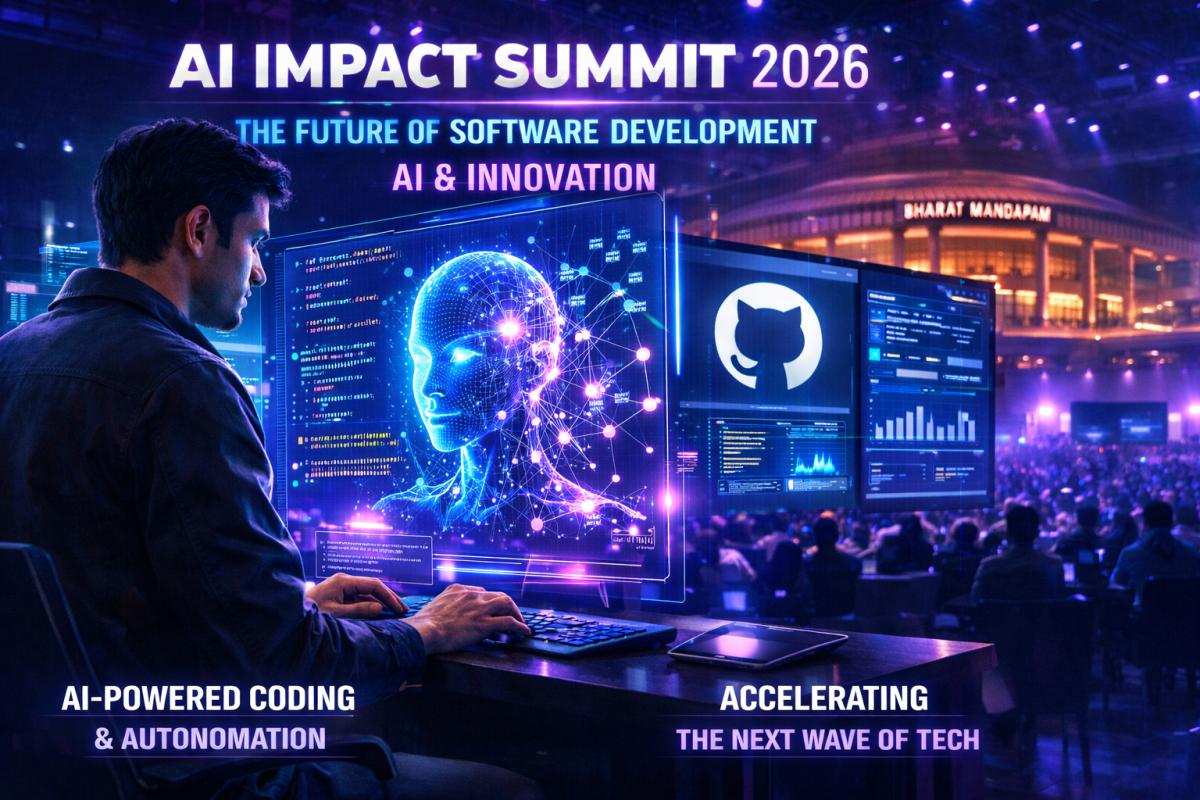

Introduction: The Beginning of an AI-Driven Engineering Era
Artificial Intelligence is no longer confined to academic experimentation or enterprise automation pipelines. It has evolved into a core infrastructure layer capable of transforming the way software is designed, developed, tested, deployed, and maintained. During the AI Impact Summit held on 19 February 2026, Anand Natarajan from GitHub Global System Integrators (GSI) shared strategic insights into how AI-assisted development environments are reshaping the software engineering lifecycle.
The discussion highlighted a fundamental transition currently underway in the global technology ecosystem — moving from human-centric coding workflows toward collaborative intelligence models where AI systems actively participate in code generation, debugging, architecture optimisation, and DevOps orchestration.
This transition is expected to redefine productivity benchmarks across IT services, enterprise software delivery, startup ecosystems, and independent developer communities.
The Shift from Traditional Development to AI-Assisted Engineering
Historically, software engineering has followed a deterministic workflow:
- Requirement gathering
- System design
- Manual coding
- Testing
- Deployment
- Maintenance
AI-powered development environments now introduce probabilistic assistance into each of these stages. Instead of developers writing entire logic structures manually, machine learning models trained on massive repositories of open-source codebases can now:
- Suggest contextual functions
- Generate repetitive boilerplate logic
- Optimize syntax structures
- Predict integration errors
- Automate documentation
This augmentation significantly reduces development cycle timelines while simultaneously improving code quality consistency.
Rather than replacing developers, AI tools are emerging as cognitive co-developers capable of accelerating engineering throughput across enterprise-scale projects.
Intelligent Code Generation and Productivity Gains
One of the most impactful use cases discussed was AI-driven code generation within integrated development environments (IDEs). AI models trained on billions of lines of publicly available code can interpret developer intent based on:
- Natural language prompts
- Partial code fragments
- Comment-based instructions
This allows engineers to move beyond low-value repetitive coding tasks and focus instead on:
- Architectural planning
- Performance optimization
- Business logic implementation
- Security engineering
AI in Debugging and Software Testing
Debugging has traditionally been one of the most time-consuming components of software development. Identifying logical flaws, memory leaks, concurrency issues, or performance bottlenecks requires extensive manual inspection.
AI-enabled debugging frameworks can now:
- Analyze runtime patterns
- Identify anomalous execution paths
- Recommend patch strategies
- Predict failure points
This results in:
- Faster deployment cycles
- Reduced post-release vulnerabilities
- Lower maintenance overhead
- Enhanced software reliability
DevOps Automation and Infrastructure Intelligence
Modern application deployment relies heavily on DevOps pipelines integrating continuous integration and continuous delivery (CI/CD). AI-driven orchestration layers are now being introduced to monitor:
- Container resource allocation
- Network latency
- System logs
- Deployment anomalies
Predictive analytics integrated into DevOps pipelines can:
- Prevent system downtime
- Optimize scaling decisions
- Forecast traffic surges
- Automate rollback mechanisms
Impact on Workforce Skills and Engineering Roles
The growing integration of AI into development workflows is expected to transform the skills required within the global software engineering workforce.
- Prompt engineering
- Model interpretation
- AI-assisted debugging
- Human-AI collaboration
Ethical Considerations and Responsible Deployment
While AI-assisted development introduces significant productivity gains, it also raises concerns related to:
- Intellectual property rights
- Algorithmic bias
- Security vulnerabilities
- Over-dependence on automation
| Industry | AI Development Impact |
|---|---|
| Finance | Automation in Digital Infrastructure |
| Healthcare | Faster System Deployment |
| Manufacturing | Operational Efficiency |
| E-commerce | Scalable Application Delivery |
| Telecommunications | Optimized Network Management |
India’s Strategic Role in the AI Development Ecosystem
Hosting the AI Impact Summit positions India as an emerging global hub for AI-driven innovation and infrastructure development.
- Democratizing access to AI resources
- Building sovereign AI infrastructure
- Enhancing digital inclusion
- Promoting human-centric innovation
Conclusion
Artificial Intelligence is rapidly transitioning from an experimental technology into an indispensable engineering collaborator. Insights shared during the AI Impact Summit underscore a future where software development becomes increasingly augmented by machine intelligence capable of accelerating productivity, improving code reliability, and optimising infrastructure performance.
Organisations and developers who successfully integrate AI-assisted workflows into their engineering practices will likely gain a competitive advantage in an increasingly digital global economy. As adoption expands across industries and national ecosystems, the collaboration between human expertise and artificial intelligence will shape the next generation of software innovation and technological progress.


Community Insights