
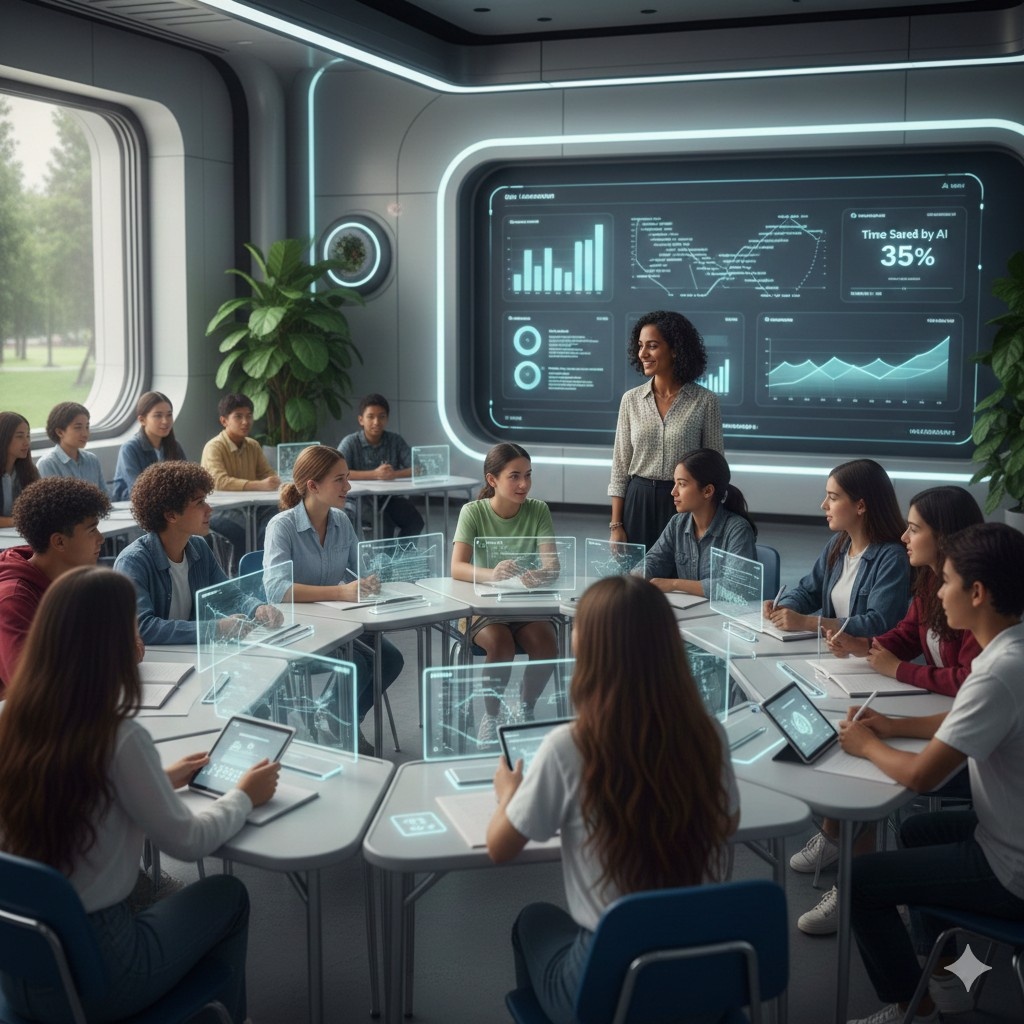

In 2026, the image of a teacher standing at the front of a room with a single textbook is officially a relic of the past. For high school educators, Artificial Intelligence has moved beyond the "hype" phase of 2023 and the "panic" phase of 2024. Today, it is a sophisticated co-pilot that is helping solve the industry’s most persistent crises: teacher burnout and the struggle for true personalisation.
This guide explores the landscape of AI in high school education in 2026—from specific tools and workflows to the deeper ethical questions of the "human-in-the-loop" era.
1. The 2026 Paradigm Shift: From "Cheating Tool" to "Partner"
Two years ago, the conversation was dominated by how to catch students using ChatGPT. Today, high school teachers have largely moved toward AI-Integrated Pedagogy.
Instead of banning AI, teachers are using it to handle the "heavy lifting" of administration and lesson prep. According to recent 2026 data, AI can reallocate nearly 20% to 40% of a teacher's time, potentially reducing the average 11-hour lesson planning week to just 6 hours.
The New Role of the High School Teacher
- Mentor over Lecturer: With AI handling content delivery, teachers focus on emotional intelligence, critical thinking, and social-emotional learning (SEL).
- Prompt Engineers: Teachers are now masters of crafting queries to generate high-quality rubrics, differentiated materials, and even "exit tickets" in seconds.
- Data Interpreters: AI analytics provide real-time dashboards showing which students are struggling with specific concepts before the final exam ever happens.
2. Essential AI Tools for the High School Classroom
Specialised education platforms have become the daily drivers for high school staff, offering security and pedagogical depth that generic models lack.
| Tool | Best For... | Key Feature in 2026 |
|---|---|---|
| MagicSchool / Eduaide | Lesson & Resource Design | Can generate 100+ types of resources, from IEP drafts to project outlines. |
| Curipod | Interactive Lessons | Turns a simple topic prompt into a full interactive slide deck with real-time polls. |
| Quizizz AI | Assessment & Engagement | Automatically adjusts question difficulty in real-time based on student performance. |
| Gradescope | Grading & Feedback | Groups similar student answers to apply consistent feedback, cutting grading time by 50%. |
3. High-Impact Use Cases: A Day in the Life
A. Instant Differentiation
High school classrooms are more diverse than ever. Using AI, a teacher can take a complex primary source document and instantly generate three versions: one simplified for lower reading levels, one translated for ELL students, and one with advanced analytical prompts for honours tracks.
B. The "Feedback Loop"
By the time a teacher grades a 2,000-word history essay, the student has often moved on. In 2026, students use AI writing labs to get immediate, formative feedback on structure, allowing the teacher to focus on the final, refined draft.
C. Predictive Analytics
AI dashboards now flag students whose engagement in the Learning Management System (LMS) has dropped significantly over a week, allowing for human intervention before a crisis occurs.
4. Rethinking Assessment: The "Human-in-the-Loop" Model
In 2026, the traditional take-home essay is largely dead. High school teachers have pivoted to more secure methods:
- Socratic Seminars: Oral exams where students must defend their ideas in person.
- AI-Collaborative Assignments: Students are graded on their prompts and how they edited the AI output.
- In-Class Writing: A return to "locked browser" sessions to ensure raw drafting is authentic.
5. Navigating the Ethical Minefield
The Equity Gap: Schools are now prioritising school-wide licenses to ensure every student has access to premium AI models, preventing a "digital divide" between students who can afford personal subscriptions and those who cannot.
Teachers must also be vigilant about Data Privacy. In 2026, "walled garden" AI environments are the standard—these are secure versions of AI that do not train on student data, ensuring compliance with privacy laws like FERPA.
6. How to Start Your AI Journey
- Step 1: Automate the Admin. Use AI to draft emails to parents or generate a syllabus to build your "prompting" muscles.
- Step 2: Create Choice Boards. Use AI to generate 10 different ways students can prove mastery of a concept.
- Step 3: Teach AI Literacy. Show students how to use AI as a tutor rather than a shortcut.
"AI is not going to replace teachers, but the teachers who use AI will certainly replace those who don’t."
Next Step:
Would you like me to create a specific AI implementation plan for a particular high school subject, such as AP Biology or English Literature?

Community Insights