
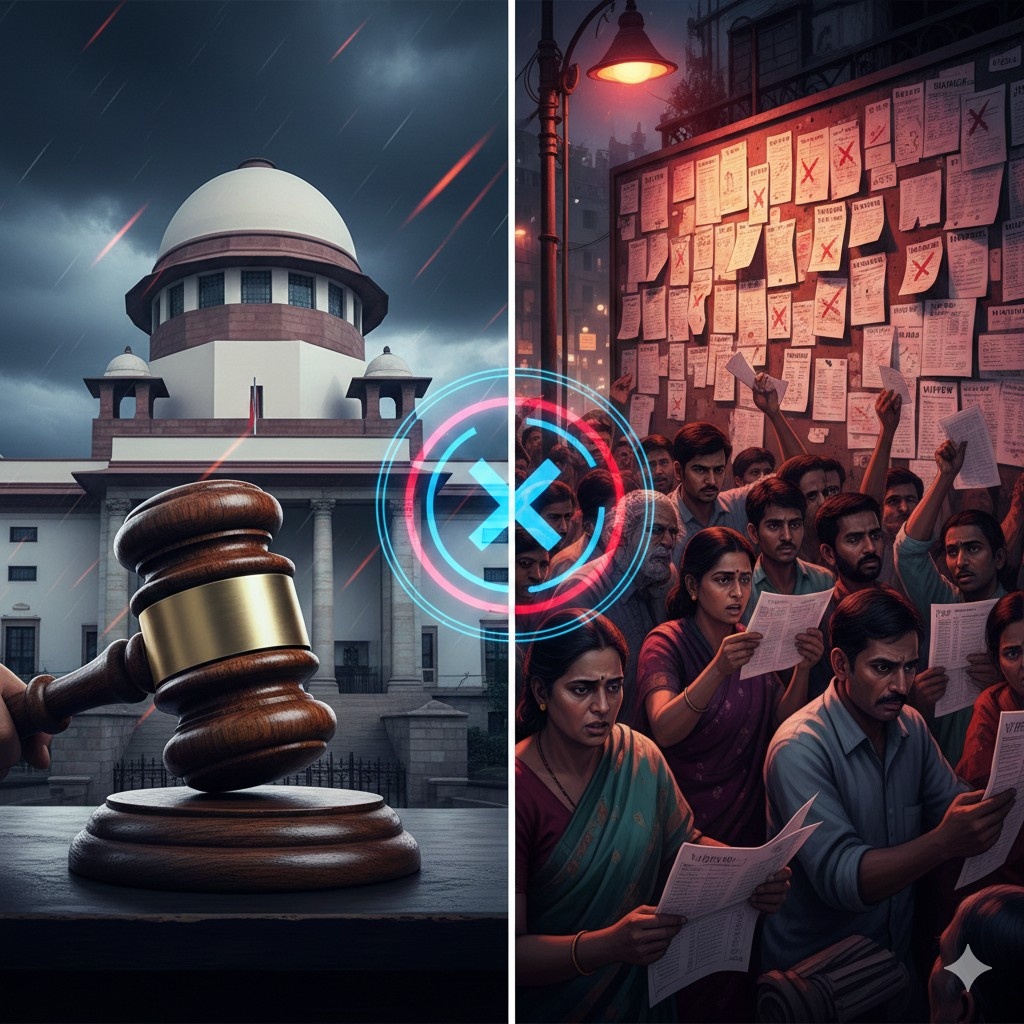

The Silent Referee Under Scrutiny: Is the ECI Violating Supreme Court Orders in West Bengal?
In the vibrant and often volatile landscape of Indian democracy, the Election Commission of India (ECI) has traditionally held the position of a silent, neutral referee. Its mandate is to ensure free and fair elections, operating in the background while political parties battle for the mandate of the people. However, recent developments in West Bengal have thrust the ECI into an uncomfortable spotlight, raising serious questions about its neutrality, its logistical capabilities, and its adherence to the rule of law.
What is currently unfolding in West Bengal is no longer just a technical issue regarding voter lists; it is fast becoming a major constitutional, political, and human crisis. With allegations flying from both the ruling BJP and the Opposition, and with the Supreme Court of India intervening with strong observations, we find ourselves at a precipice where the administrative process itself threatens to hurt the very democracy it is meant to serve.
The Scale of the "Cleanup": Special Intensive Revision (SIR)
The controversy centres on the Special Intensive Revision (SIR) of electoral rolls. While revising voter lists is a standard procedural practice, the sheer scale and speed at which this is being conducted in West Bengal have sent shockwaves through the legal and political communities.
The algorithm employed by the ECI has flagged entries based on criteria that many argue are arbitrary or disconnected from the social realities of India. The system flags issues such as doubtful age gaps between parents and children or instances where individuals over the age of 45 are registered as "new voters". Essentially, the algorithm is declaring that "something looks odd," automatically generating notices to millions of citizens.
| Category of Voter | Estimated Number Affected | Primary Reason for Flagging |
|---|---|---|
| Logical Discrepancies | 1.25 Crore | Algorithmic flags (age gaps, late registration, family size) |
| Unmapped Voters | Approx. 40 Lakh | Unclear addresses or booth mapping issues |
| Total Affected | 1.65 Crore+ | Combined SIR Scrutiny |
The Supreme Court Intervenes: The January 19 Order
Recognising the gravity of the situation, the Supreme Court of India stepped in to apply the brakes. On January 19, a bench led by Justice Surya Kant issued a direct order to the Election Commission. The Court's directive was rooted in the fundamental democratic principle of transparency: the names of all voters categorised under "logical discrepancies" or "unmapped" lists must be publicly displayed.
"If a citizen's right to vote is being questioned based on an algorithmic flag, that citizen has the right to know. Transparency is the first line of defence against disenfranchisement."
Logistical Failure or Deliberate Obstruction?
The timeline following the Supreme Court's order raises uncomfortable questions about the ECI's capacity to comply. Reports suggest the necessary software reached officials late on a Friday night, leaving Booth Level Officers (BLOs) with an impossible task: downloading and printing data for crores of individuals overnight.
Critics argue that this "logistical constraint" might be a convenient excuse to bypass the spirit of the Court's order, while others view it as a genuine administrative collapse. Regardless of intent, the transparency mandated by the highest court was compromised by software delays and impossible deadlines.
"Logical Discrepancies" vs. Indian Reality
During hearings, the criteria used to flag voters came under intense legal scrutiny. Senior Advocate Kapil Sibal questioned the validity of these flags, noting they were often raised over minor issues like spelling differences. The defence offered by the ECI, represented by Senior Advocate Rakesh Dwivedi, often clashed with the judicial bench's understanding of Indian society.
Justice Bagchi’s rebuttal regarding age gaps was particularly sharp: "We are not in a country where child marriages are not a reality." This observation acknowledges a social context that rigid algorithms ignore. Furthermore, shifting thresholds for "unusually high numbers of children" suggested that the criteria were less about logic and more about casting a wide net of suspicion.
The WhatsApp Controversy: Governance by Instant Message?
One of the most shocking revelations was the alleged use of WhatsApp to subvert due process. It was claimed that messages were sent to officials instructing them to keep Booth Level Agents away from hearings. The Supreme Court reprimanded the ECI, asserting that official circulars must be issued for such instructions, stating: "There is no question of running everything through WhatsApp."
The Court’s Mandate: Key Directives for Protection
To ensure the "cleanup" does not become a "purge," the Supreme Court issued specific directions to safeguard the electorate:
- Time to Object: Voters must be given 10 days to file objections.
- Mandatory Hearing: Even if documents are unsatisfactory, the person must be heard in person or via a representative.
- Written Reasons: Authorities must provide receipts for documents and record written reasons for any final decisions.
- State Responsibility: The State Government must ensure sufficient manpower and law and order to facilitate the process.
Conclusion: A Test for Democracy
The events in West Bengal serve as a stress test for Indian democracy, representing a collision between algorithmic governance and human rights. The Election Commission, once the silent referee, is now the story itself. As the Supreme Court noted, these are not just files; they are real families. The integrity of the democratic process depends on whether these 1.65 crore voters get a fair chance to prove their existence or become collateral damage in a flawed administrative process.

Community Insights