
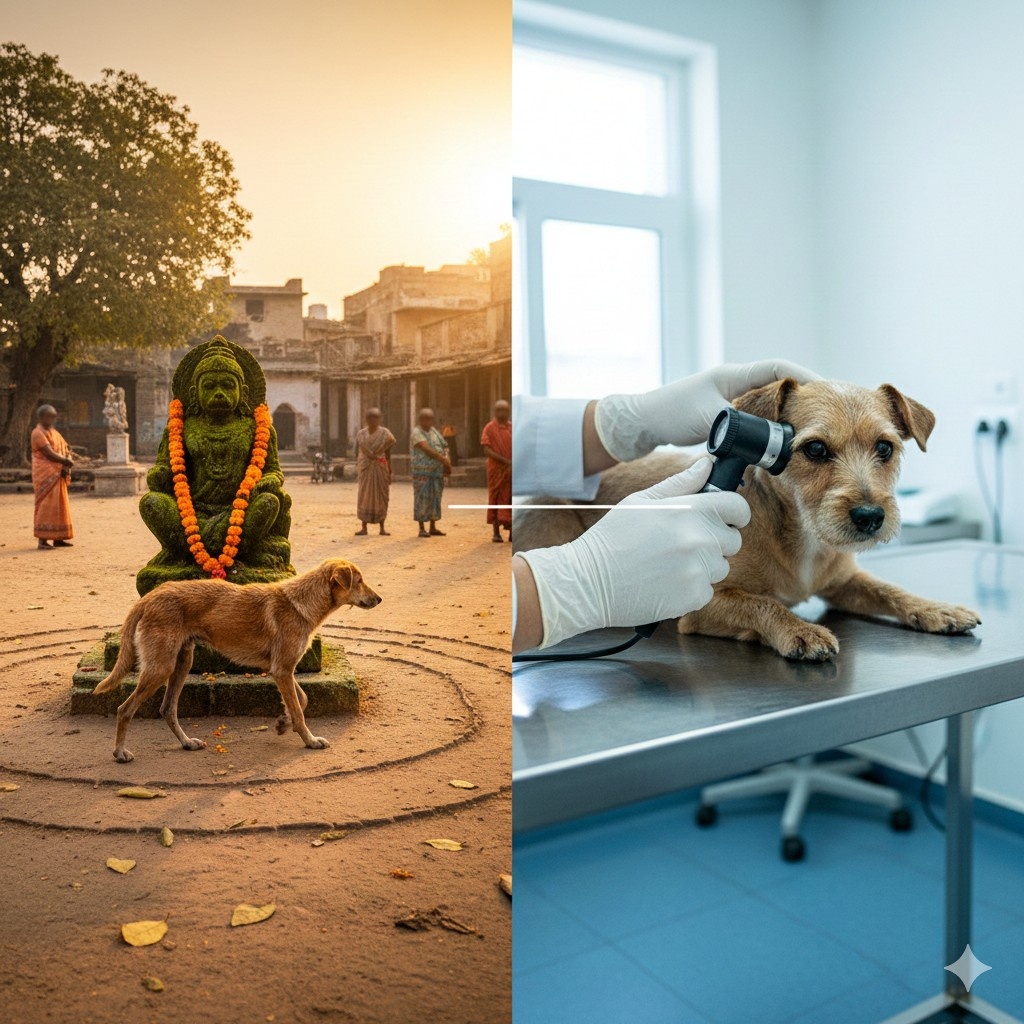

An in-depth look at the stray canine that captured the hearts of believers before being saved by medical intervention.
In the bustling landscape of Indian viral sensations, a peculiar and touching story recently emerged from the district of Bijnor, near Meerut. It is a tale that perfectly illustrates the intersection of traditional belief, animal behaviour, and the critical importance of veterinary care. A stray dog, now widely referred to as the ‘Parikrama’ dog, became the centre of attention after villagers witnessed it engaging in a repetitive, circular motion around a religious site. While the local community interpreted this behaviour through a lens of spirituality, it took the intervention of medical professionals to reveal the distressing reality behind the dog’s actions.
The Sensation: Devotion or Distress?
The incident centred on a stray dog found in Bijnor. To the astonishment of local villagers, the canine was observed performing what appeared to be parikrama—the Hindu ritual of circumambulation—around an idol of Lord Hanuman. In Hindu tradition, circling a deity is a profound act of reverence and prayer. Consequently, the sight of a stray animal seemingly engaging in this pious act sparked a sensation in the area.
According to reports, the dog’s actions attracted a significant number of believers. The villagers, moved by the sight, gathered to watch the animal, interpreting its persistent circling as a sign of spiritual devotion. For a brief period, the animal was not merely a stray but a symbol of faith, drawing crowds who were mesmerised by its unceasing movement around the Hanuman idol.
The Intervention: An Urgent and Quiet Rescue
While the phenomenon attracted believers, it also caught the attention of animal welfare experts who recognised the signs of medical distress rather than spiritual ecstasy. Understanding the delicate nature of the situation—where religious sentiment was high—veterinarians planned a rescue mission that had to be handled with extreme care.
The rescue was described as an "urgent but quiet operation." This discretion was likely necessary to ensure the safety of the animal and to avoid conflict with the gathered crowds who viewed the dog as a spiritual figure. Last week, the veterinary team successfully stepped in, removing the dog from the site to provide it with the medical attention it desperately required.
The Diagnosis: Uncovering the Neurological Truth
Once the dog was safely in the care of medical professionals, the true cause of the ‘parikrama’ was revealed. Vets diagnosed the animal with a neurological disorder. In veterinary science, compulsive circling is often a symptom of forebrain lesions, vestibular disease, or other neurological conditions, rather than a conscious decision to circumambulate an object.
The circular movement that had mesmerised the village was, in reality, a manifestation of this "neuro trouble." The dog was not performing a ritual; it was suffering from a condition that physically compelled it to move in circles. This diagnosis highlighted the vital importance of viewing animal behaviour through a medical lens, ensuring that suffering is not mistaken for a miracle.
Road to Recovery: Update from Delhi
Following the rescue, the dog was transported to a hospital in Delhi for specialised treatment. The latest updates from the medical team are overwhelmingly positive. On Friday, the attending vets reported that the canine is "much better" following treatment.
The transformation has been significant enough that the medical team has deemed the dog ready to go back, signalling a successful recovery from the acute phase of its neurological episode. The prompt intervention by the vets turned a story of potential medical neglect into a success story of rescue and rehabilitation.
Conclusion
The story of the Bijnor dog serves as a poignant reminder of the complexities of animal welfare in a society deep in faith. What appeared to be a divine act of parikrama around a Hanuman idol was, in truth, a cry for help caused by a neurological disorder. Thanks to the "urgent but quiet" work of the veterinarians, the dog was treated rather than merely worshipped, and is now on the path to full health.



Community Insights