
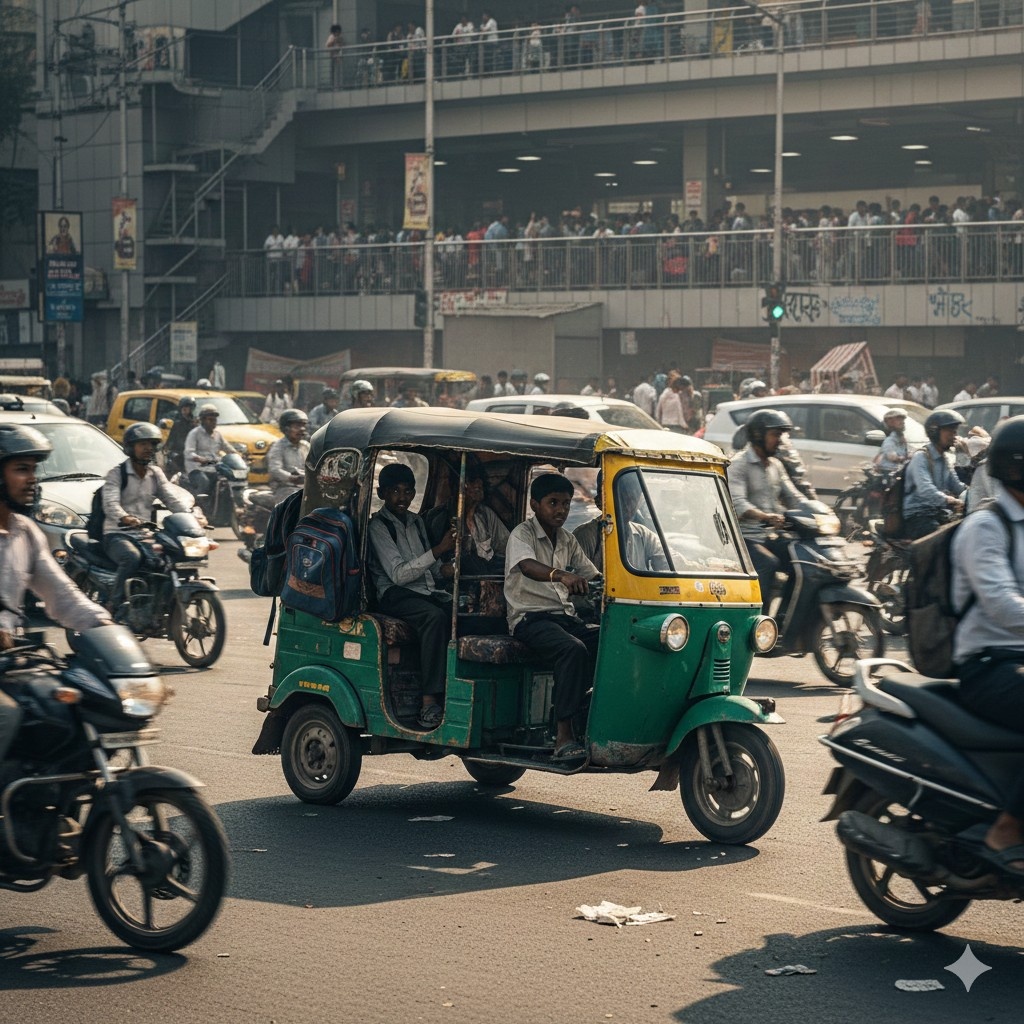

If you live in an Indian city, you know the feeling. You are driving or riding along a busy road, the traffic is moving at a decent pace, and suddenly—without a signal, without a glance backward—the vehicle in front of you slams on its brakes. It’s an e-rickshaw. Why did it stop? Because the driver spotted a potential passenger on the side of the road.
This phenomenon, often called the "Sawaree Reflex" (Passenger Reflex), is a daily hazard. For the driver, it is a simple logic: see a passenger, hit the brake. But for the bike or scooter coming up behind, it is a life-or-death situation where they must brake, fall, or collide.
In recent years, the humble e-rickshaw has transformed from a symbol of sustainable transport into a chaotic headache for urban India. They are unpredictable, structurally unstable, and often unregulated. Yet, simply banning them isn't the answer. To understand why, and to find a real solution, we must look at the history, the physics, and the systemic failures that brought us here.
The Vision vs. The Reality: A History Lesson
It wasn't supposed to be this way. The story of the e-rickshaw in India began with noble intentions around 30 years ago, in 1995. Dr. Anil Rajvanshi, a Padma Shri awardee and Director of the Nimbkar Agricultural Research Institute (NARI), visited Lucknow and was appalled by what he saw. He witnessed thin, sweating rickshaw pullers dragging heavy loads manually—a practice he found "inhuman" for the approaching 21st century.
Determined to use technology to solve this, Dr. Rajvanshi and his team spent five years developing a motorized solution. By 2000, they officially unveiled "Alexa"—India's first electric rickshaw. However, the system wasn't ready. Batteries were heavy, and the government offered no subsidies.
The idea went cold until 2012, when Delhi was suddenly flooded with e-rickshaws. But these weren't carefully engineered "Alexas." These were "Jugaad" vehicles, assembled from cheap parts with zero safety standards. Today, the crisis stems from three distinct human failures:
- The Drivers
- The Design
- The Government
Factor 1: The "Sawaree Reflex" and Untrained Drivers
The first major problem lies behind the handlebars. A vast majority of e-rickshaw drivers are untrained and lack basic traffic sense. These drivers do not operate with eyes on the road; their eyes are locked on customers. To them, the e-rickshaw is just a cycle that can squeeze through anywhere. The consequences are often fatal:
Prayagraj (April 27, 2024): A 21-year-old man died on the New Yamuna Bridge. An e-rickshaw driver, without signaling, stopped in the middle of the road and suddenly took a U-turn. The young biker behind him had no time to react.
Hapur (Christmas Evening): On National Highway 334, an e-rickshaw driving on the wrong side in the dark collided head-on with a car. A 55-year-old passenger was killed instantly.
Factor 2: The "Matchbox" Design Flaw
The design of the typical Indian e-rickshaw is fundamentally flawed regarding stability. Think of an e-rickshaw like a standing matchbox. It has a narrow base but a tall, heavy upper body, giving it a high center of gravity. This instability is exacerbated by two main issues:
- The Overloading Trap: Designed for four people, they are often stuffed with 10 to 12 children with heavy school bags. This shift in the center of gravity makes the vehicle flip during simple turns.
- The "Open Cage" Danger: With no doors or seatbelts, passengers—particularly infants—are often ejected during collisions or even when hitting simple potholes.
Factor 3: The Governance Void
The government’s approach has been reactive rather than proactive. This has created a regulatory vacuum characterised by:
| Issue | Impact |
|---|---|
| Assembler Economy | Low-quality kits imported and assembled without safety checks. |
| Illegal Charging | Drivers use unsafe setups that lead to battery explosions and fires. |
| Lack of Enforcement | Traffic violations are increasing rapidly with little policing. |
Why Banning Is NOT the Solution
Banning e-rickshaws would be an "illusion of control" and would cause more harm than good:
- Livelihood Destruction: Millions of families depend on these daily earnings.
- The Mobility Crisis: They provide essential "last-mile connectivity" that buses and cabs do not.
- Environmental Impact: They save roughly 5 crore liters of petrol every day and reduce massive tailpipe emissions.
The Roadmap: From Chaos to Order
The answer lies in Intelligent Governance through a four-step solution:
1. Control and Categorize
Create a legal category called Electric Last Mile Vehicle (ELMV). Use scientific analysis to cap permits based on road width and mandate speed governors locked at 25 km/h.
2. Zoning and Infrastructure
Use GPS to geofence vehicles. Keep them in "Green Zones" (inside colonies) and out of "Red Zones" (highways and flyovers). Build dedicated stands away from congested metro gates.
3. Professionalizing the Driver
Shift from a "puller" mindset to a "professional" mindset with 10-day mandatory training and identity badges. "Dignity brings discipline."
4. Tech-Based Enforcement
Utilize QR codes and GPS trackers for automated fines. If a driver enters a restricted zone, the system should automatically issue a challan to their phone.
Conclusion
The e-rickshaw is a classic example of a "grassroots innovation"—a solution that emerged from the streets to solve a real need. However, an innovation without regulation becomes a hazard. The problem isn't the vehicle; it is the regulatory void it operates in. The solution isn't to crush the industry but to refine it. We need to secure the safety of the school child and the infant while preserving the livelihood of the driver. We don't need a ban; we need a system. It is time to tame the beast, not kill it.


Community Insights