
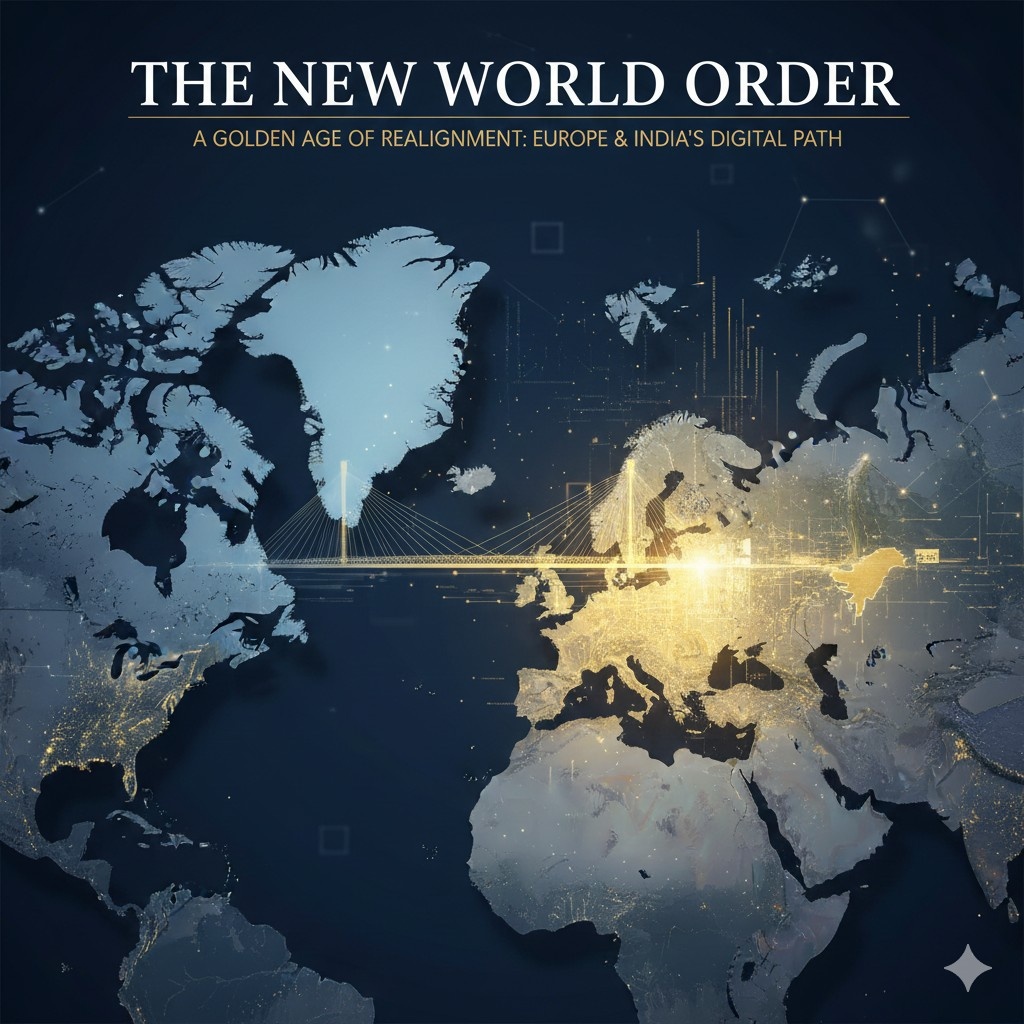

As we navigate the turbulent opening months of 2026, the architecture of international relations is undergoing a profound transformation. The comfortable certainties of the post-Cold War era have officially evaporated, replaced not merely by a binary US-China rivalry, but by a complex, fragmented network where 'middle powers' and 'swing states' are increasingly calling the shots. Two seemingly unrelated developments—the diplomatic crisis over Greenland and the imminent signing of the India-EU free trade agreement—offer a striking window into this new reality. They reveal a world where traditional alliances are fraying, and strategic autonomy is the new currency of power.
The Greenland Crisis: A Symptom of Atlantic Fracture
The geopolitical shockwaves felt in January 2026 cannot be overstated. The crisis ignited by US President Donald Trump’s renewed and aggressive attempts to annex Greenland—an autonomous territory of the Kingdom of Denmark—has fundamentally altered the transatlantic relationship. What began as a transactional proposal in his first term evolved into an existential threat to NATO cohesion in his second. With threats of a 25 per cent tariff on European allies and the refusal to rule out military force, Washington pushed its oldest allies into a corner.
While the immediate threat of invasion has subsided—a reversal widely dubbed by critics as a 'TACO' (Trump Always Chickens Out) moment following intense pressure from aides and European solidarity—the damage is done. The deployment of Operation Arctic Endurance, involving troops from Denmark, France, the UK, and other NATO members to defend Greenland, signalled a rupture in the old world order. It demonstrated that Europe could no longer rely implicitly on American restraint. Furthermore, the establishment of the controversial 'Board of Peace'—a body proposed by Trump to oversee global conflict resolution, which critics fear undermines the United Nations—has forced nations like India to carefully weigh their options between engaging with a mercurial Washington or upholding established multilateral frameworks.
Enter the Technological Swing States
Amidst this great-power volatility, a new class of actors has emerged: the Technological Swing States (TSS). As detailed in recent academic analysis regarding the global politics of AI governance, these are middle powers possessing the technological capacity and strategic flexibility to navigate the US-China divide without fully submitting to either. They are not merely passive observers; they are reshaping the rules of the game, particularly regarding Artificial Intelligence.
The power of these states lies in how they manage the 'black box' of AI. The structural opacity of advanced AI systems—where even developers cannot fully explain how algorithms arrive at decisions—has created a governance vacuum. Technological Swing States leverage this uncertainty to their advantage through three distinct strategies:
- South Korea: Delay and Hedging. Situated at the sharp end of the semiconductor supply chain, Seoul has mastered the art of playing for time. By securing waivers and stalling irreversible commitments to US-led export controls, South Korea preserves its market access to China while maintaining its security alliance with Washington. This 'wait-and-see' approach is a calculated insurance policy against geopolitical volatility.
- Singapore: Selective Alignment. Lacking the raw manufacturing base of Korea but possessing immense infrastructural centrality, Singapore has positioned itself as a hub of institutional transparency. By developing rigorous certification and auditing regimes for AI, Singapore offers a neutral ground where US and Chinese tech can ostensibly coexist under a framework of procedural trust, making it an indispensable node in the global digital economy.
- India: Normative Intermediation. Perhaps the most ambitious of the three, India utilises its position to reshape the normative frameworks of global governance. By championing concepts like 'Digital Public Infrastructure' and reframing AI debates from security-centric to development-centric ('AI for All'), India acts as a bridge between the Global South and the West. This ability to define the 'focal points' of negotiation gives New Delhi influence disproportionate to its current material capabilities in AI hardware.
The India-EU Pivot: The 'Mother of All Deals'
The rise of these swing states is culminating in tangible shifts in economic alliances, most notably the historic rapprochement between India and the European Union. Scheduled for signature on 27 January 2026, the India-EU Free Trade Agreement (FTA) represents a strategic convergence born of necessity. For the EU, bruised by the Greenland standoff and wary of American isolationism, India offers a massive alternative market and a partner in diversifying supply chains away from China. For India, facing punitive 50 per cent tariffs from the US, the EU represents a vital economic lifeline and a partner that values its strategic autonomy.
European Commission President Ursula von der Leyen has aptly termed this the 'mother of all deals'. While sensitive agricultural sectors have been excluded to ensure domestic political stability in India, the agreement is expansive, covering services, technology, and manufacturing. It is expected to be India’s most significant trade deal to date, integrating two of the world's largest economies into a combined market of nearly two billion people.
This is not just about economics; it is geostrategy in action. The FTA signifies a mutual recognition that in a world of weaponised interdependence—where tariffs and supply chains are used as instruments of coercion—diversification is the only path to security. It aligns perfectly with India’s strategy of normative intermediation, allowing it to act as a stabilising pole in a multipolar world, and provides the EU with the 'strategic autonomy' it has long promised but rarely delivered.
A New Geopolitical Architecture
The events of early 2026 paint a picture of a world in flux. The US administration’s erratic behaviour regarding Greenland and the 'Board of Peace' has accelerated the fragmentation of the West, prompting allies to seek new arrangements. We are witnessing the end of hub-and-spoke diplomacy where all roads lead to Washington or Beijing. Instead, we are entering an era of networked governance.
In this new era, authority does not rest solely on military might or economic dominance, but on brokerage power. Whether it is Singapore certificating opaque AI algorithms, South Korea hedging on semiconductor alliances, or India and the EU forging a massive trade bloc to insulate themselves from American protectionism, the lesson is clear: influence belongs to those who can bridge divides, manage uncertainty, and build resilient networks. As the 'hands off Greenland' protests fade and the ink dries on the India-EU treaty, the message to the great powers is unambiguous: the middle ground is no longer just a place to be squeezed; it is a place of power.


Community Insights