

By Legal Affairs Correspondent
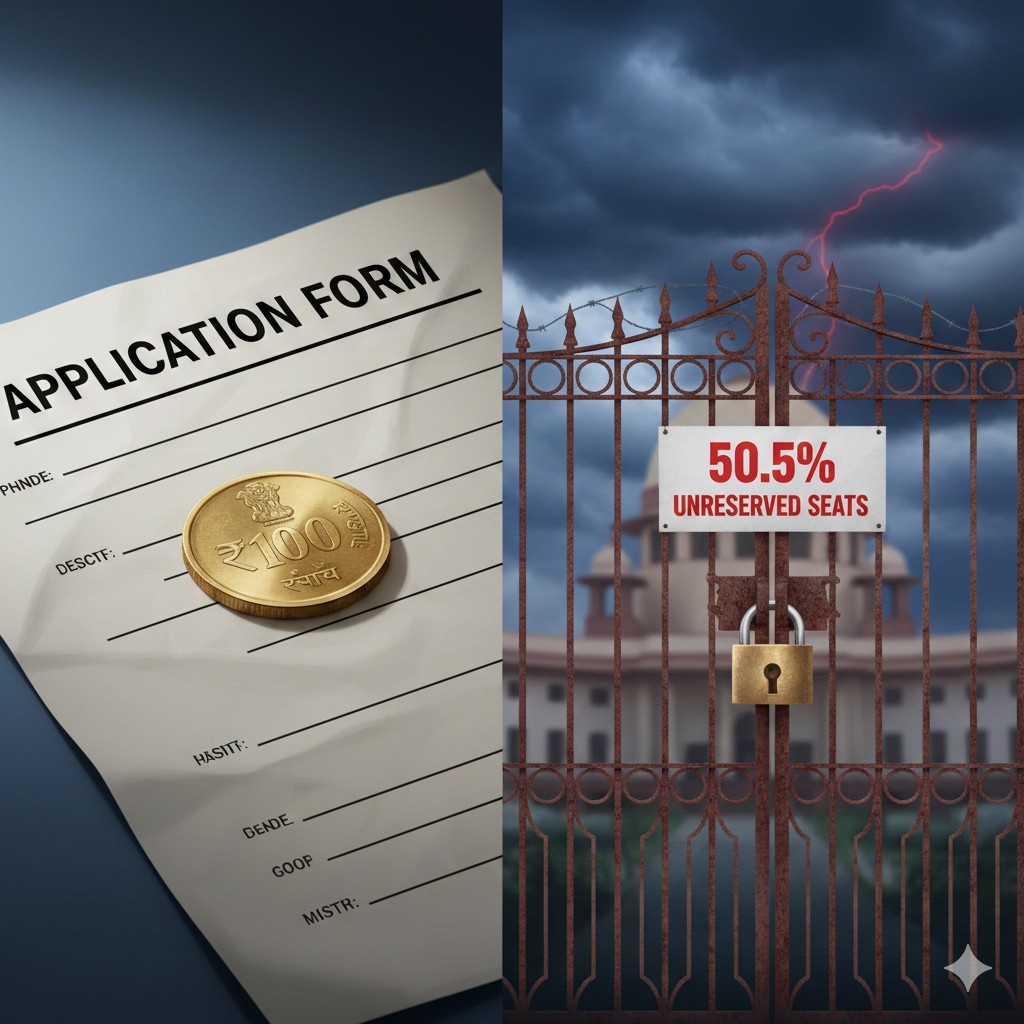
In the fiercely competitive landscape of Indian civil services, where a fraction of a decimal point in the final score can determine a candidate's entire career trajectory, the rules of engagement are paramount. For decades, the constitutional promise of reservation has been viewed as a tool for inclusion—a mechanism to level the playing field for historically marginalised communities. However, a startling analysis of recent judicial interpretations suggests that the ground beneath these candidates may be shifting in a profound and potentially exclusionary manner. At the heart of this controversy lies a sum so trivial it seems almost absurd: one hundred rupees.
According to emerging legal commentaries and recent analyses of Supreme Court verdicts, specifically referencing a bench led by Justice Deepankar Datta, the path for Reserved Category candidates (SC, ST, and OBC) to compete for "Unreserved" (General) seats has been severely constricted. The crux of the matter is the concept of "relaxations." The ruling purportedly establishes that if a candidate avails of any relaxation—be it age limits, number of attempts, lower qualifying marks, or even a concession on examination fees—at any stage of the examination process, they are permanently categorised as "Reserved." Consequently, they are barred from migrating to the Unreserved (General) category, regardless of whether their final merit score supersedes the General cut-off.
This development raises an existential question for the Indian recruitment system: Has the "Unreserved" pool, technically open to all citizens based on merit, been effectively converted into a quota reserved for the Upper Castes? This article delves into the intricacies of this legal shift, drawing on the specific claims regarding the case of Union of India vs. G. Kiran Rao and the profound implications for millions of aspirants.
The Myth of the 50.5% "Open" Pool
To understand the gravity of the situation, one must first revisit the arithmetic of Indian reservation. As it stands, approximately 49.5% of government vacancies are constitutionally reserved: 15% for Scheduled Castes (SC), 7.5% for Scheduled Tribes (ST), and 27% for Other Backward Classes (OBC). The remaining 50.5% is classified as "Unreserved."
A common misconception, one that pervades public consciousness, is that this 50.5% is the exclusive domain of the "General" category or Upper Castes. This is constitutionally incorrect. The Unreserved pool is meant to be a meritocracy where anyone—SC, ST, OBC, or General—can secure a seat provided they meet the requisite cut-off marks. Historically, a meritorious Dalit or OBC candidate who scored high enough would be allocated an Unreserved seat, thereby freeing up a Reserved seat for another candidate from their community who truly needed the affirmative action support. This mechanism ensured maximum representation.
However, the recent discourse suggests a dismantling of this mechanism. If the interpretation of the recent verdict holds, the moment a candidate ticks a box declaring their Reserved status and accepts any associated benefit, they forfeit their claim to that 50.5% open pool. The Unreserved category, therefore, becomes a "Reserved" category for those who have never claimed a benefit—predominantly the Upper Castes.
The "Fee Concession" Trap: A Catch-22 for SC/ST Candidates
The most alarming aspect of this legal interpretation is the "Fee Concession" trap. The Union Public Service Commission (UPSC) charges a nominal examination fee of ₹100. By government policy, candidates belonging to Scheduled Castes, Scheduled Tribes, and female candidates are exempted from paying this fee. This exemption is not optional in practice; it is a direct consequence of their status.
When an SC or ST candidate fills out the UPSC application form, they face a binary choice. They must declare their category. If they truthfully declare they are SC or ST, the system automatically processes the fee exemption. They do not pay the ₹100. However, under the strict interpretation of the "no relaxation" rule allegedly upheld by the Justice Deepankar Datta bench, this fee waiver constitutes a "benefit" or "relaxation."
The logic follows a brutal trajectory: 1. The candidate declared their category and received a fee waiver. 2. A fee waiver is a relaxation used at the preliminary stage. 3. Therefore, the candidate has availed of a benefit unavailable to the General category. 4. Consequently, this candidate is ineligible for Unreserved seats, even if they score the highest marks in the entire examination.
The candidate is essentially punished for telling the truth. They cannot choose to pay the fee to keep their options open because the form requires an honest declaration of status. Falsifying this information—claiming to be General category when one is SC/ST—would amount to a false declaration, which is a criminal offence and grounds for immediate disqualification from government service. Thus, for the price of ₹100, which the state benevolently waives, a meritorious candidate is stripped of their right to compete for half of the available vacancies. This creates a situation where the 50.5% Unreserved quota is effectively fenced off, accessible only to those who pay the fee—primarily Upper Caste men and EWS candidates (who interestingly pay the fee and thus might avoid this specific trap).
The Disproportionate Impact on OBC Candidates
While SC and ST candidates face the fee waiver hurdle, the implications for Other Backward Classes (OBC) are equally, if not more, severe due to demographic realities. The OBC population in India is estimated to be significantly higher than the 27% quota allocated to them—often cited as being upwards of 50% or 55% of the population.
Previously, high-performing OBC candidates would migrate to the Unreserved category, allowing the 27% quota to serve those with lower scores. However, the new ruling reportedly dictates that if an OBC candidate utilises any relaxation—such as a relaxation in the upper age limit or the number of attempts permitted—they are permanently locked into the OBC category. They cannot be considered for General vacancies.
The source analysis posits that this is a form of punishment for being OBC. If an OBC candidate utilises an age relaxation (permitted because of their background), they are barred from the Unreserved pool. Given that the OBC population is vast, confining all OBC candidates—including the high achievers—strictly within the 27% silo creates hyper-competition within that category. It effectively reduces the opportunities for a vast demographic majority to a mere quarter of the available posts, while leaving the 50.5% Unreserved pool for a much smaller demographic segment.
The Legal Timeline: Anomalies and Precedents
It is crucial to scrutinise the specific legal references made in the analysis of this situation. The commentary references a "Union of India vs. G. Kiran Rao" case and litigation involving the Rajasthan and Karnataka High Courts. However, a peculiar detail in the reported timeline requires attention: the source explicitly mentions judgment dates of "December 19, 2025" and "January 6, 2026."
The mention of future dates suggests one of two possibilities: either the commentary is projecting a hypothetical scenario based on the trajectory of current hearings, or there is an error in the spoken record regarding the specific years. However, the legal doctrine cited—that of preventing "Double Benefits"—is a very real and present debate in Indian constitutional law. The principle established by the Justice Deepankar Datta bench, as cited, reinforces the idea that one cannot have it both ways: one cannot use a relaxation to enter the door (Prelims) and then claim "General" status when inside (Mains/Service Allocation).
The commentary notes that on January 6, 2026 (likely referencing a past or imminent equivalent date in the context of the argument), a ruling regarding the Indian Forest Service clarified that this restriction applies not just to securing a job, but to Service Allocation and Cadre Allocation. This means a candidate might secure a rank, but because they took a preliminary relaxation, they could be denied a prestigious "Unreserved" vacancy in a preferred cadre (like their home state), forcing them to settle for a quintessential "Reserved" slot or a less desirable service allocation.
The "Merit" vs. "Privilege" Debate
Underpinning these technical rules is a fierce philosophical battle regarding the definition of merit. The prevailing argument from the judiciary and the executive seems to be the avoidance of "Double Benefit." The logic is that if a candidate uses a lower qualifying mark or a fee waiver to clear the Preliminary stage, they have already been advantaged. To then allow them to compete with General candidates who did not have that advantage is seen as unfair to the General candidates.
However, the counter-argument presented in the source material is compelling. It challenges the very notion that a preliminary relaxation negates subsequent merit. The Preliminary examination is merely a screening test. The Main examination and the Interview are the actual determinants of ranking. In the Mains, answer scripts are evaluated blindly; the examiner does not know the candidate's caste. If a Reserved candidate scores higher marks in the Mains than a General candidate, solely on the strength of their intellectual labour, why should their preliminary fee waiver of ₹100 disqualify them from a General seat?
The critique suggests that using "Merit" as a shield in this context actually protects privilege. By rigorously policing "relaxations," the system ensures that the Unreserved pool remains homogenous. The source argues that Upper Castes have historically enjoyed social capital and privileges that are not quantified in exams. When institutions focus hyper-technically on "relaxations" provided to the marginalised, they end up supporting the "Privileged Ones" by reserving the lion's share of vacancies for them.
Strategic Implications for Aspirants
For the lakhs of aspirants preparing for the Civil Services Examination, this is not merely a legal debate; it is a strategic emergency. The analysis advises candidates to be acutely aware of the "finer prints" of the notification.
1. The Declaration Dilemma: Candidates must recognise that ticking the category box now comes with a heavy price tag—the potential loss of 50.5% of seats. Yet, they have no legal alternative if they wish to be truthful.
2. The Risk of Age and Attempt Relaxation: OBC candidates, in particular, must weigh the cost of utilising an extra attempt or age relaxation. If they can compete without it, doing so might keep them eligible for the larger Unreserved pool. However, avoiding these relaxations is a luxury many cannot afford due to systemic disadvantages.
3. Evolving Examination Rules: The source also highlights other procedural changes, such as the introduction of "Face Authentication" at exam centres. While seemingly minor compared to the reservation issue, it signifies a tightening of the examination infrastructure. Candidates whose physical appearance has changed significantly (impacting biometrics) are advised to prepare for alternative authentication methods to avoid last-minute panic. It is a signal that the UPSC is becoming more rigid and technologically pervasive in its monitoring.
Conclusion: A Silent Reversal of Social Justice?
The narrative emerging from this analysis is one of a silent but drastic reversal. The ethos of the Indian Constitution, specifically the provisions for reservation, was to ensure substantive equality. It was acknowledged that a "General" seat was not a "Brahmin" seat or a "Rajput" seat, but a seat for the citizen with the highest marks.
If the interpretation holds that a ₹100 fee waiver is sufficient grounds to segregate a candidate from the General pool, then the system has effectively weaponised a trivial financial concession to enforce a massive social segregation. The "Unreserved" category is being reshaped into a de facto reservation for those who do not need fee waivers—consolidating privilege under the guise of procedural fairness.
As we look toward the future dates mentioned in the source—2025 and 2026—whether they represent a prophecy or a confusion in the timeline, the warning is clear. The rules of the game are changing. The walls between "Reserved" and "Unreserved" are becoming higher and more impermeable. For the aspirant, this demands not just academic preparation, but a sobering realisation that the administrative and legal frameworks governing their selection may be stacked against them in ways they had not previously imagined.
The question remains for the republic to answer: Is the price of maintaining the purity of the "Unreserved" category worth the exclusion of high-merit candidates simply because they accepted a hundred-rupee waiver designated to them by the state? The answer, it seems, is currently being written in the courtrooms, often to the detriment of the very inclusion the Constitution sought to guarantee.

Community Insights