

Introduction: The River as a Goddess and a Drain
In the collective consciousness of India, the rivers Ganga and Yamuna are not merely bodies of water; they are living, breathing divinities. The Ganga is revered as Mother Ganga, a goddess who descended from heaven to purify the souls of humanity. For millions of Hindus, a dip in the Sangam—the confluence of the Ganga, Yamuna, and the mythical Saraswati—is a ritual believed to wash away sins and grant spiritual liberation.
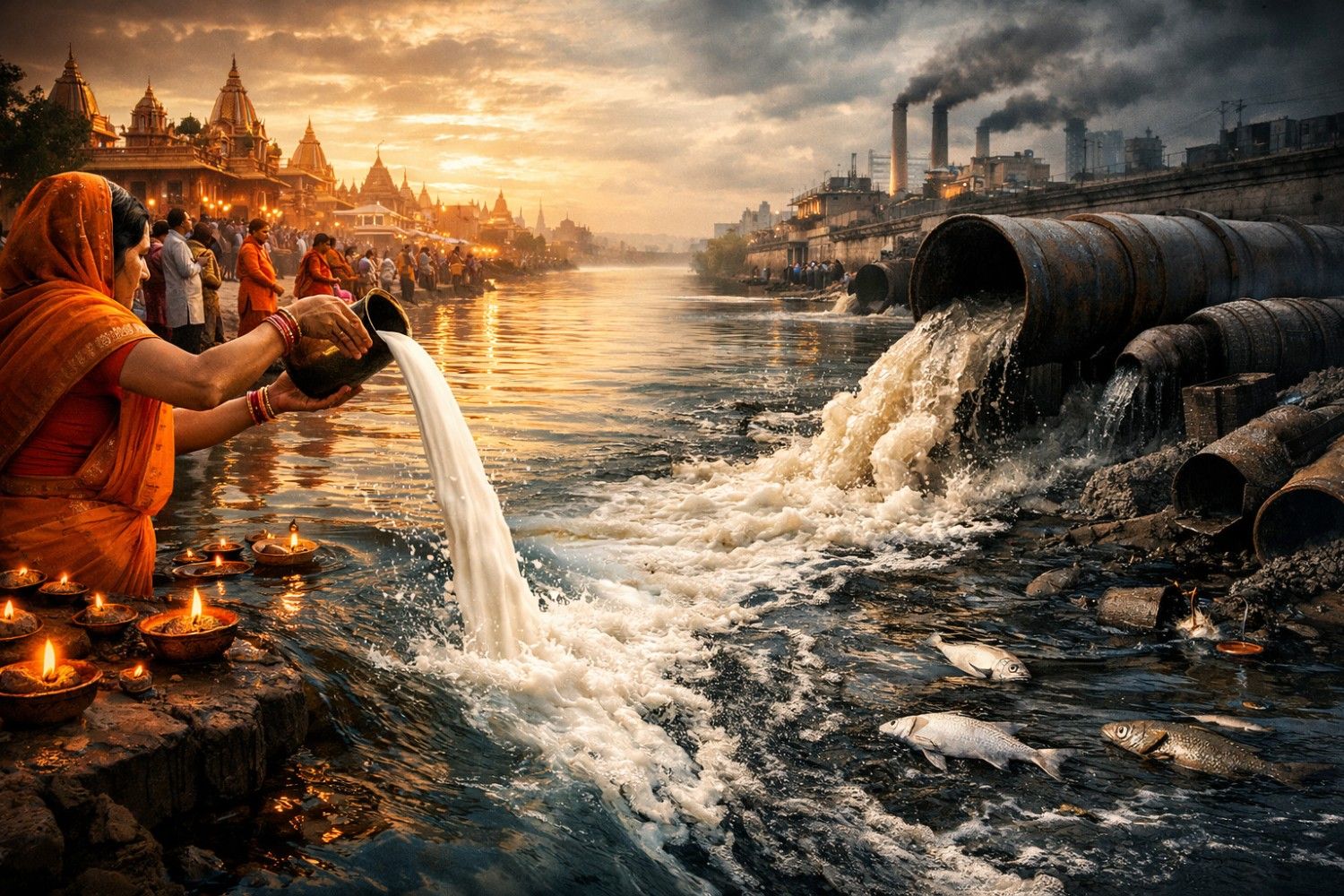
Yet, a tragic paradox lies at the heart of this reverence. The very rivers worshipped as the givers of life are being choked to death by the devotees who revere them and the industries that rely on them.
The reality of these rivers today is grim. They are facing a pollution crisis that threatens not only ecological integrity but the human rights of millions who rely on them for water. From industrial tanneries to dairy farms, and from ritual milk offerings to idol immersions, the sacred waters have become a toxic cocktail of heavy metals, sewage, and organic waste.
Part I: The White Poison – The Hidden Danger of Milk Pollution
The Science of Milk: More Polluting Than Sewage?
It is a common misconception that because milk is natural, it is harmless to aquatic life. In reality, milk has an extremely high Biological Oxygen Demand (BOD), which measures the oxygen required by bacteria to decompose organic matter.
Household sewage typically has a BOD of around 300 mg/litre. Whole milk, however, has a BOD close to 100,000 mg/litre, making it roughly 50 times more polluting than domestic sewage in its ability to strip oxygen from water.
Suffocating the Ecosystem
When milk enters rivers, bacteria rapidly consume dissolved oxygen while breaking it down. As oxygen levels crash, fish and aquatic organisms suffocate. Anaerobic conditions develop, producing foul-smelling, toxic sludge from decomposing casein.
Milk also contains nitrogen and phosphorus, which trigger eutrophication. Algal blooms spread across the surface, blocking sunlight and further reducing oxygen levels, eventually killing life beneath.
The Role of the Dairy Industry
India’s expanding dairy industry generates enormous volumes of wastewater. On average, 2.5 litres of wastewater are produced for every litre of milk processed.
In regions such as Jabalpur, untreated dairy effluent rich in fats, proteins, and lactose is discharged directly into rivers, dramatically increasing BOD and Chemical Oxygen Demand levels.
Ritual Spillage
Milk is also poured into rivers as a religious offering. While each act is devotional, the cumulative discharge of thousands of litres into slow-moving water bodies can devastate ecosystems, transforming sacred offerings into environmental hazards.
Part II: The Bacterial Bomb – Sewage and the Kumbh Mela
The “Holy Dip” and Faecal Coliforms
Mass gatherings such as the Kumbh Mela bring millions of people to the riverbanks. During the 2025 event, water quality monitoring showed faecal coliform levels far exceeding safe bathing standards.
The acceptable limit for bathing water is 2,500 units per 100 millilitres. Recorded levels reached 11,000 units near Shastri Bridge and 7,900 units at the Sangam.
The Health Risks
Bathing in contaminated water exposes pilgrims to gastrointestinal infections, hepatitis A, typhoid, skin diseases, and respiratory infections. Long-term exposure has even been associated with increased cancer risks.
The Yamuna’s Category E Status
The Yamuna is classified as Category E, meaning it is largely unfit for bathing, drinking, or aquatic life. Nearly 75 percent of its pollution comes from untreated domestic sewage, particularly from urban centres.
Part III: Industrial Toxicity – The Heavy Metal Crisis
The Tannery Problem
Industrial discharge, especially from tanneries, introduces persistent toxins into rivers. In parts of Uttar Pradesh, chromium levels have been recorded at hundreds of times above permissible limits.
Chromium is highly carcinogenic and accumulates in human and animal tissues, causing kidney failure, genetic damage, and widespread cancer in riverbank communities.
A Cocktail of Poisons
- Arsenic contaminates groundwater across large stretches of the basin.
- Mercury is detected even in pilgrimage centres.
- Lead and Cadmium exceed safe limits in water and sediments.
| Pollutant | Primary Source | Major Health Impact |
|---|---|---|
| Chromium | Tanneries | Cancer, kidney failure |
| Faecal Coliform | Untreated Sewage | Infections, hepatitis |
| Nitrogen & Phosphorus | Dairy Waste & Ritual Milk | Eutrophication, fish death |
Part IV: The Clash of Culture and Ecology
Idol Immersion
Modern idols made from Plaster of Paris and toxic paints release heavy metals into rivers during immersion, turning religious celebrations into ecological disasters.
The Green Ganesha Movement
Across Indian cities, a shift towards biodegradable clay idols is emerging. This movement reflects a growing understanding that environmental responsibility and religious devotion can coexist.
Faith that poisons its own river is not devotion, it is neglect dressed as tradition.
Legal Personhood of Rivers
In 2017, the Ganga and Yamuna were declared legal persons by a High Court ruling, recognising them as living entities with rights. Although later stayed, the judgment marked a radical rethinking of humanity’s relationship with nature.
Part V: The Path to Restoration
- Zero Discharge: Industries must recycle wastewater instead of releasing it into rivers.
- Decentralised Treatment: Wetlands and local treatment systems can prevent sewage inflow.
- Ecological Flow: Rivers need sufficient water volume to dilute pollutants.
- Community Engagement: Religious leaders can reframe pollution as a moral failure.
- Global Lessons: Rivers like the Thames and Rhine show recovery is possible.
Conclusion: A Call for a Green Faith
The degradation of the Ganga and Yamuna is an environmental, medical, and spiritual tragedy. Water believed to cleanse the soul is now poisoning the body.
Milk with its high BOD, sewage filled with bacteria, and industries releasing carcinogenic metals are not isolated problems. They are symptoms of a deeper disconnect between belief and responsibility.
True reverence for the river must extend beyond ritual into protection. Only when faith aligns with science, and devotion with discipline, will these rivers breathe again as the living entities they are meant to be.



Community Insights