

Introduction
In August 2025, the monsoon session of the Indian Parliament witnessed the introduction of one of the most consequential and contentious pieces of legislation in recent history: The Constitution (One Hundred and Thirtieth Amendment) Bill, 2025. Introduced by Union Home Minister Amit Shah, the Bill proposes a radical shift in the disqualification norms for high constitutional functionaries—the Prime Minister, Chief Ministers, and Ministers.
The Bill emerges against a backdrop of intense political debate regarding the "criminalisation of politics" and the unprecedented spectacle of elected leaders continuing to govern while in judicial custody. Recent instances, such as former Delhi Chief Minister Arvind Kejriwal and Jharkhand Chief Minister Hemant Soren retaining their posts while incarcerated, highlighted a constitutional vacuum: while the law disqualifies a convicted legislator, it remained silent on an "undertrial" minister.
The 130th Amendment seeks to fill this gap by mandating the removal of ministers detained for 30 consecutive days on serious charges. However, this proposal has ignited a firestorm regarding the Presumption of Innocence, the Basic Structure Doctrine, and the fragile balance of Federalism. This blog provides a comprehensive analysis of the Bill, examining its provisions, the government’s rationale, and the critical legal and ethical challenges it poses.
1. The Core Provisions of the Bill
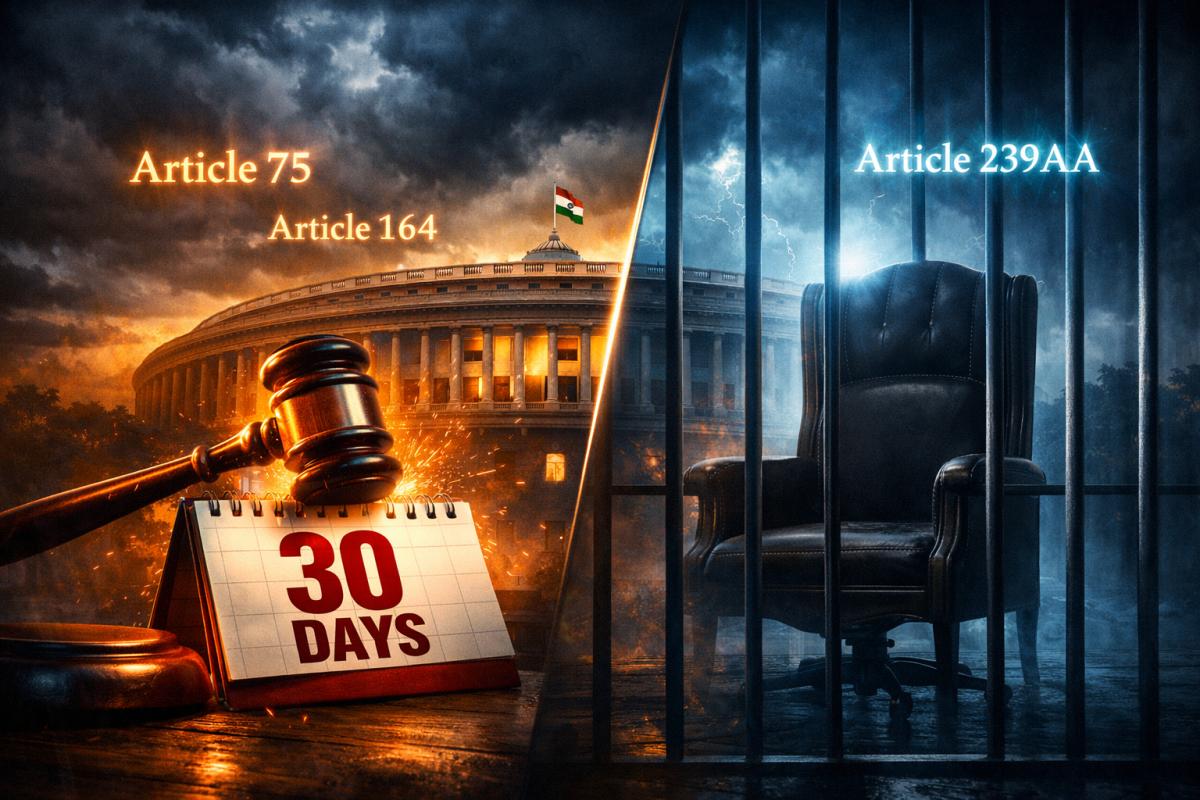
The Bill seeks to amend Articles 75 (Union Executive), 164 (State Executive), and 239AA (Special Provisions for Delhi) of the Constitution. It is accompanied by two auxiliary bills—the Jammu and Kashmir Reorganisation (Amendment) Bill, 2025, and the Government of Union Territories (Amendment) Bill, 2025—to ensure uniformity across all administrative units.
The "30-Day Rule" and Automatic Cessation
The central thrust of the amendment is the introduction of a new eligibility condition for continuing in office:
- Threshold: If a Prime Minister, Chief Minister, or Minister is arrested and detained in custody for 30 consecutive days on an allegation of an offence punishable with imprisonment of five years or more, they face removal.
- Mechanism for Ministers: By the 31st day, the Prime Minister (for Union Ministers) or Chief Minister (for State Ministers) must advise the President or Governor to remove the detained minister. If such advice is not tendered, the minister automatically ceases to hold office on the day falling thereafter.
- Mechanism for Heads of Government: If a Prime Minister or Chief Minister is the one detained, they must resign by the 31st day. Failure to do so results in automatic cessation of office.
Reappointment Clause
Crucially, the Bill includes a provision that allows a minister removed under these grounds to be reappointed upon their release from custody. This indicates that the disqualification is tied to the inability to function due to custody rather than a final determination of guilt.
2. The Rationale: "Constitutional Morality" and Administrative Integrity
The Government’s justification for this drastic measure rests on three pillars: Constitutional Morality, Administrative Propriety, and Public Trust.
A. The Argument of Constitutional Morality
The Statement of Objects and Reasons of the Bill argues that the character and conduct of ministers must be "beyond any ray of suspicion". Home Minister Amit Shah has argued that allowing a leader to govern from jail thwarts the principles of good governance and diminishes public trust. He invoked Dr B.R. Ambedkar’s concept of "constitutional morality," suggesting that mere adherence to the letter of the law is insufficient; leaders must adhere to the higher ethical standards expected of their office.
B. Equivalence with the Civil Services
Proponents of the Bill draw a parallel with the permanent executive. Under current service rules, a bureaucrat or government employee is automatically suspended if they spend more than 48 hours in police or judicial custody. The government argues that it is anomalous for the political masters (ministers) to enjoy immunity from suspension while their subordinates (IAS/IPS officers) face immediate administrative action for the same situation.
C. Preventing "Jail-Based Governance"
The practical argument is that governance cannot effectively be conducted from a prison cell. Access to files, meetings with officials, and Cabinet decisions are severely hampered by incarceration. The Bill aims to prevent the "extraordinary situation" where secretaries and DGPs have to visit jails to take orders, which is seen as an insult to democracy.
3. Critical Analysis: The Constitutional Challenges
While the objective of decriminalizing politics is noble, the method proposed by the 130th Amendment raises profound constitutional anxieties. Legal experts and the opposition argue that the remedy may be worse than the disease.
A. Presumption of Innocence (Article 21)
The most significant legal critique is that the Bill conflates custody with guilt.
- Pre-Trial Punishment: Under the Indian criminal justice system, an accused is presumed innocent until proven guilty. The Representation of the People Act, 1951 (RPA), currently disqualifies legislators only upon conviction (Section 8).
- Article 21 Violations: Removing a democratically elected leader based merely on an "allegation" and "detention" (before a trial has concluded) violates the fundamental right to liberty and due process. Critics argue this amounts to "disqualification by suspicion".
- Process as Punishment: In India, over 75% of prisoners are undertrials. Given the low conviction rates in special acts like UAPA (approx. 3%) and PMLA, a leader could be jailed, lose their office, and be acquitted years later. The "reappointment clause" is of little solace if the government has already fallen or the political damage is done.
B. Violation of the Basic Structure: Separation of Powers
The Bill threatens the Basic Structure of the Constitution by distorting the separation of powers between the Legislature, Executive, and Judiciary.
- Police Deciding Tenure: In a parliamentary democracy, a Prime Minister or Chief Minister holds office as long as they enjoy the confidence of the House. The 130th Amendment effectively transfers the power to remove a head of government from the Legislature (via a No-Confidence Motion) to the investigative agencies (Police, CBI, ED).
- Bypassing the Legislature: As noted by legal scholars, "where Parliament cannot remove, a police officer can" under this Bill. If an agency arrests a CM and opposes bail for 30 days, they effectively decapitate the elected government, bypassing the people's mandate.
C. The Federalism Conundrum
The Bill introduces a volatile dynamic into Centre-State relations.
- Weaponisation of Agencies: Police is a state subject, while agencies like the CBI and ED are under the Union.
- Scenario 1: The Union government could use the ED/CBI to arrest an Opposition Chief Minister. If bail is denied for 30 days (common under PMLA), the CM is automatically removed, potentially toppling the state government.
- Scenario 2: A State government could retaliate by having its police arrest a Union Minister (or even the PM) for an offence committed within the state, triggering their removal.
- Destabilisation: This creates a mechanism for "regime change through investigation," threatening the federal balance protected by the Supreme Court in S.R. Bommai v. Union of India.
D. Arbitrariness and Rule of Law
The criterion of "30 consecutive days" is arbitrary. Judicial bail decisions depend on various factors, including the backlog of cases and the specific judge. Tying a constitutional tenure to the vagaries of bail hearings—rather than a conviction based on evidence—undermines the Rule of Law. Furthermore, the definition of "serious offense" (punishable by 5 years or more) is broad and could be applied to politically motivated charges.
4. Judicial Precedents and Comparative Context
To evaluate the Bill, we must look at how the judiciary and other democracies handle this issue.
- Lily Thomas v. Union of India (2013): The Supreme Court ruled that MPs/MLAs are disqualified immediately upon conviction, striking down the 3-month window for appeal. The 130th Amendment pushes this further by acting pre-conviction.
- Manoj Narula v. Union of India (2014): A Constitution Bench advised that PMs/CMs should not appoint ministers with criminal antecedents, citing "Constitutional Morality," but refused to mandate disqualification at the stage of framing charges, leaving it to Parliament.
- International Norms:
- United Kingdom: Ministers resign by convention if charged, but there is no automatic constitutional removal.
- USA: No constitutional bar prevents a person under indictment from holding office; removal requires impeachment.
- Conclusion: India’s proposed law is significantly harsher than global democratic norms, moving from "political accountability" to "automatic legal expulsion".
5. Status and The Way Forward
As of early 2026, the Bill has been referred to a Joint Parliamentary Committee (JPC) chaired by Aparajita Sarangi. The JPC is consulting with legal experts, universities (like NLSIU and NLU Delhi), and state governments to address these concerns.
Suggestions for a Balanced Approach (Way Forward):
- Judicial Confirmation of Charges: Instead of triggering removal upon arrest, the bar could be set at the framing of charges by a court. This ensures a judicial mind has applied itself to the evidence, finding a prima facie case exists, rather than relying solely on police action.
- Independent Review Mechanism: To prevent political vendettas, an independent body (like a tribunal of retired judges) could review the necessity of removal in cases of detention, ensuring the arrest isn't mala fide.
- Time-Bound Trials: Rather than removing the minister pre-trial, the focus should be on Fast-Track Courts. The Supreme Court has already directed special courts for MPs/MLAs; these need to be strengthened to deliver verdicts within a year, making the conviction-based disqualification effective.
- Graduated Response: A system of "interim suspension" rather than "automatic removal" could be explored. The minister could be suspended from duties while in custody but retain their constitutional status until a specified judicial milestone is reached.
Conclusion
The Constitution (130th Amendment) Bill, 2025, represents a critical juncture in Indian democracy. On one hand, it addresses the genuine moral crisis of leaders clinging to power while incarcerated, which undeniably erodes public faith in the system. As the government argues, the "hopes and aspirations" of the people cannot be represented from a prison cell.
On the other hand, in its current form, the Bill risks becoming a "wolf in sheep’s clothing". By bypassing the judiciary and empowering investigative agencies to determine the tenure of elected governments, it endangers the separation of powers and federal stability. If passed without safeguards, it could transform the Constitution into a tool for political retribution.
For the UPSC aspirant, the 130th Amendment is a perfect case study of the tension between Political Ethics and Constitutional Safeguards. The ultimate solution lies not in suspending the rights of the accused, but in accelerating the judicial process so that the guilty are convicted swiftly and the innocent are exonerated, thereby upholding both integrity and liberty.
Key Takeaways for Prelims/Mains:
- Article 75 & 164: Govern the appointment/tenure of Ministers (Union/State).
- Article 239AA: Special provisions for Delhi (NCT).
- Representation of People Act, 1951 (Sec 8): Governs disqualification upon conviction.
- Proposed Change: Disqualification upon 30 days detention for offenses with 5+ years imprisonment.
- Basic Structure Challenges: Federalism, Separation of Powers, Rule of Law (Art 14/21).

Community Insights