
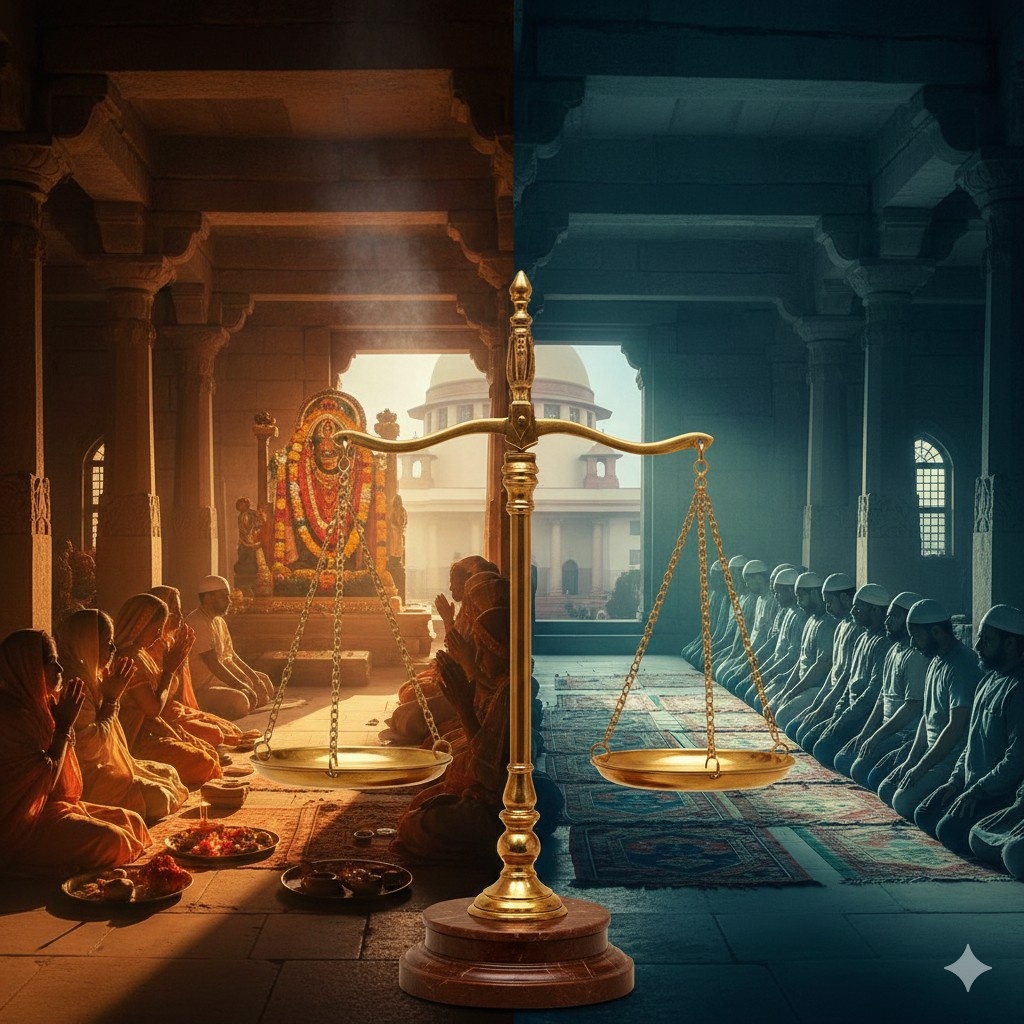

In the vibrant and complex tapestry of Indian jurisprudence, few cases illustrate the delicate tension between religious sentiment and constitutional order as vividly as the dispute surrounding the Bhojshala complex. It is a narrative where history meets the present, where faith intersects with the rigid ticking of the clock, and where the Supreme Court of India is tasked not merely with interpreting the law, but with maintaining the very fabric of social harmony. Recently, a bench led by Chief Justice Surya Kant, alongside Justice Joymalya Bagchi and Justice Vipul M. Pancholi, faced a challenge that was described not just as a legal dispute, but as a "heavy constitutional question."
The matter at hand was a classic conflict of "Faith versus Faith" and "Tradition versus Timing." At the centre of this storm stands the Bhojshala monument in Dhar, Madhya Pradesh—an 11th-century structure protected by the Archaeological Survey of India (ASI). To the Hindu community, this site is revered as the Temple of Goddess Saraswati, or Vagdevi. To the Muslim community, it is the Kamal Maula Mosque. These competing claims have existed for decades, managed by a fragile administrative arrangement established in 2003. However, when the calendars of two faiths collide, as they did recently with Basant Panchami falling on a Friday, that fragility is tested to its breaking point.
The Collision of Calendars: Basant Panchami meets Jumma
The 2003 arrangement was designed to share time: Hindus were granted rights to perform Puja on Tuesdays, while Muslims were permitted to offer Namaz on Fridays. For years, this temporal separation acted as a buffer. However, the equilibrium was threatened when the ASI introduced scientific surveys and sealed covers, causing the existing harmony to tremble. The situation escalated dramatically this year because Basant Panchami, a festival intrinsically linked to the worship of Goddess Saraswati, fell on a Friday—the holiest day of the week for Muslims.
The conflict was logistical and theological. For the Hindu devotees, Basant Panchami dictates rituals that span from sunrise to sunset, including Puja and Havan. Conversely, the Islamic tradition requires the Jumma (Friday) Namaz to be performed at a fixed, non-negotiable time in the afternoon. With both communities asserting their rights to the same space, on the same day, utilizing the same singular gate, a confrontation seemed inevitable. The "Hindu Front for Justice" approached the Supreme Court with an application demanding that day-long rituals be permitted from sunrise to sunset, essentially implying a restriction on the Friday Namaz to accommodate the festival.
The Courtroom Drama: Defining the Boundaries of Faith
As the hearing commenced, the temperature within the courtroom mirrored the rising tensions on the ground. The arguments presented were a study in the contrast between religious absolutism and the necessity of public order. Senior Advocate Salman Khurshid, representing the Mosque Committee, sought to de-escalate the "time" conflict. He argued that the ASI had already stipulated that the survey would continue and Namaz would take place. He offered a concession regarding the timing, stating that the Jumma Namaz is centred around noon. He proposed that the Muslim community would utilise the premises specifically for two hours and would vacate the area between 1:00 PM and 3:00 PM.
It was at this juncture that the Bench intervened with a crucial observation that shifted the trajectory of the hearing. Justice Joymalya Bagchi, displaying a keen understanding of the rituals involved, noted that the "muhurat" (auspicious timeframe) for the Puja typically extends until 1:00 PM. He suggested a practical compromise: let the Puja be completed by 1:00 PM, after which the Namaz could proceed. This was a clear signal that the Court intended to balance the scales rather than allowing one side to overpower the other.
However, this suggestion met with immediate resistance from the applicants. Advocate Vishnu Shankar Jain, representing the Hindu side, countered the Judge's observation by asserting that the auspicious period lasted from sunrise to sunset. This provoked a stern and significant response from Justice Bagchi, who remarked, "Don't tell us, I know personally it is till 1 PM."
This exchange was pivotal. It demonstrated that the Supreme Court was not a passive recipient of religious claims but an active arbiter of "reasonableness." The Court signalled that while it respects faith, it will not allow subjective interpretations of tradition to override the requirements of public order. When Advocate Jain further suggested shifting the Namaz to after 5:00 PM to accommodate rituals like the 'Akhand Havan', Senior Advocate Khurshid stood firm. He explained that unlike other prayers, the Friday congregational prayer is time-specific and required at noon. The Court was thus faced with two faiths presenting their "non-negotiables."
Governance over Theology: The Administrative Solution
Recognising that a theological debate would lead to a stalemate, the focus of the proceedings shifted towards governance and logistics. Additional Solicitor General (ASG) K.M. Nataraj entered the fray with a solution focused on administration rather than religion. He proposed that if the specific numbers of devotees could be provided, the administration could create designated areas within the complex to maintain separate "ingress and egress" (entry and exit).
This proposal marked a turning point. The conversation moved from spiritual rights to crowd control, passes, and separate enclosures. Senior Advocate Khurshid agreed to furnish the approximate number of attendees. Chief Justice Surya Kant then framed the matter through a constitutional lens. He clarified that the application pertained to a historical site subject to conflicting claims—one side asserting it is the Bhojshala Saraswati Temple, the other the Kamal Maula Mosque. He emphasised that since the main suit regarding the character of the monument is sub-judice before the High Court and a final opinion is awaited, the Supreme Court would not express a final opinion on the title or character of the site. Their sole focus was the immediate arrangement for the upcoming Friday.
The Chief Justice noted the urgency, acknowledging that Basant Panchami fell the very next day. He expressed appreciation for the stand taken by the ASG and the assurance from both the Centre and the State that law and order would be maintained. The Court made it clear: they were not deciding history today; they were deciding peace.
The "One Gate" Dilemma and the Triumph of Will
Even with a theoretical agreement in place, practical hurdles remained. Advocate Ashwini Upadhyay raised a critical logistical point regarding the physical constraints of the monument. He highlighted that the Bhojshala complex possesses only one gate, which he described as being the size of the courtroom door. He questioned how two opposing groups could manage entry and exit through such a bottleneck without sparking conflict.
Justice Bagchi’s response was simple yet profound: "A portion can always be cordoned off for the Namaz." This statement underscored the judicial philosophy that space management is always possible if the intention to coexist exists. The Court was effectively stating that physical constraints should not become an excuse for communal discord. If the will to maintain peace is present, a single gate is not an insurmountable obstacle.
The Final Order: Discipline, Data, and Decorum
In dictating the final order, Chief Justice Surya Kant recorded the statement by Senior Advocate Khurshid that the approximate number of persons belonging to the Muslim community who would perform Namaz would be furnished to the District Magistrate that very day. This requirement for specific details introduced a layer of accountability and administrative control—transforming a faceless crowd into a registered number.
The Court then issued a rare but powerful judicial appeal: "We appeal to both sides to observe mutual respect and trust towards each other."
When Advocate Jain insisted once more that the Puja should continue from sunrise to sunset, the Chief Justice clarified without ambiguity that the traditional Basant Puja would take place "as per the ASI order." The Court left no room for confusion. The final outcome was a balanced directive: Basant Panchami Puja would occur, and Jumma Namaz would also occur. This would be achieved through separate spaces, separate entry/exit passes, and strict administrative control.
The Larger Context: The ASI Survey
Beyond the immediate issue of the festival, the Supreme Court touched upon the larger, more volatile context of the dispute—the ongoing ASI survey. The Court reiterated that the purpose of the survey is solely to identify the "real and true character" of the historical building. It emphasised that there should be no excavation or structural changes during this process. The report is currently in a sealed cover with the High Court, and directions were given for the bench to unseal the report in open court and supply copies to both sides.
This aspect of the ruling highlights the judiciary's reliance on scientific evidence over emotional claims, yet it maintains strict procedural safeguards to prevent the survey itself from becoming a source of irreversible damage to the monument.
A Constitutional Stress Test
The Supreme Court’s handling of the Bhojshala case serves as a fascinating study of what can be termed a "Constitutional Stress Test." The Court was not merely adjudicating a religious dispute; it was testing the resilience of the state mechanism. The challenge before the Court was not to decide who is right or wrong in the annals of history, but to determine the role of the State and the Judiciary when two communities stand at the same spot with conflicting beliefs.
In the Bhojshala case, the Court clearly demonstrated that suppressing faith is not the solution, but allowing chaos in the name of faith is equally unacceptable. This is why the bench placed such heavy emphasis on administrative terms like "numbers," "passes," "separate enclosures," and "ingress/egress." The language used was not religious; it was administrative and constitutional. It was a language of boundaries and order.
The proceedings revealed that for the Supreme Court, constitutional balance is greater than religious fervour, and discipline is more powerful than noise. The final truth of Bhojshala will eventually be decided by the High Court, but the Supreme Court ensured that while that truth is being determined, the debate will happen within the system, not on the streets. The order was a message that peace is prioritized over provocation.
Conclusion: The Warning in the Appeal
Chief Justice Surya Kant’s appeal for "mutual respect and trust" was more than a moral platitude; it served as a subtle warning. It suggests that if communities cannot show restraint themselves, the State may be forced to implement even more restrictive measures in the future. The Court indirectly signalled that if festivals and religious timings are continuously turned into grounds for confrontation, the biggest casualty will be the rule of law and public order.
The Bhojshala hearing reinforces the idea that coexistence in a diverse democracy is not merely a slogan to be recited. It demands discipline, patience, and strict adherence to constitutional boundaries. By focusing on logistics over theology and order over emotion, the Supreme Court has provided a blueprint for how modern India must navigate its ancient complexities. The case stands as a reminder that in the eyes of the Constitution, the right to pray is fundamental, but the duty to respect the peace is paramount.

.jpeg)
Community Insights